









From “Bee-Bass” to “Muskie-Monarch”
MDC staff test new materials to make floating wetlands more durable
Floating wetlands bring the benefits of aquatic plants to lakes and ponds whose shorelines can’t support them. MDC Wetlands Coordinator Frank Nelson and Fisheries Biologist Kara Tvedt are co-leading a project to improve how these floating platforms of vegetation are designed.
“When you look at our floating wetlands, they’re small, and you might think this isn’t going to do anything,” said Nelson. “But we’re seeing positive results despite their small footprint.”
In 2023, Nelson and Tvedt deployed several floating wetlands, each about 42 square feet, containing plants with root systems that grow down into the water. By filtering excess nutrients from the water, the plants have noticeably reduced the algae and scum on the surface of small water bodies.
Floating wetlands are not a new concept, but many of the materials typically used for them don’t hold up over time. For this project, Tvedt explained, “we’re looking at how we can get away from using plastic and do some other types of designs that also have structural integrity. We need something that doesn’t break down but has buoyancy.”
They also need the floating wetlands to look nice and deter geese and other grazers from eating the plants. City Utilities of Springfield and other partners were interested in the evolving design.
After a year of working and learning, the team launched the “Bee-Bass” in July 2024. Made from aluminum pontoons and wire-mesh baskets filled with chunks of recycled glass aggregate (looks like large gravel), the Bee-Bass is 100 percent plastic-free. The name refers to how its native plants attract bees and other pollinators above the water, while under the water, the plants’ roots provide habitat for bass and other fish.
“Since then, we’ve been tweaking that design,” Tvedt said. “This past year we upgraded to our Muskie-Monarch* — a little bigger critter name to reflect the new wetland’s scaled-up size. It’s more stable, with greater surface area, while needing less adjustment and less maintenance.”
Over the coming years, they hope to streamline the process and share information with the public to make floating wetlands easier to adopt.
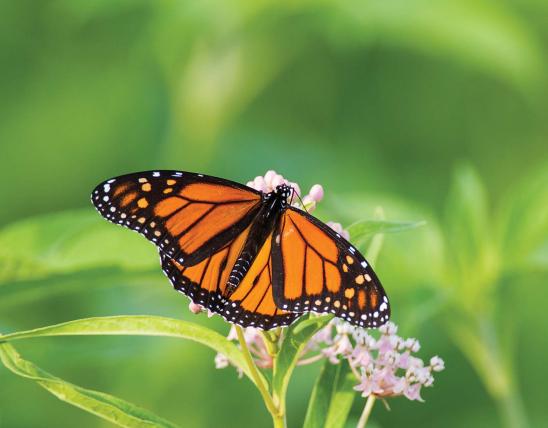
*Muskie is short for muskellunge, a large fish in the pike family. Monarch refers to monarch butterflies.
At a Glance
MDC staff are testing designs for floating wetlands, with the goal of making them plastic-free, low maintenance, and long-lasting. The designs should be attractive as well as functional. Materials need to be durable and buoyant.
Best finds so far:
Aluminum pontoons, wire-mesh baskets, recycled glass aggregate.
Recycled glass aggregate provides a light-weight substrate for planting native plants and allows their roots to reach the water. The plants gain nutrients from the water while also filtering out pollutants. The roots provide habitat for fish and other aquatic organisms.


And More...
This Issue's Staff
Editor – Angie Daly Morfeld
Associate Editor – Larry Archer
Photography Editor – Ben Nickelson
Staff Writer – Kristie Hilgedick
Staff Writer – Joe Jerek
Staff Writer – Dianne Van Dien
Designer – Marci Porter
Designer – Kate Morrow
Photographer – Noppadol Paothong
Photographer – David Stonner
Circulation – Marcia Hale