










MDC Announces New Commissioner
Gov. Mike Kehoe appoints Smithville man to serve on commission
MDC and the Missouri Conservation Commission welcome Frank Kruse of Smithville to the Missouri Conservation Commission following his recent appointment by Gov. Mike Kehoe and pending confirmation by the Missouri Senate.
“Frank has a long history of connection to conservation, including serving in a variety of roles with conservation organizations,” said MDC Director Jason Sumners. “He also brings a wealth of professional experience in financial planning, business development, and marketing. We’re excited to have his knowledge, experience, and passion for conservation on the commission.”
Kruse is president of Martin Hill Advisors. He previously served as vice-president of business development and marketing for Sekisui XenoTech LLC. He also previously served as an international marketing representative for the Missouri Department of Agriculture.
Kruse is a graduate of the University of Missouri-Columbia with degrees in agriculture, economics, and Russian studies and a graduate of North Carolina State University with a master’s degree in economics.
He is a member of several conservation organizations including the Missouri Conservation Heritage Foundation (MCHF), Theodore Roosevelt Conservation Partnership, and the Johnny Morris Institute for Fisheries, Wetlands, and Aquatic Systems.
Kruse was raised on a family farm near Carrollton, where he learned and lived conservation practices from an early age, such as creating and supporting wildlife habitat. One of his fondest memories is taking a break during harvest season to hunt surrounding draws and field edges with his brother and father. A lifelong outdoorsperson, he still enjoys hunting deer, turkey, ducks, and doves, along with fishing local streams, hiking, and backpacking.
Kruse and his wife, Nancy, have four grown children and reside on their family farm in rural Platte County where his conservation heritage continues through habitat creation and management for wetlands, woodlands, and fields. They raised their kids to be conservation minded and all enjoy the outdoors.
“One of our youngest kids really took to archery and was an early enrollee in MoNASP [Missouri National Archery in the Schools Program] years ago,” Kruse said. “It is amazing how MoNASP has grown to include such a wonderful cross-section of young Missourians from many different walks of life who really learn and benefit from both their individual accomplishments and the teamwork that develops.”
MoNASP, an in-school archery program for Missouri students in grades 4 through 12, teaches the basics of archery. It is coordinated through MDC, the Conservation Federation of Missouri, and MCHF — of which Kruse is the secretary/treasurer.
He said he is thrilled to have the opportunity to serve.
“I am thankful to the governor for this appointment, and I look forward to learning, leading, and serving,” he said. “The future of our outdoors is at stake every day and we have to be engaged with Missourians to continue our legacy of conservation excellence for the next generations.”
Kruse was appointed for a six-year term that will expire in 2031. He replaces outgoing Commissioner Steven Harrison of Rolla, whose term expired July 1, and joins Commissioners Margaret F. (Margy) Eckelkamp of Washington, Raymond T. (Ray) Wagner Jr. of Town and Country in St. Louis County, and Edward C. Clausen of Centertown.
The Missouri Conservation Commission consists of four members appointed by the governor with the advice and consent of the Senate. Commissioners serve six-year terms with no salary or other compensation with not more than two allowed from the same political party. Their responsibilities include appointing the MDC director, serving as MDC policy makers, approving regulations of the Wildlife Code of Missouri, strategic planning, and budget development and major expenditure decisions.
Ken Babcock Joins Conservation Hall of Fame
Ken Babcock of Jamestown was the 48th inductee in the Missouri Conservation Hall of Fame. He received the honor during a special ceremony in September at the Stoney Creek Hotel in Columbia.
“Throughout his career at MDC, Ken either led, influenced, or supported initiatives that had transformative implications for the agency,” said MDC Director Jason Sumners. “He had an early focus on integrating science, resource management, and the public’s enjoyment of fish, forest, and wildlife resources. He expanded partnerships with state and federal agencies, non-government agencies, and private landowners. He also was instrumental in implementing the department’s 1976 Design for Conservation.”
After graduating from Hendrix College in Conway, Arkansas, with a bachelor’s degree in biology in 1965 and earning his master’s degree in wildlife management from Louisiana State University, Babcock began his career as a waterfowl biologist with the Mississippi Game and Fish Commission in 1967 before joining MDC in 1970. During his career at MDC from 1970 to 1997, Babcock excelled in various roles including research scientist, assistant wildlife division chief, and ultimately assistant director.
Babcock also led planning efforts to implement The North American Waterfowl Management Plan for Missouri.
“Ken was and still is committed to abundant and quality habitat for healthy long-term populations of all wetland species,” Sumners added. “His efforts led the department’s transition from lead to nontoxic shot for waterfowl, showcasing his commitment to addressing environmental issues, and ultimately assisting in the recovery of the bald eagle.”
After retiring from MDC as an assistant director, Babcock was recruited by Ducks Unlimited (DU) where he served various regional and national roles, culminating in his role as the senior director of conservation programs.
Babcock helped develop a partnership with DU and the U.S. Department of Agriculture aimed at restoring more than 300,000 acres of bottomland wetlands in the Lower Mississippi Alluvial Valley. He also contributed significantly to conserving the North American Boreal Forest, serving on a team involving DU, DU Canada, First Nations, and the Pew Charitable Trust. Together, they developed a program to protect and sustainably manage a half-billion acres of this critical habitat for native and migratory birds.
After his retirement from DU, Babcock joined the Missouri Conservation Heritage Foundation (MCHF) where he helped in leading and reinvigorating fundraising efforts. He served on the board for two terms and continues to serve as an advisor to the board. He was also a key force in MCHF’s efforts to partner with MDC and the University of Missouri in the development of the Johnny Morris Institute for Fisheries, Wetlands, and Aquatic Systems. Babcock was named the MCHF’s 2024 Champion of Conservation.
The Hall of Fame honors living or deceased citizen conservationists, former employees of MDC and other conservation-related government agencies, universities, or organizations (including conservation law enforcement and conservation education-related activities) who changed the landscape of conservation in the state of Missouri in the field of fisheries, forestry, or wildlife resource management. To learn more about the Conservation Hall of Fame or to submit a nomination, visit short.mdc.mo.gov/ZyG.
Susan Flader Named Master Conservationist
Susan Flader of Columbia was named a Master Conservationist during a special ceremony in September at the Stoney Creek Hotel in Columbia.
“Susan Flader has played pivotal roles in advocating for the preservation of our state’s natural landscapes through her involvement with the Missouri Parks Association and the Missouri Department of Conservation,” said MDC Director Jason Sumners. “Her efforts have raised awareness about sustainable forest management, water quality, and public land conservation.”
Flader is a professor emerita of American western and environmental history at the University of Missouri-Columbia. She has written extensively about Aldo Leopold — considered by many to be the father of wildlife ecology and modern conservation — and served as board chair of the Leopold Foundation. Flader also is a founder and past president of the American Society for Environmental History and the Missouri Parks Association (MPA).
Flader is best known for her scholarship on Aldo Leopold. In addition to numerous articles, she has authored or edited 10 books including her seminal book, Thinking Like a Mountain: Aldo Leopold and the Evolution of an Ecological Attitude toward Deer, Wolves, and Forests (1974), which established her as a leading voice in environmental history.
She has combined her academic work with conservation advocacy, taking on leadership roles in organizations such as the MPA and teaching at the University of Missouri.
Sumners added that as an influential educator at the University of Missouri, Flader has inspired generations of students in environmental history and policy.
“Her leadership has extended beyond academia into public service where she has served on numerous conservation boards and commissions, advocating for policies integrating scientific research with conservation practice.”
Flader’s research focuses on the relationship between people and natural ecosystems, and the evolution of conservation thought and practice. Key areas of her research include Aldo Leopold and ecological thought, Missouri conservation history, public lands and park preservation, and conservation policy and water resources.
“Her research provides a historical lens for understanding contemporary conservation challenges to help policymakers and citizens make more informed decisions regarding natural resource management,” Sumners said.
Flader has also been involved with the L-A-D Foundation since the 1970s where she has had significant leadership roles in the organization that owns and manages the 146,000-acre Pioneer Forest and a dozen natural areas and parks in the Missouri Ozarks. She most recently was board president for the past seven years.
She has also served in leadership roles on the National Audubon Society board of directors and the Audubon Missouri board of directors. As an Audubon Missouri board member, she championed the establishment of the Audubon Center at Riverlands in the St. Louis metro area to engage urban and underserved communities in conservation. She is currently on the Audubon Center at Riverlands advisory board and continues to contribute her time, expertise, and resources to the center.
She has lectured extensively across the United States and internationally, served on numerous professional and environmental boards, and received many awards for her publications and conservation efforts.
The MDC Master Conservationist Award was created in 1941 to honor living or deceased citizen conservationists, former commissioners of the department, and employees of conservation-related agencies, universities, or organizations who have made substantial and lasting contributions to the fisheries, forestry, or wildlife resources, including conservation law enforcement and conservation education-related activities in the state. To learn more about the Master Conservationist Award or to submit a nomination, visit short.mdc.mo.gov/Zyp.
Mandatory CWD Sampling
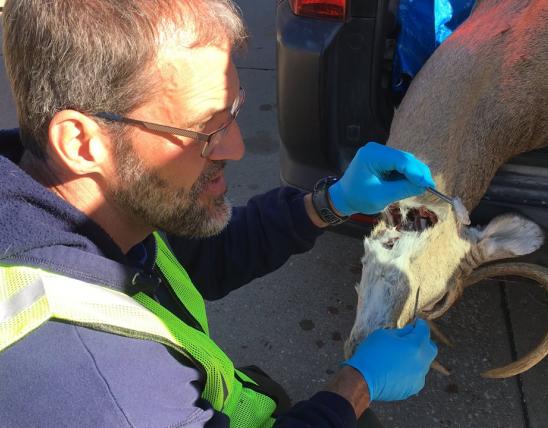
During opening weekend of firearms deer season, Nov. 15–16, hunters in certain CWD Management Zone counties must take their harvested deer (or its head) to a mandatory CWD sampling station. Stations are open from 7:30 a.m. to 8 p.m.
Counties that require mandatory sampling Nov. 15–16 are Audrain, Bollinger, Boone, Callaway, Cape Girardeau, Carroll, Chariton, Clark, Cole, Daviess, Dent, Douglas, Grundy, Harrison, Henry, Howard, Lewis, Livingston, Madison, Maries, Marion, Miller, Moniteau, Morgan, Osage, Ralls, Randolph, Saline, Shannon, St. Charles, St. Clair, St. Louis, Texas, and Webster.
Note that Callaway, Cape Girardeau, Daviess, Harrison, Henry, Marion, Miller, Moniteau, Morgan, Ralls, St. Louis, and Texas counties are new additions to the CWD Management Zone.
Refer to MDC’s 2025 Fall Deer & Turkey Hunting Regulations and Information booklet for a complete list of sampling stations in these counties and other related information.
Jake Myers
Johnson County
Conservation Agent
Every year, hunters across Missouri anxiously await the arrival of November and the opening of firearms deer season. Amidst all the excitement and preparation, don’t forget to make safety a top priority. Whether you hunt on public or private land, always wear a hunter orange hat and vest, coat, or shirt. Make sure your tree stand is in good condition, and your personal safety harness has a fall arrest system that can be clipped to your stand. And always unload your firearm before transporting it up the tree. A little forethought will make for a safe and enjoyable season. For more information, consult MDC’s 2025 Fall Deer and Turkey Hunting Regulations and Information booklet at short.mdc.mo.gov/ZVo.
Spotlight on people and partners
by Emily Franklin
Julie Kline

Seventh-grade science teacher Julie Kline was teaching about ecosystems when she noticed the severe lack of diversity in the courtyard of Central Middle School in Park Hills. She and her students decided to act.
A biodiversity dilemma
With support from the school principal, the class surveyed staff and student interest in creating a pollinator garden. Since 2021, the modest initial proposal has grown to cover the full courtyard, including the removal of invasive Callery pear trees.
In addition to growing into a great pollinator habitat, the space lets teachers personalize curriculum and has sparked student interest in agriculture, biology, and conservation careers.


Title
Answer
Bur Oak Acorn
Bur oak trees bear fruit in the form of an acorn between September and October. But this is no ordinary acorn. Bur oaks are Missouri’s only native oak tree to develop an acorn with an unusual fringed border. The nuts are brown, smooth, and rounded at the top. A scalylike cup covers more than half of the base of the nut. A hairy fringe borders the cup all around the acorn.
And More...
This Issue's Staff
Editor – Angie Daly Morfeld
Associate Editor – Larry Archer
Photography Editor – Ben Nickelson
Staff Writer – Kristie Hilgedick
Staff Writer – Joe Jerek
Staff Writer – Dianne Van Dien
Designer – Marci Porter
Designer – Kate Morrow
Photographer – Noppadol Paothong
Photographer – David Stonner
Circulation – Marcia Hale