





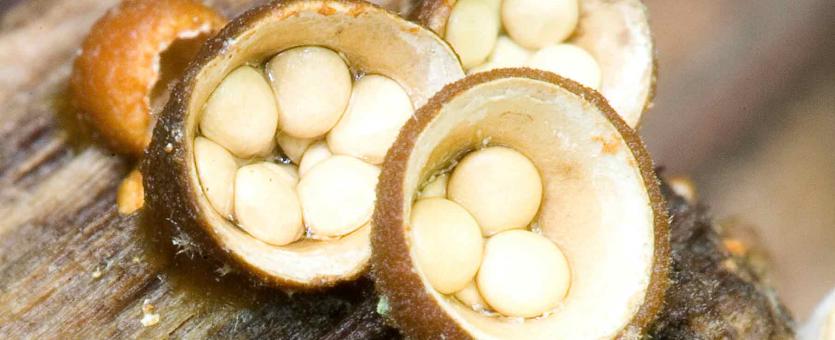
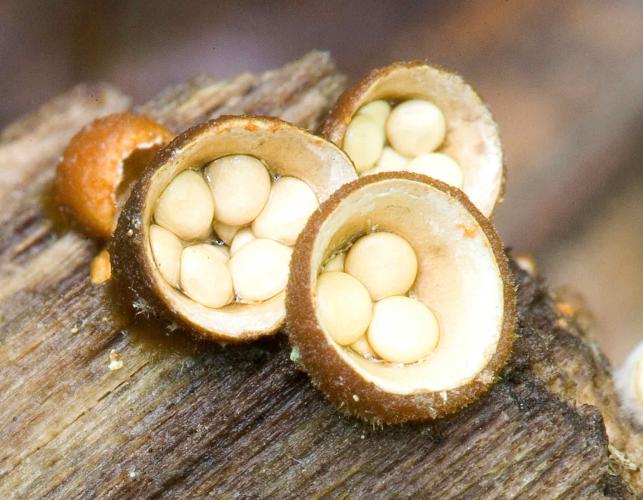
Splash cups, also called bird's nest fungi, are small brown cups holding tiny “eggs” that are each attached to the “nest” by a cord. They grow in clusters on dead wood, debris, and wood chips. There are several species.
In the species common bird's nest (Crucibulum laeve), the cup is small; yellowish and smooth inside, with tiny whitish “eggs” in the cup; and dark brownish gray and woolly-textured outside. Each “egg” is ⅟₃₂–⅟₁₆ inch wide, flattened, attached to the cup by a very thin but strong cord. The spore print is colorless. Spores magnified are elliptical and smooth.
July–October.
Lookalikes: There are several other types of bird's nest fungi, and they all look more or less like tiny bird nests filled with eggs.
- One common lookalike is the fluted bird's nest, Cyathus striatus. It has grooved (striated) walls inside the cup, and the cup's exterior is hairy or shaggy.
- A close relative of the fluted bird's nest is the dung-loving bird's nest, Cyathus stercoreus. Unlike C. striatus, it has a smooth (not grooved) inner surface that is dark gray or blackish. The "eggs" are blackish. The shaggy outer surface is brown or rusty.
Cup width: ¼ to ⅝ inch; height: ¼ to ⅝ inch.

Statewide.
Habitat and Conservation
Grows clustered on dead wood, debris, and wood chips. Common on landscaping mulch.
Status
Not edible.
Life Cycle
This species exists as a network of fungal cells (mycelium) within rotting wood. When it's ready to reproduce, small knoblike structures develop, each covered by a membrane that opens at maturity, revealing the cuplike shape beneath.
Spores are contained in the egglike spore sacs in the "nest." When raindrops hit the sacs, they spring from the cups and adhere to surfaces three or four feet away. When the spores mature, they are released, falling to the ground to begin new growth on mulch and other decaying materials.
Apparently, in some cases, the spore sacs adhere to nearby vegetation and are consumed by herbivores. When the spores emerge from the animal's digestive tract unscathed, the droppings are a perfect habitat and food for the newly dispersed spores.
Human Connections
Like wildflowers, even the smallest and humblest of fungi can turn out to be strikingly beautiful, strange — or even cute. Discovering these wonders can bring out our childlike sense of awe.
Ecosystem Connections
This is one of the many fungus species that live on decaying plant matter. It and other such saprobic fungi play an incredibly important role in breaking down the tough materials plants are made of and returning those nutrients to the soil.
Structures called "splash cups," in this and many other species, use the kinetic energy of raindrops to launch their reproductive bodies toward new places.
- Many types of lichens develop cup-shaped reproductive structures that use rain for dispersal. For example, rim lichens have cuplike apothecia that release spores, and pebbled pixie cup has goblet-shaped podetia that hold circular green scale-like structures that break off and start new lichens elsewhere.
- Several mosses, such as starburst mosses and tooth mosses, have splash cups that disperse male gametes (sperm) when it rains.
- Several liverworts, such as umbrella liverwort, produce cups containing tiny buds called gemmae, which break away to form new plants.





Mushrooms are a lot like plants, but they lack chlorophyll and have to take nutrients from other materials. Mushrooms are neither plants nor animals. They are in a different kingdom — the fungi. Fungi include the familiar mushroom-forming species, plus the yeasts, molds, smuts, and rusts.
Always be cautious when eating edible mushrooms. Be absolutely sure of the ID, and only eat a small amount the first time you try it to avoid a reaction..