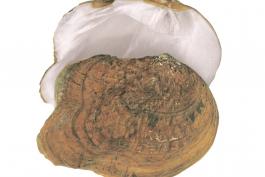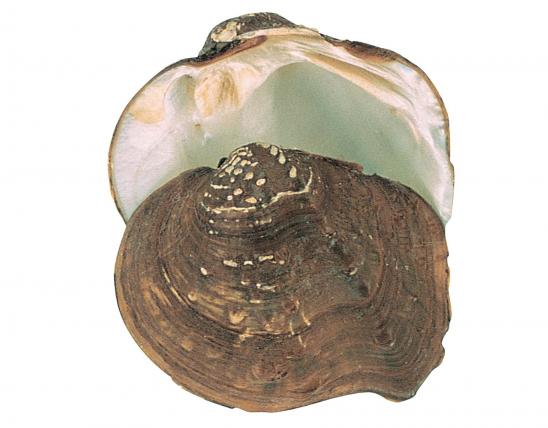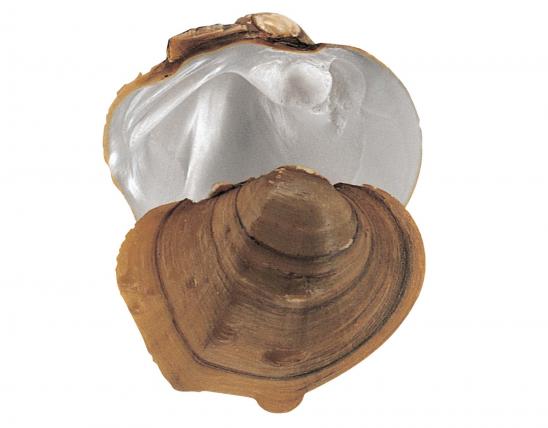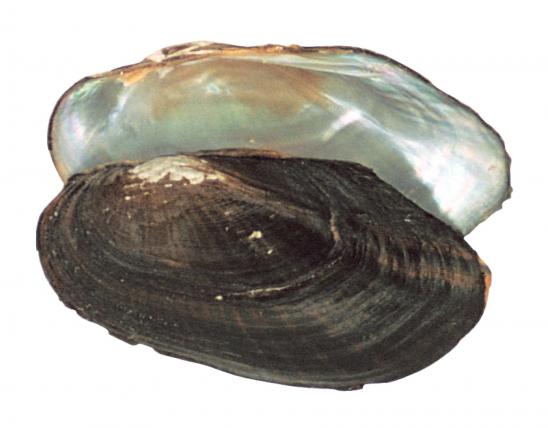













The monkeyface has a prominent posterior ridge, lobed posterior margin, and numerous bumps and knobs. It's a riffle species that lives in swift rivers flowing off the Salem and Springfield plateaus (except for south-flowing streams in the central lower Ozarks), and in the Mississippi and Salt rivers.
Externally, the monkeyface has a thick, rounded or squared, inflated shell, with a very prominent posterior ridge and lobed posterior margin; pustules (bumps) extend from the umbo (beak) to the posterior ventral margin, increasing in size. The umbo is narrow and slightly raised above the hinge line. The periostracum (thin outer layer) is yellowish green, becoming brown with age; it may have randomly scattered dark-green chevron marks.
Inside the shell, the beak cavity is deep; the pseudocardinal teeth are large, grooved, and triangular; the lateral teeth are short, streaked, and straight; the nacre (mother-of-pearl layer) is white, iridescent posteriorly.
- The prominent posterior ridge, pustules, and knobs make this species easy to identify.
For a fuller introduction to Missouri’s native freshwater mussels, and to learn the terms for their anatomy, see their group page.
Similar species: Other species that are similar include the mapleleaf, the pimpleback, and the Gulf mapleleaf (Quadrula nobilis).
Adult length: 2–4 inches.

Rivers flowing off the Salem and Springfield plateaus (except for south-flowing streams in the central lower Ozarks); Mississippi and Salt rivers.
Habitat and Conservation
Medium to large rivers in relatively swift current in a stable clean-swept mix of coarse sand and gravel. A typical riffle species.
Food
Freshwater mussels consume algae, bacteria, and fine particles of decaying organic matter. They extract nutrients and oxygen from water drawn into the body cavity through a specialized structure called the incurrent siphon; sediment, undigested food, and waste (called pseudofeces) are expelled through the excurrent siphon.
Status
Common, although degrading water quality and watershed destabilization interfere with the survival of this and all freshwater mussels.
Life Cycle
Males release sperm directly into water. Females downstream siphon sperm into the gill chamber, where eggs are fertilized. Eggs mature into larvae (called glochidia), which discharge into the water and attach to host fish. This species uses green sunfish, bluegill, and sauger, but it's also been recorded using more than 20 species of New World minnows. The tiny mussel eventually breaks away and floats to the bottom of the stream, and the cycle repeats.
Human Connections
Mussels play important roles in maintaining the health of Missouri’s water resources:
- As food for fish, they are important for Missouri’s fisheries. Small mammals and some birds eat them, as well.
- They filter algae, bacteria, and other particles from the water, improving water quality and cycling nutrients and energy in streams and lakes. Clean water is necessary for people and nature.
- Because mussels are sensitive to habitat disturbance and pollution, they are good indicators of the overall health of aquatic ecosystems and water quality.
The shells of several types of mussels, including this species, were an important resource historically for button manufacture. Some species are still commercially important in the cultured pearl and jewelry industries.
Ecosystem Connections
Mussels play important roles in maintaining the health of Missouri’s water resources:
- As food for fish, they are important for Missouri’s fisheries. Small mammals and some birds eat them, as well.
- They filter algae, bacteria, and other particles from the water, improving water quality and cycling nutrients and energy in streams and lakes. Clean water is necessary for people and nature.
- Because mussels are sensitive to habitat disturbance and pollution, they are good indicators of the overall health of aquatic ecosystems and water quality.
The shells of several types of mussels were an important resource historically for button manufacture. This species is one that was used to make buttons. Some species are still commercially important in the cultured pearl and jewelry industries.