










Adult king rails look rusty overall; on the back and wings, the feathers are blackish brown with lighter golden or olive edges. The neck and breast are cinnamon brown, and the belly and sides are heavily barred with black and white. The bill is slender, longer than the head, and curves slightly downward. The body is somewhat compact (some say chickenlike) with grayish tan legs, long toes, and a short tail that may be held upright when walking. It has rounded wings and often flies short distances with its legs hanging down.
Juveniles look similar to adults but have duller colors. Chicks are black.
The most common call is usually heard at night and is a long series of evenly spaced, sharp clicking or chipping sounds described as kek-kek-kek. The call usually slows toward the end. Some have likened it to the sound made by rusty bedsprings. They sing most frequently when establishing territory in nesting season. Another call is a repeated chip-burrrrr.
Similar Species: In Missouri, the most similar species is the Virginia rail. It is considerably smaller than the king rail, with more distinct gray cheek patches, less barring on the flanks, and a slightly shorter bill that is more orange.
Length: 15 to 19 inches; wingspan: 19½ to 20½ inches.
Statewide, in appropriate habitats. The king rail is very rare in Missouri.
Habitat and Conservation
In Missouri, principally found in marshes and swamps, often among cattails. King rails live in quiet, shallow freshwater and brackish marshes with scattered pools of deeper water. They choose areas with vegetation tall enough to provide cover and that is near shallow water and along marsh edges for foraging. Areas with grasses, rushes, cattails, and sedges are preferred; woody vegetation is generally avoided. King rails use rice fields year-round.
The strong legs and long toes of rails help them walk on floating vegetation.
King rails have a scattered distribution throughout the eastern half of the United States and are most concentrated along the Gulf and east coasts; they are also found in Cuba. In Missouri, they are rare but may be found occasionally at conservation areas and wildlife refuges with appropriate habitat.
Over the past 60 years, the king rail population has declined by 85 percent across its overall range. Loss of wetlands is the main cause of the decline.
Food
King rails feed mostly on crustaceans, especially crayfish, but also eat fish, frogs, beetles, grasshoppers, crickets, and other insects. They sometimes eat the seeds of aquatic plants. They wade in the shallow parts of a marsh, snatching prey with their bills. Most food is swallowed whole, but larger prey may be dismembered before being eaten.
Status
Uncommon migrant; rare summer resident. A Missouri species of conservation concern, it is critically imperiled and endangered in our state, largely due to habitat loss. Federally, it is classified as a bird of management concern.
Life Cycle
Nests are round platforms made from vegetation with a canopy overhead, and sometimes a ramp leading to the water. After nesting, the king rail molts completely and is rendered flightless for a month while its new feathers grow.
Clutches may include 6–14 eggs (most typically 10–12); these are incubated for 21–23 days. There can be 1 or 2 broods a year. Like young ducks and chickens, king rail chicks can walk and follow their parents shortly after hatching. They become independent in about 2 months.
A migratory species, the king rail is present in Missouri (in small numbers) from about mid-March through mid-October. The winter, nonbreeding season is spent in areas to the south, especially along the US east coast and all along the Gulf coast of the United States and Mexico, and most of Cuba.
Human Connections
King rails frequently forage and breed in rice fields where this type of agriculture has taken the place of natural wetlands. Changes in rice-growing practices to clear vegetation can result in less cover for nesting.
King rails are sometimes caught in muskrat traps, and they sometimes crash into human-built structures during migration.
King rails are very secretive and usually only emerge from vegetation at twilight and at night. This makes them difficult for people to observe and study.
For information about how to implement construction projects in ways that minimize impacts on king rails, MDC offers best management practices.
The phrase “thin as a rail” comes from the way rails flatten themselves side-to-side so they can pass through the narrow openings between marsh plants. Viewed head-on from the front, these birds appear very skinny.
Our word “rail,” used for the bird, comes from a French word râle, which in turn came from Latin words rascula and rādere, which mean “scrape”—all referring to the harsh scraping calls these birds make. (Another connection: the scraping structure in a snail’s mouth is called the radula.)
An alternative explanation for the word “rail” (for the bird) has it coming from French words raille or reille, from Latin regula, meaning a ruler or straightedge. This means it would have the same etymology as the word “rail” as used for a railing or barrier.
The loud cries of rails, which sound something like clucking and other noises of chickens, gave rise to their being called “mud hens.”
Ecosystem Connections
King rails eat crustaceans and insects, helping to keep those populations in check. Young rails are prey for mammals like foxes, raccoons, mink, feral cats, and coyotes, and adults may be taken by great horned owls and northern harriers.
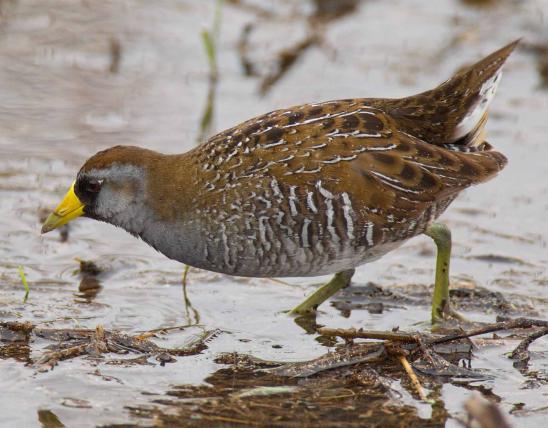
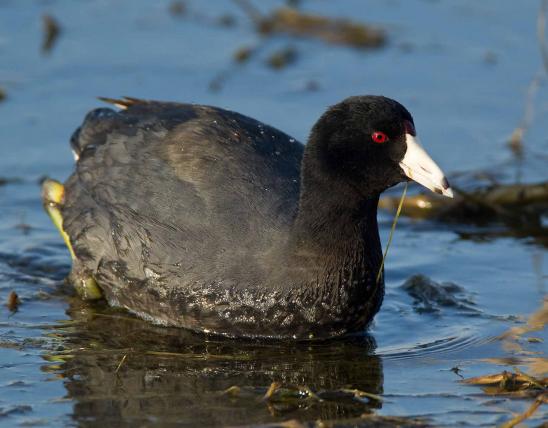
Other members of the rail family are the sora and the coots, gallinules, crakes, swamphens, and moorhens. Most of these birds live in wetlands, usually on the ground but sometimes on the water. Their bodies are often described as “chickenlike.” All have short, rounded wings and are generally weak fliers, but they typically have strong legs with long toes. Most would rather walk or run to safety than fly. As a group, these birds are threatened by loss of wetland habitats; also, their weak flight makes them vulnerable to overhunting and (where they live on islands) predation by introduced species.



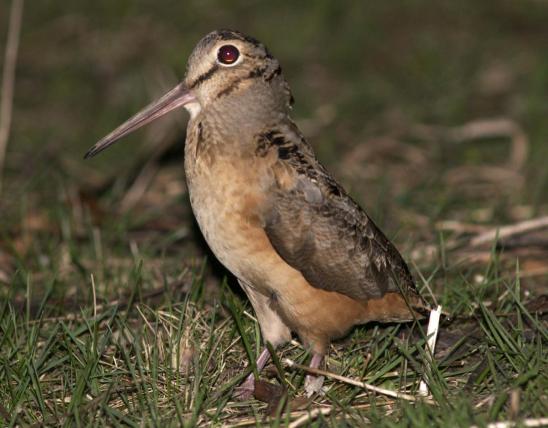
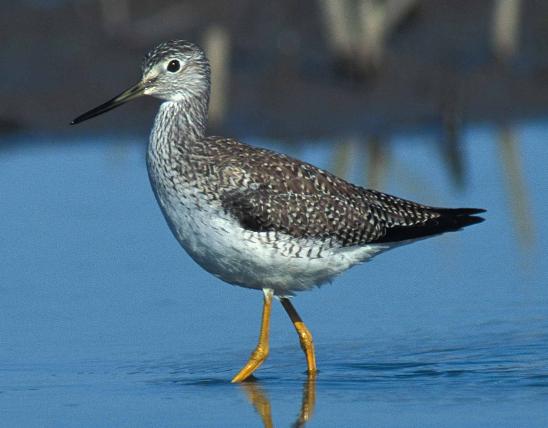


About 350 species of birds are likely to be seen in Missouri, though nearly 400 have been recorded within our borders. Most people know a bird when they see one — it has feathers, wings, and a bill. Birds are warm-blooded, and most species can fly. Many migrate hundreds or thousands of miles. Birds lay hard-shelled eggs (often in a nest), and the parents care for the young. Many communicate with songs and calls.