








Osage Prairie is a remnant of the prairie ecosystem that once covered more than a quarter of Missouri. It is also home to plants and animals that are specially adapted for life on the open prairie.
Media

Scientific Name
Silphium laciniatum
Family
Asteraceae (daisies, sunflowers)
Description
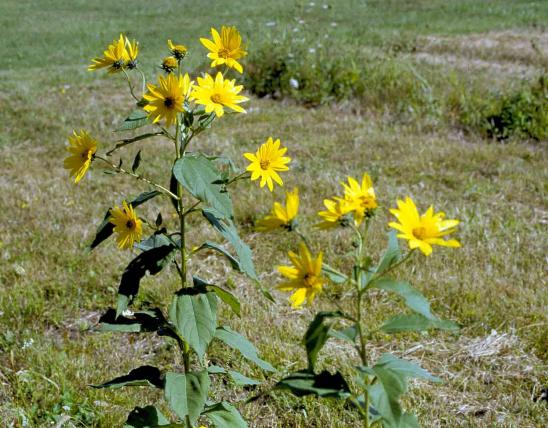
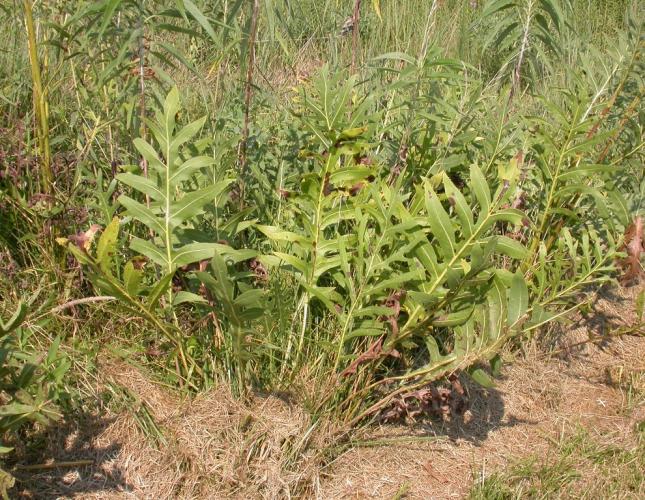
Compass plant grows to 8 feet tall and has foot-long, deeply cleft leaves at its base. It got its common name because its leaves turn so that the surfaces face east and west to take full advantage of the sun’s rays.
Compass plant is a tall, showy, perennial with hairy stems and large, leathery, deeply cleft, flattish basal leaves.
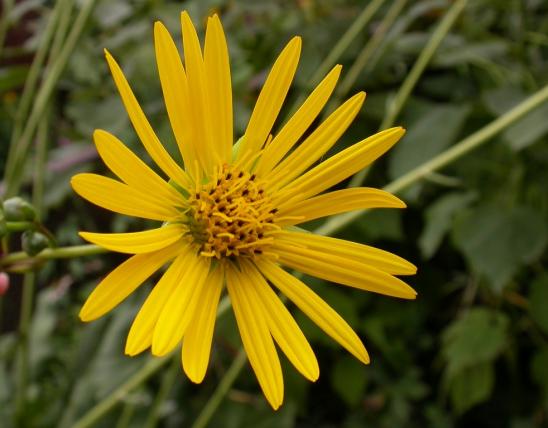
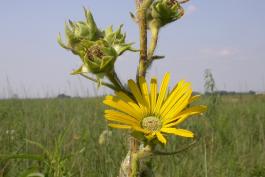
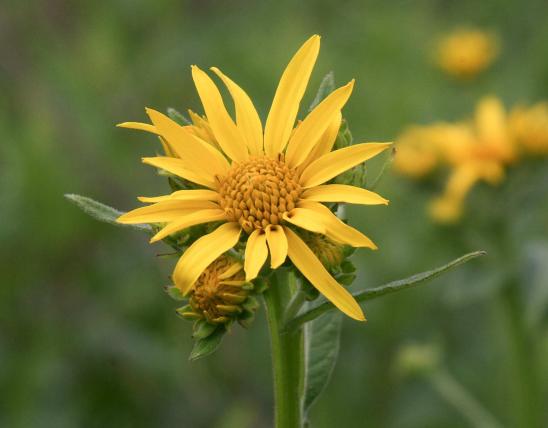
The flowerheads are few to many, arising from a tall stalk. They are about 2½ inches across, and both the petal-like ray flowers and the central disk flowers are yellow. Ray florets are 20–35.
Blooms July–September.
The leaves are thick and leathery, roughened, hairy, and deeply cleft almost to the midrib, the lobes sometimes having secondary divisions. At the bottom of the plant, the leaves are huge — to 16 inches long — but the leaves are progressively smaller toward the top of the stem.
- In full sun, the upright lower leaves turn their edges toward north and south, with the flat surfaces facing east and west, giving compass plant its common name.
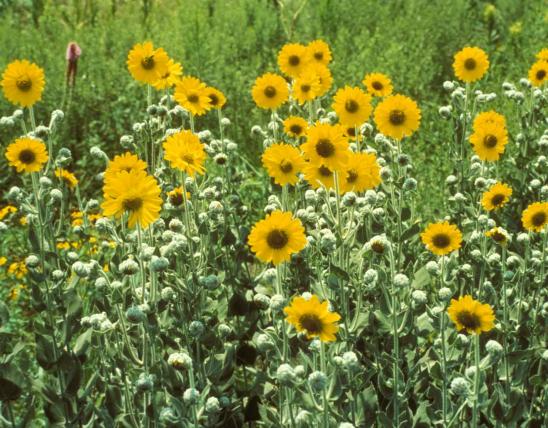
Similar species: Six Silphium species are recorded for Missouri. Of these, compass plant, starry rosinweed (S. asteriscus), prairie dock (S. terebinthinaceum), wholeleaf rosinweed (S. integrifolium), and cup plant (S. perfoliatum) are relatively common. The sixth species, rough-leaved rosinweed (S. radula), is known only from a single collection from Vernon County in 1965.
- Compass plant is identified by its deeply cleft leaves.
To separate rosinweeds from the similar-looking sunflowers (genus Helianthus), see Ecosystem Connections.
Other Common Names
Rosinweed
Size
Height: to about 8 feet.
Where To Find

Scattered nearly statewide, but nearly absent from the southeastern quarter of Missouri.
Habitat and Conservation
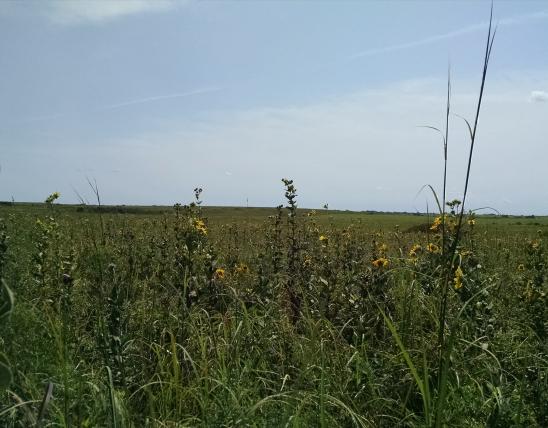
Occurs in glades, upland prairies, savannas, and openings of dry upland woodlands; also along railroads and roadsides.
The majestic and hardy compass plant is increasingly used in plantings, as native plants become more popular with landscapers and home gardeners.
Status
Native Missouri wildflower. Prairie wildflower.
Human Connections
When colonies of these large, impressive flowers decorate roadsides, they enhance our journeys, and attractive roads help our state’s tourism industry.
Compass plants are also becoming popular in landscaping.
In the past, the dried sap of this resinous plant was chewed as gum by Native Americans and pioneers.
In his classic, influential book on conservation, The Sand County Almanac (1949), Aldo Leopold discussed the almost complete loss of America's native prairies. He used the compass plant as an example.
- He wrote about the situation in his home county in Wisconsin, where only one plant remained, growing in a cemetery. It was surely one of the few remaining compass plants in his area: "What a thousand acres of Silphiums looked like when they tickled the bellies of the buffalo is a question never again to be answered, and perhaps not even asked."
Ecosystem Connections
Many bees, butterflies, and other insects visit and pollinate the flowers.
Goldfinches and other small birds, and other wildlife, eat the seeds.
The eggs and larvae of many small wasps and beetles develop within the stems of this and other rosinweeds.
Compass plant, prairie dock, and many other native prairie perennials grow tough, deep taproots that extend 10 to 15 feet or more into the soil.
- Over the centuries, the living and dying of these deep-rooted plants caused the deep soils of the Great Plains to become some of the richest in the world.
- The Dust Bowl in the 1930s occurred after the deep-rooted native plants were plowed up and replaced with shallow-rooted row crops.
- American farmers still benefit from the vast prairies that once dominated the center of the continent.
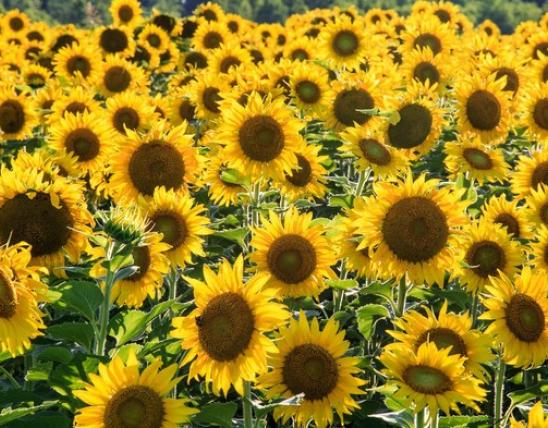
Compass plant and other rosinweeds are in their own genus, Silphium, and not in genus Helianthus (sunflowers). Yet the two groups look so much alike! How can you tell the difference? It has to do with which parts of the compound flowerheads produce seeds:
- The disk (center) florets in rosinweeds are staminate (male, producing only pollen) and therefore don’t create seeds; meanwhile, the disk florets in sunflowers are pistillate and create seeds. Then, in rosinweeds, it’s the petal-like ray florets that are pistillate (female) and turn into seeds, while those in sunflowers produce only pollen.
- Due to the above fact, the disks in rosinweeds tend to be smaller in diameter than the disks of sunflowers.
- Looking beneath the flowerhead, the green, leafy outer involucral bracts in rosinweeds are comparatively large and broad compared to those in sunflowers.
Title
Media Gallery
Image

Caption
Compass plant is a tall, showy, yellow rosinweed with hairy stems. Its flower heads arise from a tall stalk and are about 2½ inches across. Both the petal-like ray flowers and the central disk flowers are yellow. It’s found in prairies, fields, glades, and roadsides.
Credit
Jim Rathert
Right to Use
Photo by Jim Rathert, courtesy Missouri Department of Conservation
Image
Caption
The easiest way to identify compass plant is by noting its huge, deeply cleft basal leaves. In full sun, the leaves turn their edges toward north and south, with the flat surfaces facing east and west.
Credit
Julianna Schroeder
Right to Use
Use of this image is restricted to MDC only
Image

Caption
Compass plant is a tall, showy, yellow rosinweed with hairy stems. It usually has 20 to 35 petal-like ray florets.
Credit
Julianna Schroeder
Right to Use
Use of this image is restricted to MDC only
Image

Caption
Compass plant's flowerhead disk is relatively small (compared to that of true sunflowers). When identifying rosinweeds and other plants in the sunflower family, it's often helpful to note characteristics of the receptacle beneath the flowerhead.
Credit
Julianna Schroeder
Right to Use
Use of this image is restricted to MDC only
Image

Caption
The leaves of compass plant are hairy and deeply cleft almost to the midrib, the lobes sometimes having secondary divisions. In full sun, the upright lower leaves turn their edges toward north and south, with the flat surfaces facing east and west, giving compass plant its common name.
Credit
MDC Staff
Right to Use
Photo by MDC Staff, courtesy Missouri Department of Conservation
Image

Caption
The majestic and hardy compass plant is increasingly used in plantings, as native plants become more popular with landscapers and home gardeners. This specimen, more than six feet tall, was blooming at Tucker Prairie on August 15, 2015.
Credit
Julianna Schroeder
Right to Use
Use of this image is restricted to MDC only
Image

Credit
Noppadol Paothong
Right to Use
Use of this image is restricted to MDC only
Image

Image

Image

Image

Image

Image
Image

Title
Similar Species
Similar Species
Media

Media

Media
Media
Media

Media

Media
Where to See Species

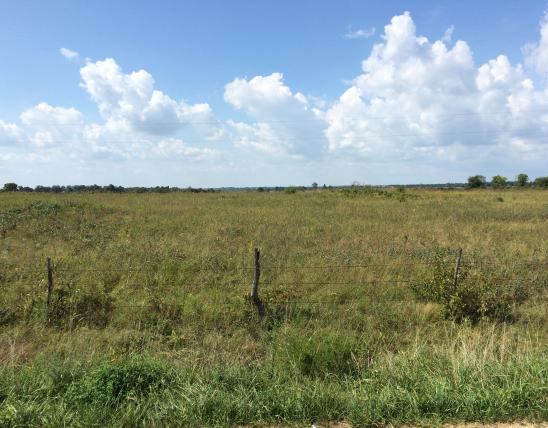
The Conservation Department created this area in 1968 with the purchase of 1,024 acres from several landowners. Later acquisitions of 924 acres have increased the area's current size.
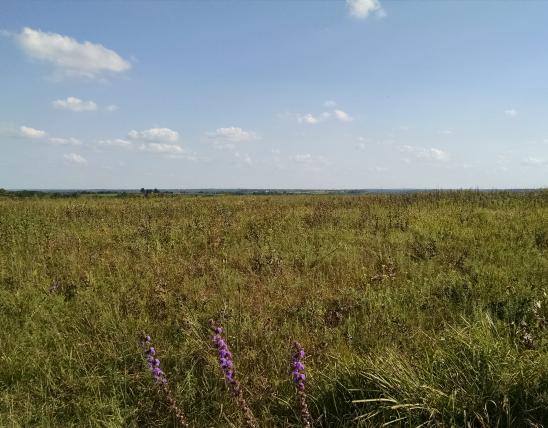
Mount Vernon Prairie was originally purchased by The Nature Conservancy in 1974 with funds from Ms. Katharine Ordway. Ms.
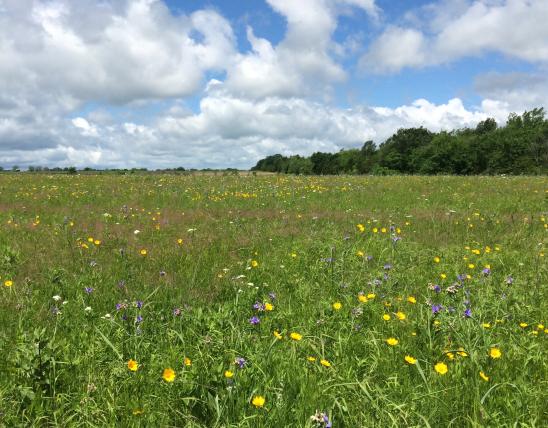
Monegaw Prairie is a remnant of the tallgrass prairie ecosystem that once covered more than one-quarter of Missouri.
The once vast prairies that covered as much as 15,000,000 acres of Missouri had diminished to just a few hundred thousand acres by the mid-1970’s. The prairies inherited by the earl
About Wildflowers, Grasses and Other Nonwoody Plants in Missouri
A very simple way of thinking about the green world is to divide the vascular plants into two groups: woody and nonwoody (or herbaceous). But this is an artificial division; many plant families include some species that are woody and some that are not. The diversity of nonwoody vascular plants is staggering! Think of all the ferns, grasses, sedges, lilies, peas, sunflowers, nightshades, milkweeds, mustards, mints, and mallows — weeds and wildflowers — and many more!