










Two species of teasels (genus Dipsacus) occur in Missouri: common teasel and cut-leaved teasel. Both are nonnative invasive plants. Learn to identify these thistlelike plants, and help to control the weedy spread of these tough, prickly invaders.
Both species of teasels are tall, thistlelike biennials with stout, straight, ridged, prickly, branching stems. They grow from a basal rosette whose leaves can vary from egg-shaped to large and oblong and can be quite hairy or prickly with age. The taproot may be more than 2 feet long and 1 inch in diameter at the crown.
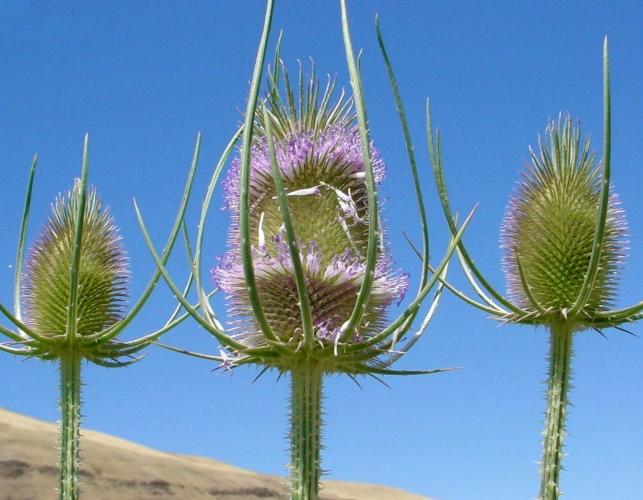
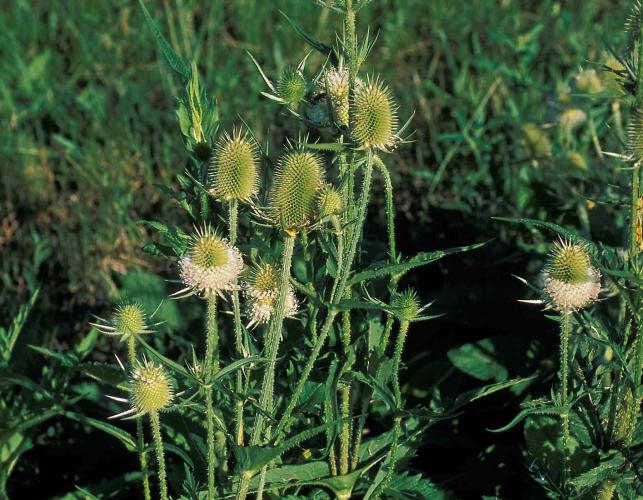
The flowers are tiny, massed on a cylindrical head, each with a tubular corolla, with stiff, narrow, pointed bracts longer than the flowers. The flowerheads form at the tops of the stems.
Blooms June–October.
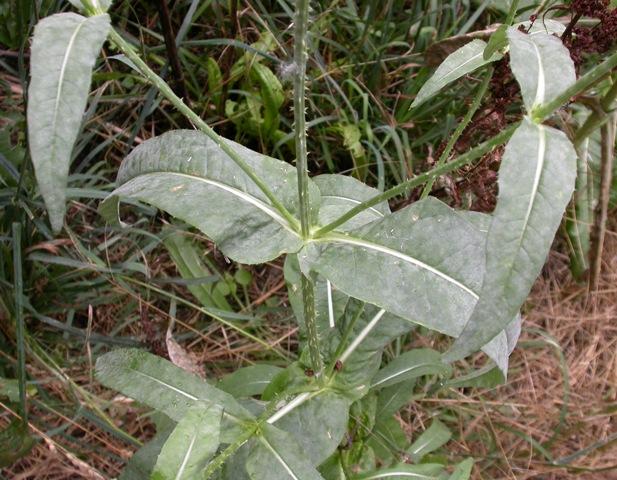
The leaves on flowering plants are large, opposite, stemless, and prickly, especially on the lower midrib.
To distinguish between the two species found in Missouri:
- Common teasel (Dipsacus fullonum) has lilac to lavender flowers; the stem leaves are oblong, lanceolate, scalloped or bluntly toothed, opposite, and sometimes slightly fused at the bases.
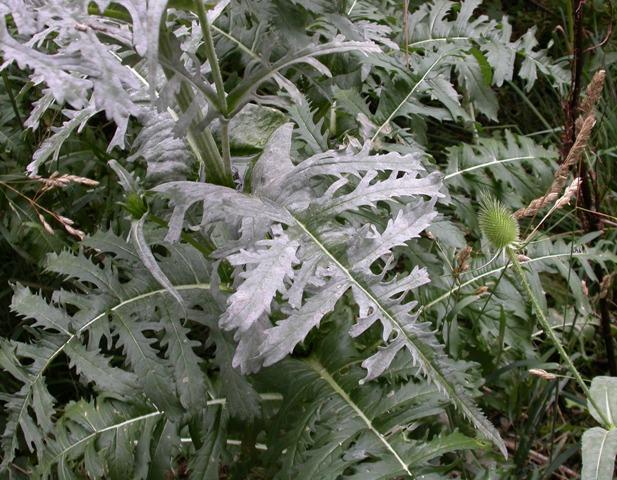
- Cut-leaved teasel (D. laciniatus) has white flowers; the stem leaves are irregularly pinnately lobed and prominently fused toward the bases, forming cups that may hold water. It is more aggressive than common teasel.
Height: to more than 8 feet.

Statewide.
Habitat and Conservation
Teasels occur in sunny fields, disturbed waste places, and roadsides, often in large colonies, along highways and waterways, even on sandbars in streams.
Cut-leaved teasel is the more aggressive of the two.
Teasels are spreading to new areas, including natural sites. A single plant can produce more than 2,000 seeds, which can remain viable for at least 2 years. Teasels present a difficult challenge for conservationists.
Learn how to identify teasels and help to stop their spread.
Status
Invasive, nonnative plant. Declared a noxious weed in Missouri in 2000; cultivation of teasel is illegal. Native to Eurasia.
Life Cycle
For a year or more, a teasel plant grows as a basal rosette. Then it sends up a flowering stalk. It dies after flowering.
A single plant produces thousands of seeds, and up to 80 percent of those can germinate.
Seeds typically don’t disperse far, so teasels usually form colonies.
Parent plants provide an optimal nursery site for their offspring: When the adult plants die, they bequeath to their offspring an area of bare ground where their own basal leaves had shaded out all other plants.
Human Connections
Introduced from Europe in the 1700s, teasels have been spreading along highways. Populations have flourished in recent decades due to late summer highway mowing.
Cut-leaved teasel was first recorded in our state in 1968, when it apparently had sprouted from seeds spread from a cemetery wreath to a nearby fencerow. But there have undoubtedly been numerous introductions since then.
In Europe and on our continent, teasels were once cultivated. The dried flowerheads were used on spindles to raise the nap of woolen cloth by textile workers.
The flowerheads have been used in dried flower arrangements and other crafts, and sold as novelties.
Please take care not to spread teasel seeds.
Ecosystem Connections
Teasels can potentially invade lightly managed grasslands as well as high-quality natural areas. Cut-leaved teasel is more aggressive than common teasel and has severely threatened several northern and central Illinois natural areas.
Currently, invasive teasels in our state occur mainly along highways, but these aggressive weeds can outcompete native plants, especially in prairies and savannas. Their spines protect them from being eaten by most herbivores, so it’s up to humans to check their spread.
Taxonomy: teasels used to be placed in their own family, the Dipsacaceae, but they have been moved into the Caprifoliaceae (the honeysuckle family). While teasels seem very unlike most honeysuckles, some species show a resemblance. Common horse gentian is one.