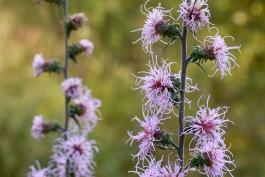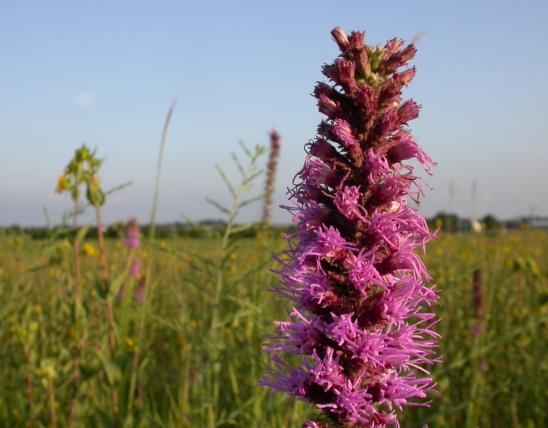









Appalachian blazing star grows in the Ozarks and Ozark border regions, especially in the southeastern quarter of the state. It is most similar to rough blazing star and savanna blazing star.
In Missouri, Appalachian blazing star is a relatively short plant, with relatively few flowerheads. However, on Crowley’s Ridge in southeast Missouri, it is taller, with many-headed flower stalks.
To distinguish Appalachian blazing star from similar-looking Missouri Liatris species, note differences in the number of florets per flowerhead, the length of flowerhead stems, the presence/numbers of leafy bracts accompanying the flowerhead stems, and the angling of the involucral bracts at the base of the flowerheads.
Key identifiers
- Stems with short, curled hairs, sometimes rough to the touch; the rootstock is a corm.
- Blooms at about 1–5 feet tall.
- Leaves with 1 main vein, oblanceolate (reverse-lance-shaped) to narrowly oval, the largest ones at the base with a leaf stalk (petiole); the blades to about 10 inches long and 1¾ inches wide; the leaves abruptly becoming smaller and mostly stalkless (sessile) up the stem; at the top of the plant, they may be linear (grasslike).
- Blooms August–November.
- The flowerheads are alternate on the plant stalk, with the plant stalk easily visible between the heads; a narrow, leafy bract is at the base of each flowerhead where it joins the main plant stalk.
- The flowerheads have 11–26 florets (sometimes to 28); the flowerheads sessile (stemless) or with short stems (not more than about ½ inch long); the topmost flowerhead is not, or only slightly larger than the rest.
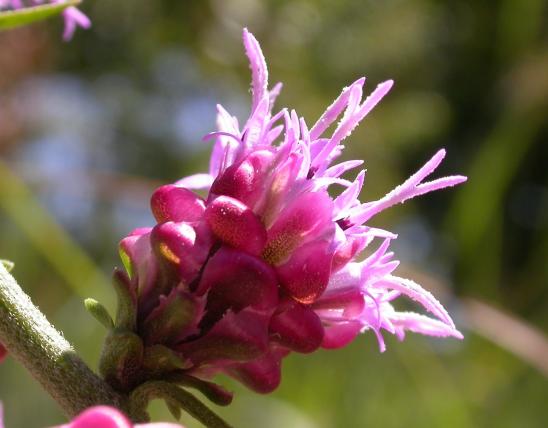
- Involucre (receptacle at the base of the flowerhead) broadly cup- or bell-shaped.
- Involucral bracts green, often purplish, at least at the outer margin, widest at the outer portion with rounded tips, often appearing slightly swollen; nearly all with the tip spreading or reflexed, with only the innermost (topmost) series usually ascending.
Similar species: Appalachian blazing star is most similar to rough blazing star and savanna blazing star.
- Rough blazing star (Liatris aspera) is more common; it is distinguished by its pouched or swollen-looking involucral bracts, which look irregularly torn on their edges.
- Savanna blazing star (Liatris scariosa) has large, fluffy, buttonlike flowerheads:
- It has 29–80 florets per flowerhead (not 11–26).
- Its flowerhead stems are about ½ to 1½ inches long (not stemless or only to about ½ inch long).
- Its flowerhead stems often have several small, loosely spaced, leafy bracts (not a narrow, leafy bract at the base of each flowerhead where it joins the main plant stalk).
- Its involucral bracts are erect or ascending, with the outer (lowest) row sometimes spreading or reflexed (not all with the tip spreading or reflexed, and only the innermost / topmost series usually ascending).
- Scaly blazing star (Liatris squarrosa) is similar mainly because its species name is so similar to Appalachian blazing star’s L. squarrulosa.
- Squarrosa means “scaly; rough”; it refers to scaly blazing star’s involucral bracts, which have long-pointed tips that are reflexed (spreading, curled back); together, they make the base of the flowerhead look like a spiny burr.
- Squarrulosa means “full of scales”; it refers to Appalachian blazing star’s involucral bracts, which have rounded tips and mostly only angle away from the involucre and look like scales.
For more information about Missouri’s blazing stars, see their group page.
Height: about 1–5 feet.
Scattered mostly in the Ozark and Ozark border regions, especially in the southeastern quarter of the state. The range of this species is mostly in the southeastern United States.
Habitat and Conservation
Occurs in glades, bases and tops of bluffs, savannas, openings of upland forests, and rarely upland prairies, ditch banks, fencerows, pastures, railroads, and roadsides.
Blazing stars are beloved by native wildflower gardeners, so you may find nearly any species in cultivation statewide.
Status
Native Missouri perennial wildflower.
Human Connections
Blazing stars are among the showier plants to grace native wildflower gardens as well as formal landscape plantings. Several species are in cultivation.
- Most of Missouri’s blazing star species can be purchased at native plant nurseries.
- In gardens, blazing stars are a magnet for pollinators such as butterflies and bees.
- Birds feed on the seeds.
- The sweet, thickened rootstocks, however, are attractive to voles and other herbivorous mammals.
Ecosystem Connections
Blazing stars, like other members of the daisy-sunflower family, are visited by numerous types of pollinators and other insects. The presence of these insects draws birds and other predators, so the community of flowers is the base of a vigorous food chain.
Birds eat the fruits of blazing stars, which are like tiny sunflower seeds. Goldfinches are notable consumers of blazing stars, coneflowers, thistles, sunflowers, and sunflower-family seeds that develop in late summer as they nest late in the season. The fuzzy tufts of blazing star seeds are also used to line nests.
Mammals that eat blazing stars include rabbits, woodchuck, and deer, which graze on the aboveground parts of the plant, and voles, which gnaw on the corms or other thickened rootstocks.