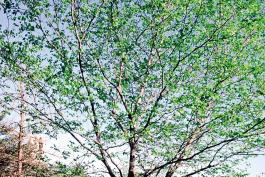






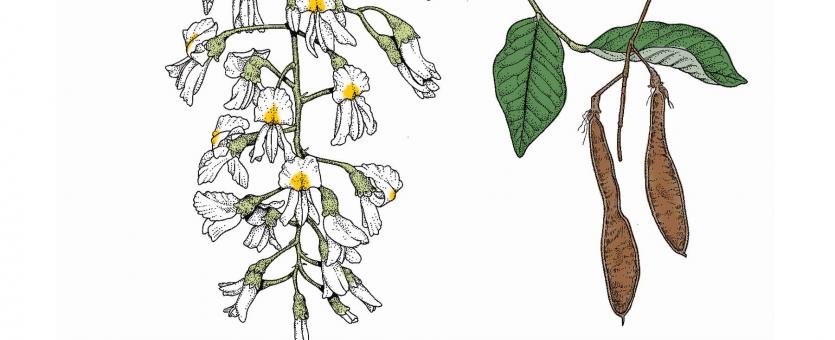
American yellowwood is a medium-sized tree with a short trunk and a broad, open, rounded crown.
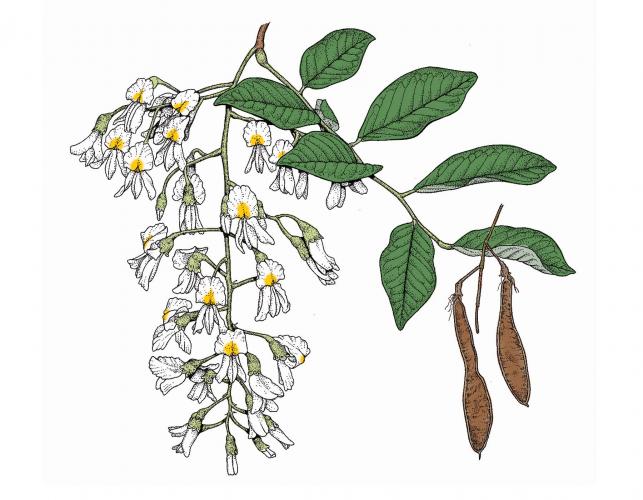
Leaves are alternate, feather-compound, 8–12 inches long, with 5–11 leaflets, not always in opposite pairs; leaflets oval to egg-shaped, broadest in the middle, 2–5½ inches long, 1½–4 inches wide, margin entire, abruptly pointed at the tip; leaf stalk enlarged at the base, enclosing a bud.
Bark is gray to light brown, thin, smooth.
Twigs are slender, smooth, shiny, zigzag, brittle, reddish brown, with numerous pores; bud at end of twig absent, side buds usually 2–4, clumped, appearing as one, hairy.
Flowers May–June, in elongated, hanging clusters 4–14 inches long; flowers white, fragrant, about 1 inch long, pea-shaped with 5 petals; upper petal rounded with a yellow blotch at the base.
Fruits in August–September. A flattened pod 3–4 inches long, late to split into 2 halves, persisting into winter. Seeds 1–6, flattened, dark brown.
Height: to 60 feet.

Missouri's natural populations are primarily limited to a few southwestern counties, particularly on the slopes and bluffs along the White River and its tributaries. The species is uncommon in the wild but is cultivated and planted as an ornamental statewide.
Habitat and Conservation
Occurs naturally along moist wooded slopes and bluffs and along rocky drainages in somewhat sheltered areas.
Yellowwood is often planted as an ornamental.
Status
Native Missouri tree. Popular as a landscaping ornamental.
Human Connections
Planted as an ornamental, yellowwood grows well in partial shade or sun and is relatively free of serious insect pests and diseases. It grows slowly and its branches are somewhat brittle, making it relatively susceptible to storm damage. The flowers are showy, and yellowwood is a good pollinator plant.
The wood has been used for fuel and for gunstocks. It is exceptionally hard and takes a high polish.
Early Appalachian settlers made a yellow dye from the root bark and heartwood (hence the common name).
Yellowwood is a prized landscape tree for its spectacular, fragrant white flowers that hang in long, wisteria-like clusters. While it may not bloom heavily every year — often following a biennial or triennial cycle — a year in full bloom is a significant event for gardeners and naturalists. Its autumn foliage is also a point of interest, turning a brilliant, clear yellow that brightens the landscape.
Ecosystem Connections
Trees are homes for numerous animals, from insects to birds and more; they provide food for many other animals, such as the bees and other pollinators that visit their flowers and the many insects and other animals that chew on their leaves. Insects that eat leaves provide food for nesting birds and other insectivores. Yellowwoods bloom when few other trees are flowering, providing a critical nectar source for honeybees and native bumblebees in late spring.
With their canopies, trees provide a shady habitat essential for many plants and animals.
Because it is a member of the bean family that fixes nitrogen, the yellowwood can grow in relatively poor soils, though it prefers well-drained conditions.