






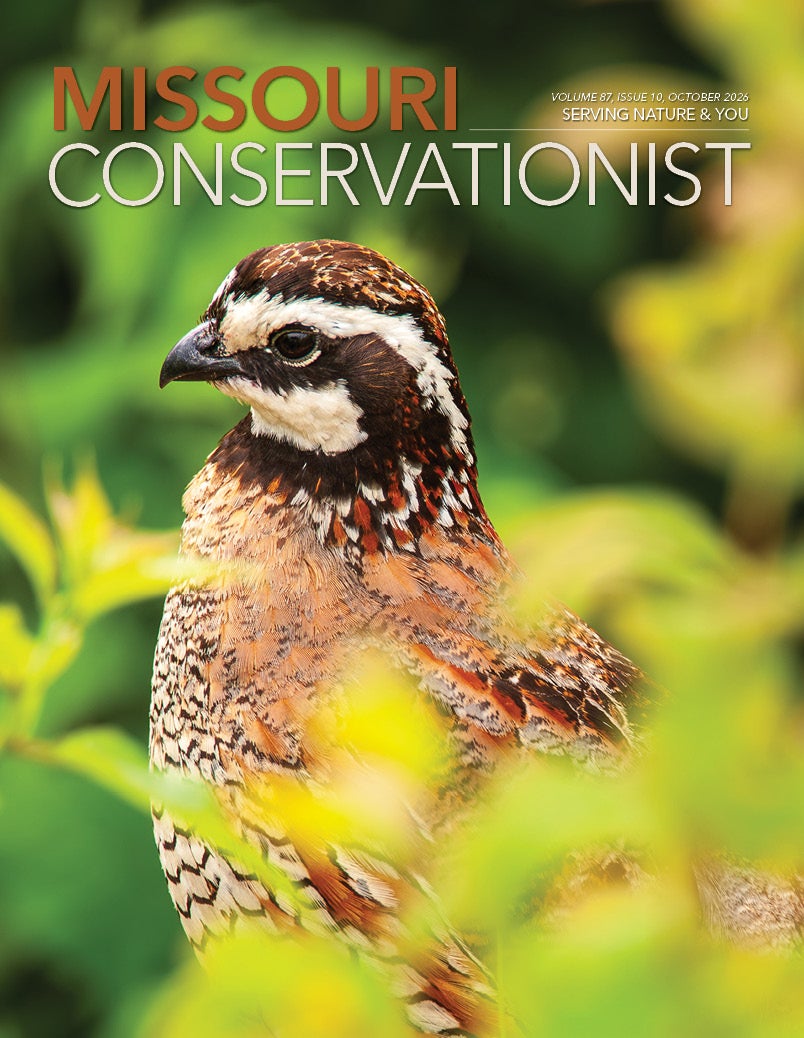

The long-absent whistles of quail are returning due to new management techniques
Brian Gilbert watched as a skid steer ripped through a stand of small trees on the Pony Express Lake Conservation Area (CA) and couldn’t help but feel encouraged about the fate of quail in northwest Missouri.
“When I got here in 2014, I looked at maps of all the conservation areas I would manage,” said Gilbert, a wildlife biologist for MDC. “From 1975 to 2014, we had lost 1,000 acres of open land to trees.
“We’re removing those trees to reclaim those grasslands. When we do, the quail and many other species definitely benefit.”
Gilbert has seen proof. At Pony Express Lake CA and other public hunting areas, the long-absent whistles of quail are being heard again.
Quail managers are taking a new approach to bring back the birds — from restoring grasslands to conducting controlled burns to providing habitat quail desire. And it’s working.
It’s not an overnight thing. It’s a long, drawn-out battle, and wildlife managers must celebrate small victories.
On a landscape where the news about quail has been mostly discouraging for the last 25 years, new management techniques on private and public land offer hope.
“We’ve had lots of success stories,” said Beth Emmerich, quail biologist for MDC. “It’s just not on a large scale. But at least we’re seeing that quail can still do well if they have the right type of habitat.”
Quail: A Blast from the Past
When it comes to quail, Missouri will never again see an era like the 1950s through the 1970s.
The state’s landscape was dominated by small family farms, brushy fencerows, weeds that attracted insects, and prime habitat everywhere you looked.
Quail hunters enjoyed boom times. They routinely shot more than 3 million birds per season and Missouri became a “go-to” state.
“Quail opener was a big deal,” Emmerich said. “Little motels were full, just about every truck going down roads had a dog box in it, and some towns got a pretty big economic boost from quail hunting.”
But that changed as modern agricultural practices advanced. The quail’s world shrank significantly.
Small family farms gave way to larger agricultural operations and cleaner farming. Instead of small fields bordered by good quail habitat, farmers went to large fields with, in many cases, crops in production from fencerow to fencerow. Chemicals were applied to keep the weeds out of fields, so the insects the quail chicks depended on were no longer abundant.
That set off a steady decline in quail numbers that accelerated in the 2000s. Now quail populations are so low in some areas that hunters no longer pursue them.
“It’s disheartening to see as a biologist, but you can’t blame the farmers,” Gilbert said. “They’re trying to make a living.
“It’s our job to show them how they can farm and still set aside good habitat for quail. It can be done.”
Rebuilding the Quail’s World
As quail have struggled, more research has been devoted to determining what the birds need to thrive.
“Years ago, we were planting lots of grass and a few forbs,” Gilbert said. “Now, it’s just the opposite. We’ve found that a diversity of forbs and just a little grass is better.”
Wildflowers are the key, Gilbert said.
“The more diversity you have in a field, the more insects it attracts and the more the quail chicks have to forage on when they are hatched,” he said.
Those forbs are easier for the quail chicks to negotiate than thick, matted grass. For the first nine weeks of their lives, the quail feed up to 90 percent on small insects, Emmerich said.
The chicks need bare dirt interspersed with forbs so that they can walk around. The forbs provide overhead cover to protect from aerial predators, so it’s a win-win.
“That ideal brood cover is what we lack the most in Missouri,” Emmerich said.
Through federal programs, such as the Conservation Reserve Program (CRP), farmers are compensated for idling, or temporarily setting aside, marginal crop land to provide wildlife habitat. There are other key factors that play a major role in land management for quail.
Conduct prescribed burns every two to three years to remove the dead thatch layer from the ground and encourage species diversity. Land disturbance, like light disking, is also beneficial.
Remove undesirable trees from the landscape, which limits predator perches and provides additional escape cover when loosely stacked.
Give quail a place to escape winter's snow, ice, and bitter temperatures by providing shrubby shelterbelts and thickets.
Plant a diverse native mix of grasses and wildflower species.
“We have people who will call us all the time wondering what has happened to the quail,” Emmerich said. “They tell us their farms haven’t changed since they had a lot of birds, but they’re gone now.
“Well, in reality, their land has changed quite a bit over time. Habitat changes slowly and people don’t notice it. Cleaner farming, fescue, which creates a monoculture that isn’t good for quail, more tree growth … it all adds up.”
Private Land Success
Bob Borman, 77, has spent more than 50 years hunting quail.
“The first time I stepped into a covey of quail, it was a thrill,” said Borman, who owns and leases land northeast of Kingston. “It still is. That feeling just never goes away.”
Once, he almost took for granted the excitement of watching his bird dogs flush a covey of quail. Now that the populations have declined, he treasures those moments even more.
Some quail hunters gave up as the bird populations plummeted. Not Borman. He dedicated himself to following recommendations from MDC and other agencies on how to improve quail habitat and went
to work.
He even opened a small business focusing on habitat management, and bought some small farm equipment to plant food plots and other habitat.
“I can get into corners where some big machinery can’t go and put down habitat, and it’s really helped,” said Borman, a life member of Quail Forever and Pheasants Forever. “Same thing for some of this CRP land. If you put down a diversified mix of forbs, you can see how it helps.
“I’ve definitely seen quail numbers rise on some of the land where I’ve done habitat work.”
Jim Denneny of Fayette has seen the same thing. A retired ear, nose, and throat doctor, he had been away from his family farm in central Missouri for years. When he inherited the piece of land that had been in his family since 1818, he was disappointed to see that much of the wildlife was gone.
“I decided to try to restore things to the way they used to be when I would be up there to spend summers on my grandparents’ farm,” he said.
He went to MDC’s Community and Private Land Conservation Branch and followed an aggressive habitat plan to make the CRP on his property more appealing to wildlife. Today, there are deer, turkeys, and at least five coveys
of quail.
Denneny will long remember a moment last fall when he was in a tree stand hunting deer.
“I saw 50 to 75 quail marching across a cornfield,” he said. “I knew then that the habitat work I was doing was paying off.”
But Denneny doesn’t plan to hunt those birds. He is just happy to provide them with a place to live.
“None of the quail here are hunted, except by coyotes,” he said. “We’re just happy to see and hear them again.”
Cautious Optimism
Terry Rouse, 65, is another quail hunter who would like to relive the good
old days.
He worked for Natural Resources Conservation Service, a division of the U.S. Department of Agriculture, for 40 years. He helped agricultural producers with crop plans that included habitat management.
He also remembers good days in the field, following one of his German shorthair bird dogs through the brushy cover.
Now, the birds are fewer and far between. But Rouse continues to hunt hard. He chased quail or pheasants in Minnesota, Wisconsin, South Dakota, and Iowa, in addition to Missouri last season.
He isn’t encountering large numbers of quail like he once did. But he sees encouraging signs.
“If you don’t burn, if you don’t disturb the soil, the quail aren’t going to come back on their own,” he said. “I think this aggressive management we’re seeing is helping.
“If I can take a dog out and find a covey or two, I’m happy. And we’re doing that.”
Getting Started
Contact your regional office (see Page 29) and ask for your private land conservationist. He or she will assess your property and issue a report on what is needed and offer assistance through state or federal cost-share programs. If you prefer to hunt public land, find a list of quail restoration landscapes, where MDC biologists have emphasized quail management and habitat improvement, at
short.mdc.mo.gov/occ.


Also In This Issue

These ancient and long-lived species are important to the state’s ecosystem

A Photographer’s View
And More...
This Issue's Staff
Editor – Angie Daly Morfeld
Associate Editor – Larry Archer
Photography Editor – Ben Nickelson
Staff Writer – Kristie Hilgedick
Staff Writer – Joe Jerek
Staff Writer – Dianne Van Dien
Designer – Marci Porter
Designer – Kate Morrow
Photographer – Noppadol Paothong
Photographer – David Stonner
Circulation – Marcia Hale