







Turtles are ancient reptiles — their fossils first recorded more than 200 million years ago. Indigenous cultures credit North America’s very existence to turtles, asserting the continent — referred to as Turtle Island in their oral histories — was formed on the back of a giant turtle.
Turtle shells are considered an evolutionary novelty — no other animal exhibits such a structure as part of its physiology. An exquisite singular structure, a turtle’s shell essentially is an external skeleton formed from expanded and fused bones — primarily ribs and vertebrae. The shell’s domed upper portion is called the carapace; the under shell is the plastron. Both are covered by bony keratin-covered plates called scutes with species-distinctive markings. Softshell turtles are an exception, covered instead with thick leathery skin.
Aquatic turtles’ shells have streamlined profiles adapted for swimming, while box turtles have domed shells to navigate the obstacles of traversing life on land. More than just bony armor, turtle shells contain nerves allowing them to feel pressure or touch. Damage to the shell is painful and can even cause bleeding.
Box turtle shells expand with age, adding what looks like growth rings to their scutes. It is a common myth that turtles can be aged by these rings. In truth, this growth has an environmental association — a well-fed turtle’s scutes expand more quickly.
“In general, turtles are long-lived,” said State Herpetologist Jeff Briggler. “But turtles don’t lay a lot of eggs and hatchlings are not fast. There is a lot of predation on nests. As they reach adult size, their prospects for longevity increase. They just need to get by that hump of shell hardness.”
With interior organs in fixed positions, a turtle must exhale to make room for its head, legs, and tail when retracting them, often making a hissing sound.
Box turtle’s hinged plastron allows them to completely withdraw into their shells. Snapping turtles are unable to fully withdraw their heads but can launch their necks forward toward prey or a perceived threat.
Turtles do not have teeth but rather rely on sharp hooked beaks. In the case of carnivorous turtles, it allows them to tear flesh from potential prey. Many plant-eating turtles shred their meals with serrated beaks.
Freshwater turtles’ webbed feet and long claws allow them to propel forward in water and climb onto logs or riverbanks. Box turtles are better adapted for cross-country navigation.
“They all have some sort of adaptation for the environment they live in,” Briggler said.
Turtles have a well-developed sense of vision and smell. An eardrum on each side of their head detects movement, pressure changes, and low frequency sounds alerting them to the presence of prey and predators.
There’s an opening at the base of a turtle’s short tail, called the cloaca, which serves multiple purposes, including waste elimination, sperm transfer, and egg-laying. Some aquatic turtle species take in water and absorb oxygen through their cloaca, earning them the nickname “bum breathers.”
All turtles lay eggs on land and may travel long distances to find a suitable spot, usually depositing them in sandy or soft soil. Depending on the species, turtle eggs can be soft- or hard-shelled. Snapping turtles and softshell turtles lay spherical eggs and all other Missouri turtles lay oval or elongated eggs.
Meet Missouri’s Turtles
Of the 56 turtle species native to the United States, 18 species are native to Missouri. They are roughly divided into three groups: hard-shelled land (or terrestrial turtles), softshell aquatic turtles, and hard-shelled aquatic turtles.
It’s a misconception that turtles are totally aquatic. Briggler said many species travel over land and among waterbodies for feeding and dispersal purposes, and all species deposit eggs on land.
Title
Hard-Shelled Land (Terrestrial Turtles)
Missouri is home to the ornate box turtle and the three-toed box turtle, which has been designated the state reptile. Missourians are very familiar with box turtles, witnessing thousands crossing roads, especially in the spring months.
Tragically, hundreds if not thousands of these land-dwelling turtles are killed by vehicles while crossing roadways each year. Many also perish from starvation or abnormal growth at the hands of well-meaning people who capture them as pets. Briggler encourages people to enjoy turtles in nature, but to always leave wildlife wild.
Box turtles, especially three-toed box turtles, only bury themselves under a few inches of soil during the winter months. The three-toed box turtle sometimes is unable to dig deep enough, leading to higher incidents of winter mortality. However, they do produce a type of anti-freeze that allows many to survive freezing winter conditions.
Ornate Box Turtle
(Terrapene ornata)
Distribution: Statewide, except in the southeast, common in western and northern parts of Missouri
Habitat: Pastures, open woods, glades, and prairies
Food: Insects, small number of berries, tender shoots
Description: Domed upper shell, measuring 4 to 5 inches, is brown with yellow lines. Lower shell is brown with distinct yellow spots and blotches. Head and limbs are brown or black with yellow spots and blotches. Normally four toes on hind legs.
Three-Toed Box Turtle
(Terrapene triunguis)
Distribution: Statewide, except for extreme north and northwest Missouri
Habitat: Ozark woodlands, grasslands
Food: Insects and earthworms; older turtles eat a large amount of plant matter
Description: Domed upper shell, measuring 4 to 5 inches, is olive or olive-brown with faint yellowish lines radiating from the center of each scute. Lower shell is plain yellow with some brown smudges and a hinge, allowing it to close for protection. Head, neck, and limbs are brown or black with varied amounts of yellow and orange. Most have three toes on each hind foot.
Title
Softshell Aquatic Turtles
Both the midland smooth and the northern spiny softshell live mainly in rivers and reservoirs throughout much of the state. These fast swimmers have snorkel-like snouts that allow them to hide beneath the surface of the water or bury themselves with only their heads slightly showing. They also avoid cold weather by burying in mud underwater. Strong jaws help them defend themselves. Softshells are considered game animals in Missouri with a defined season and bag limit.
Midland Smooth Softshell
(Apalone mutica mutica)
Distribution: Statewide, uncommon in the Ozarks
Habitat: Large rivers with abundant sand or mud
Food: Aquatic animals including fish, crayfish, tadpoles, snails, and insects
Description: For males, smooth upper shell, measuring 4 to 10 inches, is olive-gray or brown with faint markings of dots and dashes, while a female’s shell measures 6 to 14 inches and is mottled with blotches of gray, olive, or brown. Lower shells are a plain cream color. Head and limbs are olive or gray above, and light gray or cream-colored below. A light stripe bordered by black is present behind each eye.
Northern Spiny Softshell
(Apalone spinifera spinifera)
Distribution: Statewide
Habitat: Medium to large rivers, lakes, large ponds, and reservoirs with muddy or sandy bottom
Food: Aquatic animals, including fish, crayfish, insects, snails, small mussels, and tadpoles
Description: Male’s upper shell, measuring 5 to 12 inches, is olive or grayish tan with distinct, small black dots, circles, and a black line. Female’s upper shell, measuring 7 to 21 inches, is dark olive or tan with brown and gray blotches. The lower shell is cream-colored. The snout is snorkel-like with a small ridge on each side. Head and limbs are normally tan or olive with small brown or black markings. A yellow line, bordered by black, extends from the snout through the eye and along each side of the head.
Title
Hard-Shelled Aquatic Turtles
Snapping Turtles
Missouri’s two snapping turtle species are the North American snapping turtle, formerly known as the common snapping turtle, and the rare western alligator snapping turtle, the largest freshwater turtle in the world.
“Although the alligator snapping turtle can achieve weights over 200 pounds throughout their range, the heaviest documented individual in Missouri was 128 pounds,” Briggler said, adding that few individuals rarely make it to 100 pounds today.
A large riverine turtle, the alligator snapper is most often captured by anglers on hook and line. Due to its large size, land travel can be quite exhausting. An alligator snapping turtle usually sits motionless on the river bottom with its mouth wide open, exposing a wormlike tip on the end of its tongue like fish bait.
“The majority seen on land are females searching for egg-laying sites along river edges,” Briggler said. “They look like prehistoric animals walking on tiptoes with extended limbs.”
The North American snapping turtle is a common turtle found statewide in a wide variety of wetlands, such as ponds, ditches, swamps, sloughs, and rivers. They also eat a wide variety of animals and even plant material. They are considered a game species with a harvestable season and limit, but it is unlawful to capture or kill the western alligator snapping turtle in Missouri.
North American Snapping Turtle
(Chelydra serpentina)
Distribution: Statewide
Habitat: Farm ponds, ditches, marshes, swamps, sloughs, rivers, and reservoirs
Food: Animal matter and aquatic plants
Description: Upper shell measures 8 to 14 inches, often with mud or algae covering it. Adults weigh 10 to 35 pounds and are normally gray or brown.
Western Alligator Snapping Turtle
(Macrochelys temminckii)
Species of Conservation Concern
Distribution: Southern, southeastern, and eastern Missouri
Habitat: Deep, muddy pools of large rivers, deep sloughs, and oxbow lakes
Food: Fish, small turtles, snakes, small mammals, crayfish, mollusks, and even nuts and fruits
Descriptions: Upper shell, measuring 15 to 20 inches, is dark brown with three prominent rows of ridges. Adults weigh 35 to 150 pounds, with a large head and pronounced hooked beak. Head and limbs are dark brown.
Mud and Musk Turtles
Mud and musk turtles are some of the smallest turtle species in the world, three of which make homes in Missouri. These dull-colored turtles have scent glands located between the carapace and plastron that produce a putrid odor when roughly handled. This behavior earned the eastern musk turtle the nickname “stinkpot.”
“Mississippi mud turtles, which are found in extreme southeastern Missouri, are one of the more common turtle species in the Bootheel of Missouri,” Briggler said. “They are quite often seen crossing roads in the spring while moving among wetlands and searching for egg-laying sites. However, yellow mud turtles live primarily in sandy soils entering wetlands to forage and mate during the spring months. This state endangered turtle occupies small niche corners of the state and is declining.”
Eastern Musk Turtle
(Sternotherus odoratus)
Distribution: Nearly statewide, except northern third of the state
Habitat: Streams, rivers, sloughs, swamps, and large lakes
Food: Aquatic insects, earthworms, crayfish, mollusks, small fish, tadpoles, algae, plants and their seed, and dead animals
Description: Nicknamed “stinkpot” and considered the state’s smallest turtle species. Domed upper shell, measuring 2 to 4 inches, is dark, gray-brown to black. Its lower shell is yellow, brown, or grayish yellow. It has two yellow stripes on the side of the head and neck.
Mississippi Mud Turtle
(Kinosternon subrubrum hippocrepis)
Distribution: Southeast Missouri
Habitat: Swamps, sloughs, oxbow lakes, and canals, most often observed in shallow water
Food: Aquatic animals and some plants
Description: Upper shell, measuring 3 to 4 inches, is dark brown or black. Lower shell is yellow with rich brown mottling. Each side of the head and neck have wide, irregular yellow stripes.
Yellow Mud Turtle
(Kinosternon flavescens)
State Endangered/ Species of Conservation Concern
Distribution: Southwest and northeast Missouri, and the Kansas City area
Habitat: Sandy habitat near wetlands, marshes, oxbow lakes, and flooded fields
Food: Aquatic animals (snails are considered a favorite) and plants
Description: Upper shell, measuring 4 to 5 inches, is flattened and usually olive brown. Lower shell is yellow with brown along scute seams. The limbs and upper parts of the head and neck are olive, while the chin and throat are normally yellow.
Basking and Marsh Turtles
With nine species, basking and marsh turtles constitute the greatest number of aquatic hard-shelled turtles. Whether they prefer rivers, ponds, wetlands, sloughs, or swamps, all require easily accessible places to pull out of the water and bask in the sun. According to Briggler, these turtles’ sunbathing behavior is for more than just relaxation and thermoregulation.
“Turtles need sun-supplied UV rays to trigger their skin to produce vitamin D that is critical for bone growth and normal shell development,” Briggler said. “Basking also promotes overall health of the turtle, by improving digestion, suppressing pathogens and parasites, and reducing the algae growth and rot on the shell.”
False Map Turtle
(Graptemys pseudogeographica)
Distribution: Statewide in large rivers
Habitat: Rivers, river sloughs, oxbow lakes, or constructed reservoirs
Food: Aquatic plants and animals such as snails, insects, crayfish, and dead fish
Description: Upper shell, measuring 3 to 10 inches, is brown or olive with yellow circles or lines and a serrated hind edge. The lower shell is greenish yellow with light brown lines along scute seams. Head and neck are brown or greenish gray with numerous yellow lines bordered by dark brown or black. A thick, yellow line behind each eye forms a backward “L” shape.
Northern Map Turtle
(Graptemys geographica)
Distribution: Statewide, except northwestern third and southeast
Habitat: Rivers, sloughs, and oxbow lakes
Food: Snails, crayfish, and some insects
Description: Upper shell measures 7 to 10 inches and is brown or olive-brown with a netlike pattern of fine yellow lines, giving an appearance of a topographical map. The hind edge is serrated. Lower shell is light yellow with dark brown seams between the scutes. Head and limbs are brown with thin yellow lines, and a yellow spot appears behind each eye.
Ouachita Map Turtle
(Graptemys ouachitensis)
Distribution: Southern and eastern Missouri
Habitat: Slow-moving rivers, sloughs, oxbow lakes, and reservoirs
Food: Insects, worms, crayfish, snails, dead fish, and aquatic plants
Description: Upper shell, measuring up to 10 inches, is brown or olive with yellow lines and a raised keel down the center. Lower shell is yellow. Head and limbs are olive with numerous thin, yellow lines. Wide yellow or orange-yellow marking behind each eye and a large yellow spot below each eye.
Eastern River Cooter
(Pseudemys concinna concinna)
Distribution: Southern half of Missouri
Habitat: Prefers rivers and sloughs, but also inhabits large reservoirs
Food: Aquatic plants, some aquatic insects, snails, and crayfish
Description: Upper shell, measuring 9 to 13 inches, is olive-brown with numerous concentric yellow lines. Lower shell is yellow. Head is small and limbs are normally dark brown or black with many yellow lines.
Western Painted Turtle
(Chrysemys picta bellii)
Distribution: Statewide, except southeast Missouri
Habitat: Slow-moving rivers, sloughs, oxbow lakes, ponds, and drainage ditches with ample mud bottom
Food: Aquatic plants, snails, crayfish, insects, and some fish
Description: Smooth upper shell, measuring 4 to 8 inches, is olive, olive-brown, or nearly black with yellow, irregular lines and a reddish-orange outer edge. Lower shell is red-orange with a prominent pattern of brown markings that follows scute seams toward the outer edge. Head and legs are dark brown or black and strongly patterned with yellow lines.
Southern Painted Turtle
(Chrysemys dorsalis)
Distribution: Southeast Missouri
Habitat: Still, quiet water of shallow swamps, streams, sloughs, and oxbow lakes
Food: Aquatic invertebrates, such as snails, crayfish, and insects, and some plant materials
Description: Upper shell, measuring 4 to 5 inches, with an orange or orange-red stripe down the center. Lower shell is yellow, often with an orange or orange-red outer edge.
Red-Eared Slider
(Trachemys scripta elegans)
Distribution: Statewide, except for extreme north-central Missouri
Habitat: Rivers, sloughs, oxbow lakes, and constructed lakes and ponds
Food: Aquatic plants and animals
Description: Upper shell, measuring 5 to 8 inches, is olive-brown with numerous black and yellow lines. Lower shell is yellow with large, dark-brown blotches on each scute. Head and limbs are dark green with narrow black-and-yellow lines. A distinct red or orange stripe occurs on each side of the head, behind the eye.
Western Chicken Turtle
(Deirochelys reticularia miaria)
State Endangered/ Species of Conservation Concern
Distribution: Southeast Missouri
Habitat: Slow-moving aquatic habitats, including swamps, river sloughs, oxbow lakes, and drainage ditches
Food: Dragonfly and damselfly larvae, crayfish, fishing spiders, and other invertebrates
Description: Oval-shaped upper shell, measuring 4 to 6 inches, is brown or olive with faint yellowish-brown lines forming a netlike pattern. Lower shell is yellow with brown along scute seams. Head and limbs are brown or black with numerous yellow or yellowish-green stripes. The head and long neck are yellow underneath.
Blanding’s Turtle
(Emydoidea blandingii)
State Endangered/ Species of Conservation Concern
Distribution: Extreme northeast and northwest Missouri
Habitat: Shallow water along the edge of marshes and river sloughs, also ponds and drainage ditches
Food: Crustaceans and a variety of aquatic insects, snails, small fish, and aquatic plants
Description: Oval-shaped and high-domed upper shell, measuring 6 to 9 inches, may be dark brown or black with many yellow spots or bars. Lower shell is yellow with a large, dark-brown blotch on outer portion of each scute, and front third is hinged and movable. Head and limbs are brown and yellow. Chin and underside of long neck are bright yellow.
The tranquil lifestyle of turtles belies the important role they play in sustaining health and balance in their biological communities. They contribute to the control of insects, algae, and aquatic plant and animal populations. Foraging turtles ultimately improve water quality by aerating sediment and recycling nutrients. Their presence serves as a marker for ecosystem health. ▲


Also In This Issue

A Photographer’s View

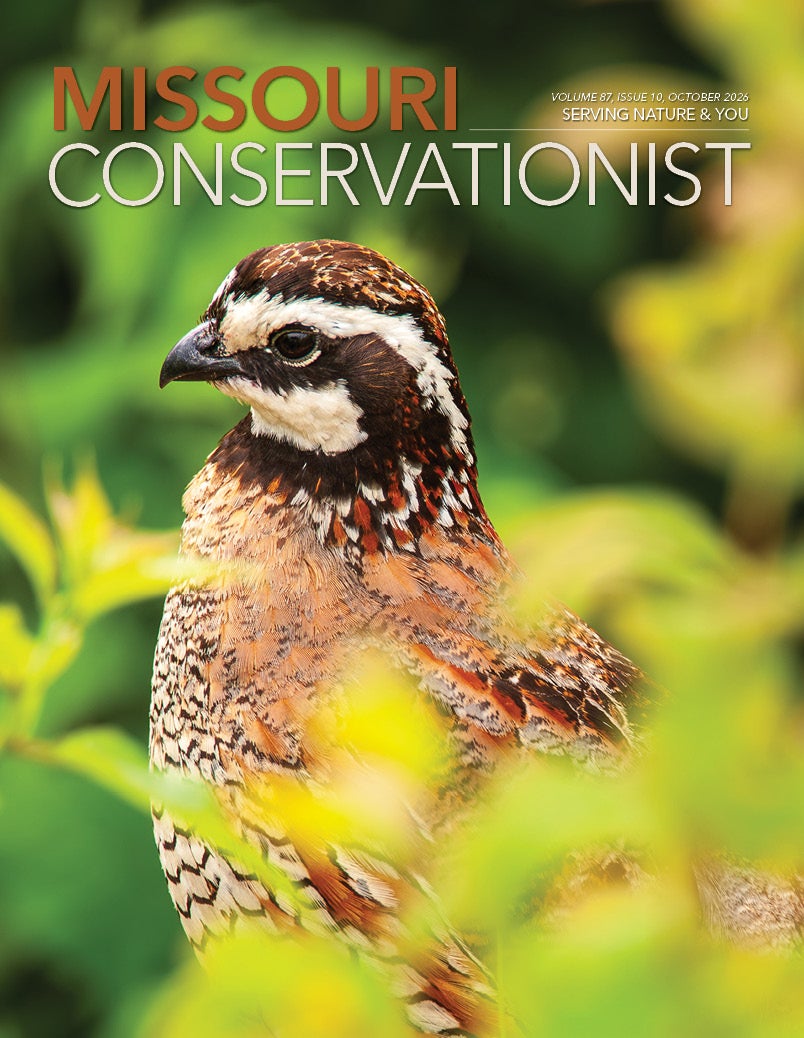
The long-absent whistles of quail are returning due to new management techniques
And More...
This Issue's Staff
Editor – Angie Daly Morfeld
Associate Editor – Larry Archer
Photography Editor – Ben Nickelson
Staff Writer – Kristie Hilgedick
Staff Writer – Joe Jerek
Staff Writer – Dianne Van Dien
Designer – Marci Porter
Designer – Kate Morrow
Photographer – Noppadol Paothong
Photographer – David Stonner
Circulation – Marcia Hale