






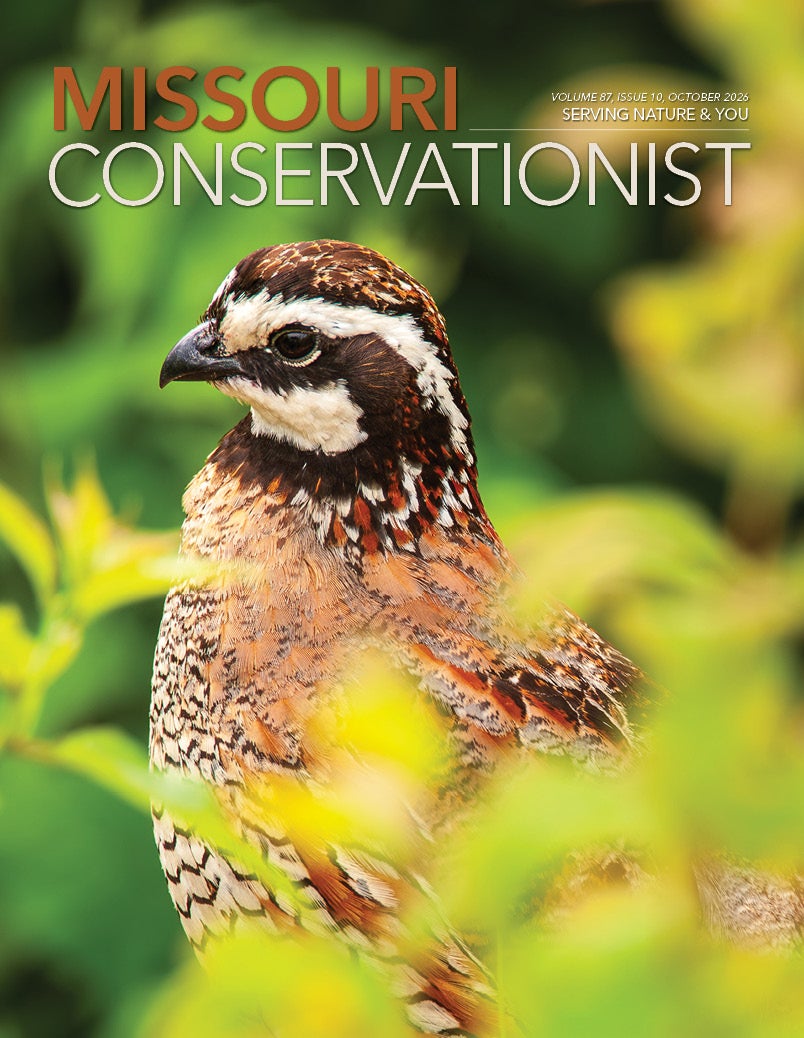

As a wildlife photographer, I’m often asked, “When is your next big trip?” While I’ve spent a fair amount of time traveling out west with camera in hand, my focus has always been on Missouri wildlife, especially animals I encounter on the small farm where I live with my wife, Joyce, in Franklin County. Monitoring the behavior of close-to-home wildlife greatly improves my chances of capturing compelling images, but I remain humbled by the ability of critters to sabotage my best laid plans.
Our farm has been in Joyce’s family since her grandparents acquired it in 1939. Joyce’s mom, Virginia, who lives next door, recalls helping her father turn the ground for row crops with a walking plow and a team of horses called Dolly and Milly. These days, we still lovingly refer to the property as “The Farm,” but it’s mostly hayfields, bordered by red cedar, shingle oak, walnut, persimmon, locust, mulberry, and cherry trees. Scattered wild plums, redbuds, and dogwoods add color to the landscape in spring, and by summer the fields are adorned with a variety of colorful forbs. After we built a new house at the site of the original homestead, we converted the adjacent meadow to the east into Indian grass, big bluestem, and native forbs to enhance wildlife diversity.
I approach wildlife photography with the same tactics I’ve used as a hunter, but with a digital camera and 500 mm lens instead of a shotgun or rifle. I usually shoot from a turkey chair, which is basically a drably colored beach chair that’s easy to collapse and carry over my shoulder to my hiding spot. After I’m settled in, I cover my tripod, lens, and camera in camo netting and wait for some action. In cooler weather, I often use a portable pop-up blind for subjects like strutting turkeys in open fields. Most of my shooting is done in the morning and I’m usually set up long before sunrise. I determine my location based on animal behavior patterns, previous observations, wind direction, and most importantly, the direction of the sun’s light. After all that, it’s simply a matter of patience, perseverance, and luck.
Spring
Spring is my favorite season, a time of renewal after a long winter. By April, our cedars and wild plums host tiny, colorful warblers in search of insects and caterpillars, fuel for their northward migration. A few species, including prairie warblers, stick around to nest on the farm. Warblers are quite approachable, but a challenge to photograph as they flit nonstop among the branches.
Spring is also the season for wild turkeys — the toms spitting, drumming, and gobbling for aloof hens, their feathers brassy in the morning light. Down at the pond, drake wood ducks show off their dazzling plumage of green, purple, and maroon in contrast to the drab attire of their mates. Occasionally, I’ll see a pair of hooded mergansers. The drake’s crest, a fan of brilliant white, is a photographer’s dream.
Every spring, I look forward to the return of eastern meadowlarks as they court on the hillside behind our house. The males serenade prospective mates from a wooden post I fixed at the highest point in the field. We begin and end every day listening to their melodious whistles. Meadowlarks are quite skittish, so I use a pop-up blind to photograph them in the open field. Sometimes I sit for hours waiting for one to come my way.
Our mulberry trees attract a variety of birds in spring, especially cedar waxwings, often in huge flocks. They are captivating in their dashing black masks and silky plumage of brown and yellow with waxy red wingtips. When the mulberries ripen, I spend most mornings near my favorite tree, waiting for the perfect shot.
Later in spring, American goldfinches gather each morning in our wildflower garden to gorge on coreopsis seeds. They often perch on spiderwort plants between meals, their vivid yellow plumage exquisite in contrast to the blue flowers. I monitor their activities from my front porch, both camera and coffee at hand.
Other highlights of spring include eastern kingbirds, regal on their sapling thrones out in the fields; blue grosbeaks, easily spotted by their intense blue plumage; eastern towhees, singing drink your tea from the tops of cedar trees; and eastern bluebirds, fiercely interacting with rivals as they lay claim to the houses we’ve provided.
Summer
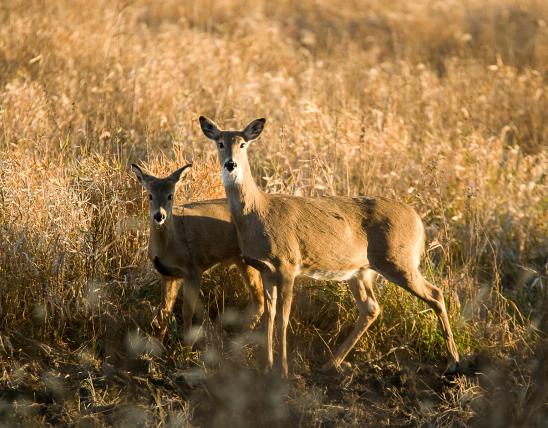
By summer we begin to see white-tailed deer fawns as they chase each other in circles around the fields at sunset. Their mamas keep close watch, occasionally warning them of threats with foot stomps and nostril blows. As fawns mature, they become quite obstinate, requiring firmer direction from their anxious mothers. Summer also brings mature bucks with velvety antlers, often traveling in groups of three or four. Bucks in velvet are spectacular when backlit by the sun at daybreak.
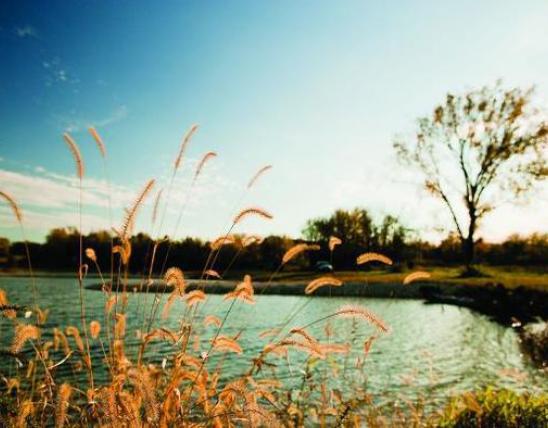
I spend a lot of time at the pond in summer as it attracts a variety of critters. I enjoy watching raccoons as they use their sensitive paws to feel the bottom for invertebrates. On rare occasions I might spot a mink that has wandered up from the Bourbeuse River. Deer often bring their fawns to the pond for a drink in the morning before they stash them in a safe place to spend the rest of their day. Sometimes we get a nesting pair of green herons. I like to photograph them catching tadpoles and salamanders for breakfast. Later in summer, their young squabble over the best floating logs from which to hone their hunting skills.
Fall
Fall is the season for rutting deer bucks with majestic antlers, shed of their velvet cover but often festooned with strips of bark from a favorite rub. They are so focused on breeding, they become less wary, a bonus for photographers. Fall is also a great time to photograph striped skunks as they fatten up for winter. I’ll never forget the time a skunk approached me as I sat in my turkey chair along a brushy fencerow. It came all the way in and began sniffing my shoe. I didn’t dare budge; I just waited until it lost interest and moved on down the line.
I often see barred owls in fall as they scan the fields for voles. One barred owl, we call Buddy, has hunted from the same cedar trees for years. He also frequents a fence post that marks a drainage pipe in the field behind our house. Buddy doesn’t seem to mind when I set up nearby. One time he swept down and caught a vole so close to my pop-up blind that he brushed a wing against the tent.
Fall is a great time to watch young critters as they begin to venture into the fields. One November afternoon I was thrilled to see a pair of bobcat kittens along a tree line next to the field behind our house. They spotted me right away, but I managed to capture a few images from our deck before they faded back into the woods. Bobcats are nocturnal to a fault, at least from a photographer’s standpoint, so any sighting is a golden opportunity.
Winter
Winter is my favorite time to photograph coyotes, imposing in their luxuriant, cold-weather coats. I’m always trying to catch one in mid-pounce before it plunges its muzzle into the snow to extract a fat vole. Deer are also beautiful in winter, especially with fresh snow on their winter coats of gray.
On extremely cold days, Joyce and I enjoy watching bluebirds gather in the heated water dish on our deck, sometimes seven or eight at a time. After a snowfall, I look for cardinals and blue jays, brilliant against the white landscape. Sometimes in winter we get a visit from a flock of American tree sparrows. They come to feed in the Indian grass, riding the tall stems to the ground as they gorge on seed.
I never tire of watching and photographing Missouri wildlife through the changing seasons on the farm. Each day is filled with new possibilities. Capturing wildlife images right out my back door is an opportunity I don’t take for granted. Perhaps that’s why I’m so compelled to share my experiences.


Also In This Issue

These ancient and long-lived species are important to the state’s ecosystem

The long-absent whistles of quail are returning due to new management techniques
And More...
This Issue's Staff
Editor – Angie Daly Morfeld
Associate Editor – Larry Archer
Photography Editor – Ben Nickelson
Staff Writer – Kristie Hilgedick
Staff Writer – Joe Jerek
Staff Writer – Dianne Van Dien
Designer – Marci Porter
Designer – Kate Morrow
Photographer – Noppadol Paothong
Photographer – David Stonner
Circulation – Marcia Hale