


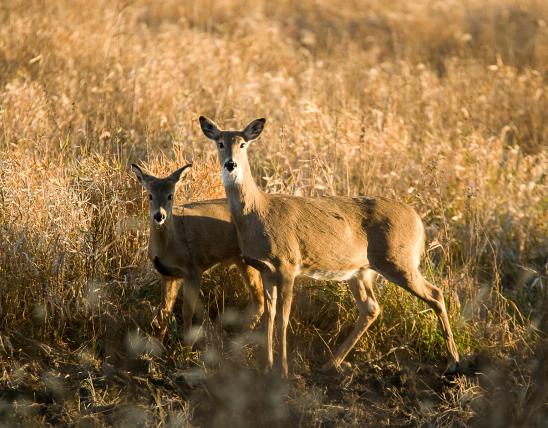






This amendment permits the use of additional fencing materials, allows existing live trees with six inch (6") or greater diameter at breast height to remain on existing facilities, and simplifies fencing standards for confined cervids while assuring the animals are confined in humane and sanitary conditions and in ways that prevent ingress and egress of those animals.
Acknowledgements
Title 3 – Department of Conservation
Division 10 – Conservation Commission
Proposed Amendment
Proposed Amendment
(3) Cages, pens, or other enclosures of individuals permitted to hold cervids shall meet the standards and requirements provided in this section[ no later than June 30, 2016. New permits for holding cervids on or after January 30, 2015, will be limited to individuals who meet the following fencing and holding requirements]:
(A) Cages, pens, or other enclosures.
1. All fencing shall extend at least a minimum of eight feet (8') high for its entire length, and consist of not smaller than twelve and one-half (12 1/2) gauge woven or high-tensile woven wire, [fourteen and one-half (14 ½) gauge high-tensile woven wire ]not smaller than six (6) gauge welded wire, not smaller than nine (9) gauge chain link, or wood planks. [Strands of barbed wire shall not be used to achieve the maximum required height.]
2. Spacing between vertical wires and wooden planks shall not exceed six and one-half inches (6 1/2").
3. If two (2) [woven wire ]or more fences are combined, one (1) above the other, the [woven wire ]fences shall be overlapped at least six inches (6") and firmly attached to each other at intervals no greater than three feet (3') or combined and firmly attached to each other at intervals no greater than [six inches (6") ]twelve inches (12”) apart[ with hog rings].
4. The fence [bottoms ]shall be installed and maintained to provide not more than three inches (3") of ground clearance for its entire length.
(B) Right-of-way.
1. The fence right-of-way shall be cleared of woody vegetation less than six inch (6”) diameter at breast height for a minimum distance of six feet (6') on the outside of the fence on land(s) under his/her control and six feet (6') on the inside of the fencing For enclosures and additions constructed after April 30, 2018, the fence right-of-way shall be cleared of all woody vegetation for a minimum distance of six feet (6') on the outside and the inside of the fencing.
2. [The permit holder shall fell all ]All dead trees with a height greater than the distance to the fence on land(s) under his/her control shall be felled.
(C) [Fence posts. ]Fence posts shall extend at least a minimum of eight feet (8') high, shall be of sufficient strength, and placed to maintain fence integrity.
[1. Fence posts shall extend at least a minimum of eight feet (8') high and shall be of sufficient strength to maintain fence integrity.
2. Pine wood posts shall be treated.
3. Wood and steel pipe posts shall be set to a minimum depth of three feet (3').
4. Metal T-posts shall be installed according to manufacturers’ specifications.
5. Metal U-posts shall be of a sufficient strength to support the fence.
(D) Line posts.
1. Wooden line posts shall be a minimum of four inches (4") in diameter and shall not be spaced more than twenty-four feet (24') apart.
2. Steel pipe line posts shall—
A. Be a minimum of two and three-eighths inches (2 3/8") in outside diameter; and
B. Not spaced more than twenty-four feet (24') apart.
3. Metal “T” and “U” line posts shall be spaced no more than twenty feet (20') apart.
4. If the woven wire is not high tensile, there shall be a wooden or steel pipe post every sixty feet (60').
5. Line braces shall be used at least every one thousand feet (1000') of straight line distance and, if necessary, at shorter intervals to sufficiently support the fence.
(E) Corner and end posts.
1. Wooden corner and end posts shall be a minimum of five inches (5") in diameter.
2. Steel pipe corner and end posts shall be a minimum of two and seven-eighths inches (2 7/8") in outside diameter.
3. Corner and end posts of other materials shall be of sufficient strength to maintain fence integrity and must be approved by the department prior to installation.
4. Corner and end posts must be set in concrete and braced in a manner to sufficiently support the fence.]
[(F)](D) Gates shall be[— ]locked, latched, and constructed to meet or exceed the standards of the fence.
[1. Constructed to meet the specifications of the fence;
2. Equipped with at least one (1) latching and one (1) locking device; and
3. Gate support posts must be braced in a manner to sufficiently support the fence.]
[(G)](E)Water gaps and stream crossings[.] shall be constructed and maintained in a condition to prevent ingress and egress of cervids at all times.
[1. Swinging water gaps and stream crossings shall be constructed to equal or exceed the standards of the fence.
2. These crossings shall be adequate to prevent ingress and egress during high water.
3. Permissible water gaps are as follows:
A. Swinging gates constructed to match the contour of the stream supported by a galvanized steel cable or hinge. Cable shall be a minimum of five-eighths inch (5/8") in diameter;
B. Pipe with swinging barrier;
C. Pipe with fixed mesh barrier; and
D. Heavy gauge woven barrier contoured to fit the gap.]
[(H)](F) If topographic, natural, or other conditions exist that enable cervids to pass through, under, or over the fence, the permit holder shall be required to supplement the fence with additional, stronger or higher fence posts, special grading, additional fencing[ wire to increase fence height], or other measures to prevent [escape ]ingress and egress of cervids at all times.
[(I)](G) Fencing shall be maintained in a condition to prevent [an escape ]ingress and egress of cervids at all times.
AUTHORITY: sections 40 and 45 of Art. IV, Mo. Const. and section 252.040, RSMo 2016. This rule was previously filed as 3 CSR 10-3.020. Original rule filed Nov. 2, 1984, effective Feb. 11, 1985. For intervening history, please consult the Code of State Regulations. Amended: Filed December 14, 2018.
PUBLIC ENTITY COST: This proposed amendment will not cost state agencies or political subdivisions more than five hundred dollars ($500) in the aggregate.
PRIVATE ENTITY COST: This proposed amendment will not cost private entities more than five hundred dollars ($500) in the aggregate.
NOTICE TO SUBMIT COMMENTS: Anyone may file a statement in support of or in opposition to this proposed amendment with Regulations Committee Chairman, Department of Conservation, P.O. Box 180, Jefferson City, MO 65102-0180, or via the department’s website at http://short.mdc.mo.gov/Z49. To be considered, comments must be received within thirty (30) days after publication of this notice in the Missouri Register. No public hearing is scheduled.