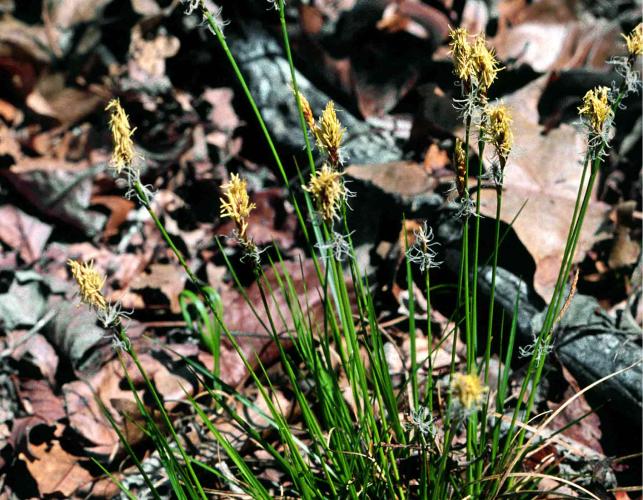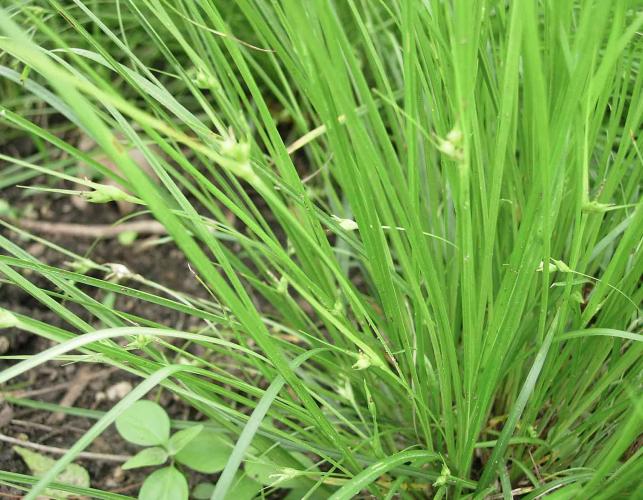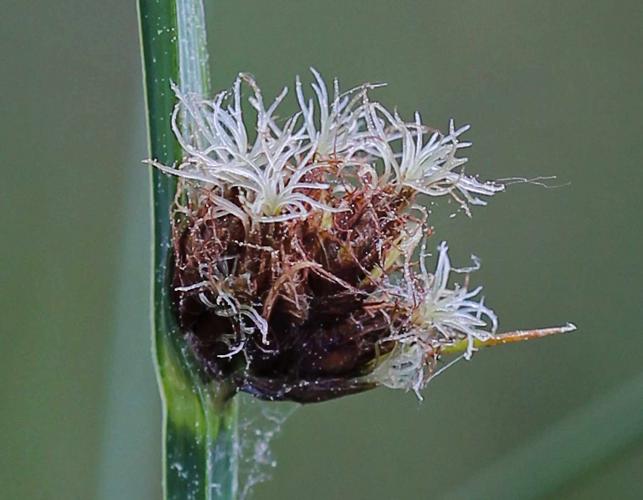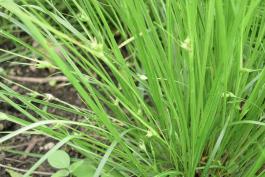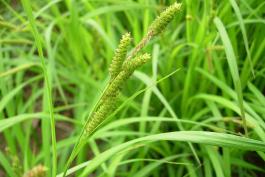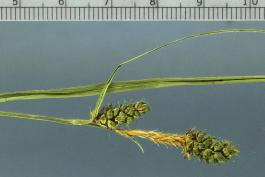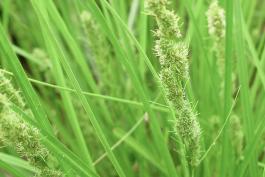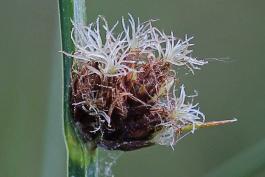







Sedges, like grasses, are nonwoody annuals or perennials with linear, parallel-veined leaves whose lower portions sheath the stems. The flowers are spikelets or spikes; each tiny flower lacks petals and sepals but is enclosed in scales (tiny bracts). The spikes can be in arranged into panicles headlike clusters, or umbels.
Key features of sedges:
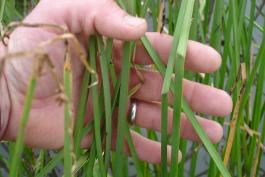
- The stems are very often triangular in cross-section and are solid, not hollow.
- The leaves are usually 3-ranked (they come out on 3 sides of the stem) (while true grasses are 2-ranked, opposite).
- The leaf sheaths are usually tightly closed or fused (in grasses, the sheaths are split open lengthwise).
- The flower clusters often have 1 or more leaflike bracts spreading out from the base.
- The fruits are 2- or 3-sided achenes (dry, single-seeded fruits that don’t split open).
Missouri has 16 genera of sedges (family Cyperaceae), comprising more than 200 species. Globally, there are about 4,000 species in the sedge family.
- Identifying the various sedge species is tricky even for botanists, who often need to see the rootstocks and use microscopes to examine tiny details of the nutlike fruits.
- It’s not hard, however, to learn some basics about the sedge family. Start by memorizing the phrase “sedges have edges,” which will help you remember their distinctive triangular stems. In many cases, you can tell a plant is a sedge just by feeling the stem!
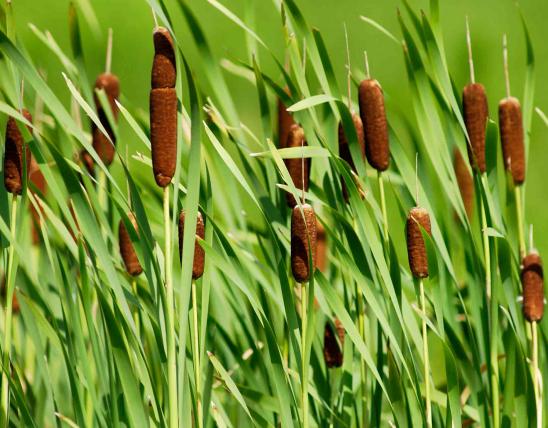
Similar species: Plants in the rush family typically have basal leaves; round, solid stems; and flowers with 3 sepals and 3 sepal-like petals. Their fruits are many-seeded capsules that split open lengthwise.
Height: some species to 4 feet, but most are much shorter.

Statewide. Some species are fairly widespread and common. Others are rare or limited to certain parts of the state.
Habitat and Conservation
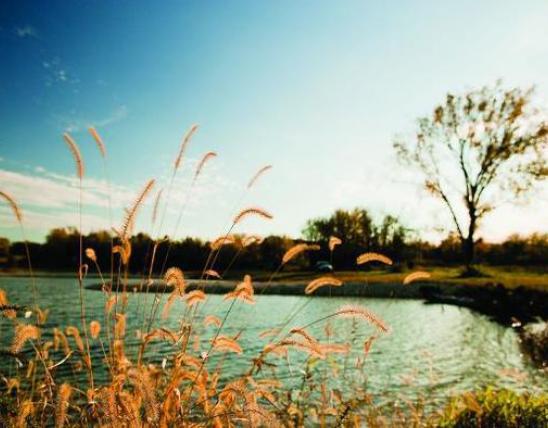
Sedges are usually found in wet habitats: margins of ponds, lakes, creeks, rivers, sloughs, wetlands, bottomland forests, and so on. Some species grow right in the water, some along the edges.
Some species live in prairies, glades, and upland woodlands.
Some are weedy and grow in yards, gardens, and vacant lots, and along roadsides and railroads.
Status
Missouri has about 219 species of sedges; 10 of these are introduced.
More than 60 Missouri sedges are species of conservation concern; several of them are listed as critically imperiled.
Human Connections
Some sedges are used as ornamentals, especially in water gardens.
Ancient Egyptians used one species to make papyrus paper, and its buoyant stems to make boats. The infant Moses’s basket may have been woven from sedges.
Parts of some species of sedges are edible. Chinese water chestnuts are the corms (rootstocks) of one type of sedge.
Considering the family’s very large size, sedges have a low direct economic importance for humans.
Ecosystem Connections
Sedges are very important for stabilizing soils in wetlands and stream and lake margins. During floods, their dense root systems help prevent soil from washing away. The entire plants help absorb the sheer force of fast-flowing water.
Their fruits provide food for many kinds of waterfowl and other animals.
Dense stands of sedges provide important habitat for the huge variety of animals that live along or visit water edges.
One species, sawgrass (Cladium jamaicense), is the dominant plant in the Florida Everglades.