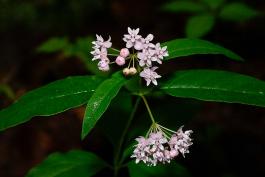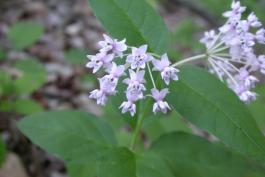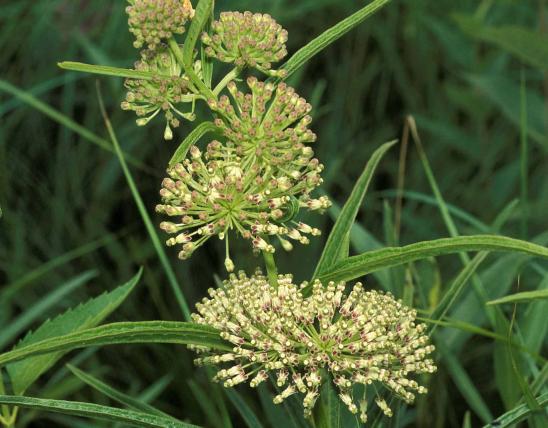











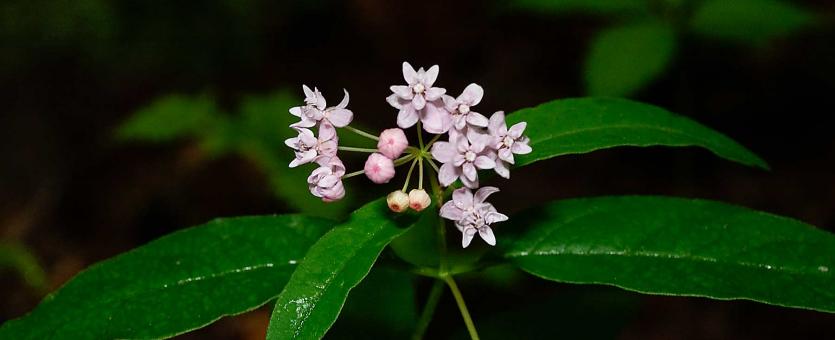
One of our earliest blooming milkweeds, fourleaf milkweed bears round clusters of pink or cream-colored flowers. As the common names suggest, at least some of the leaves are arranged in whorls of 4. It is usually associated with woodlands.
Fourleaf milkweed is a slender, single-stemmed perennial. The sap is milky white.
The flowers are technically in loose umbels, either upright or drooping, with 1 to 3 umbels per plant, light pink, pale lavender, or cream-colored, nicely fragrant.
Blooms May–July.
The leaves are opposite or whorled. There are 3 or 4 sets of leaves, of which 1 or 2 of the upper sets has 4 leaves in a whorl, the other sets with 2 leaves. The leaves are broadly lanceolate, pointed at both ends.
Key identifiers:
- Usually grows in woodlands
- Flowers have the typical form of milkweeds
- Flowers pale: pink, lavender, or off-white
- Plant is rather delicate, compared to other milkweeds
- At least one set of stem leaves are in a whorl of 4.
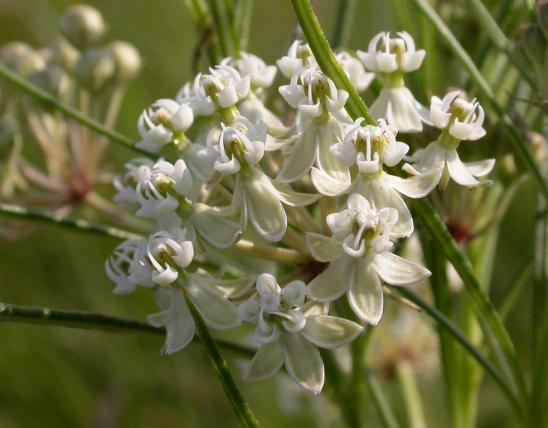
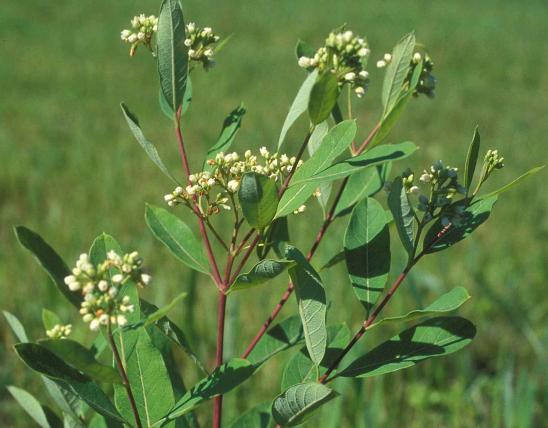
Similar species: Similar in name: Asclepias verticillata, sometimes called horsetail milkweed, is also called whorled milkweed. It looks much different, bearing 3–6 soft, narrow, threadlike leaves per whorl and has white or greenish-white flowers. It grows in sunny upland prairies, fields, glades, and is not commonly found in the woods.
Learn more about Missouri's milkweeds on their group page and on the several other individual species pages in this guide.
Height: normally 12–18 inches, but occasionally taller.
Scattered nearly statewide, but apparently absent from the Mississippi Lowlands of the Bootheel and from the western portion of the Glaciated Plains (northwestern Missouri).
Habitat and Conservation
Occurs in open, dry, or rocky woods, usually on upland slopes.
Its smaller and rather delicate habit, and it woodland habitat, set it apart from most of our most familiar milkweed species. Most other Missouri milkweeds are stout, robust plants that favor prairies, pastures, and other open, sunny places.
Status
Native Missouri wildflower.
Human Connections
Milkweeds have a long list of historical medicinal uses.
Milkweeds are increasingly popular in native plant gardens, because people are wanting to help the declining populations of monarch butterflies, which use milkweeds as their larval food plants. If you are wanting to put native wildflowers in your garden, be sure to get them from reputable native wildflower nurseries, or else collect seeds and cultivate from them.
Ecosystem Connections
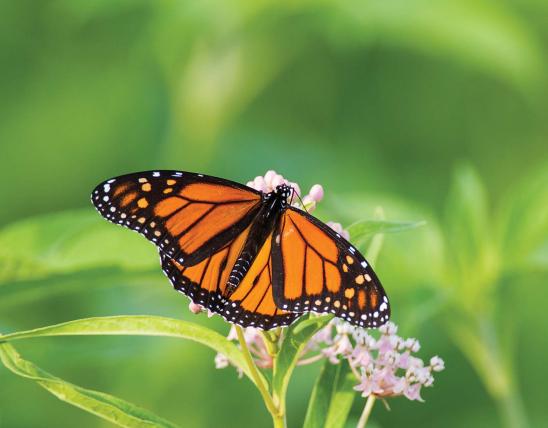
The cardiac glycosides and other chemicals in the milky sap (latex) are unpalatable and toxic, so few herbivores eat milkweeds. The larvae of monarch butterflies, however, use milkweeds as a food plant. They store the toxins in their bodies, rendering them unpalatable to predators.
The entire former milkweed family (Asclepiadaceae) has recently been rolled into the dogbane family (Apocynaceae). For many years, botanists have known the two families were closely related. The milkweed group, with its distinct floral structures, is still considered a unique subfamily or tribe of the dogbane family. As you consult various sources, you can expect to see milkweeds grouped in either family.