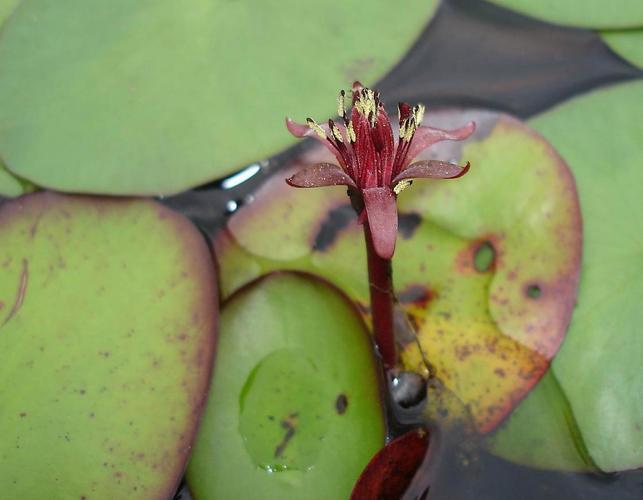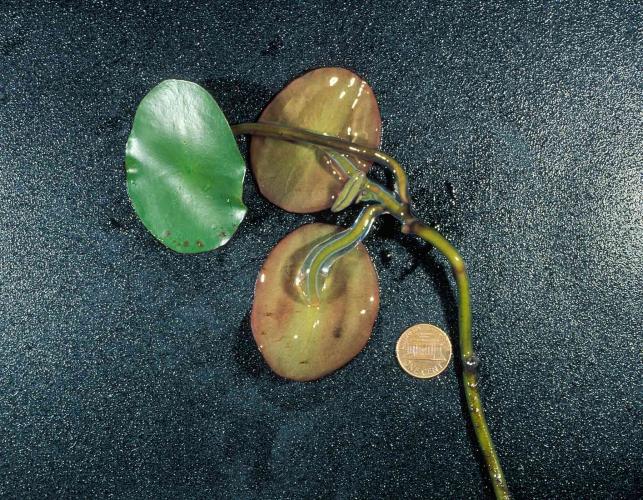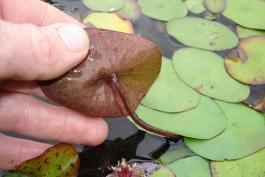










Water shield is a perennial aquatic plant with long, branching stems and floating oval leaves that may reach 4–5 inches in length and resemble small water lily leaves, only without a split. There is a thick, jellylike covering on the young stems, buds, and lower leaf surfaces. The underwater parts have a reddish or purplish tinge. It spreads quickly via rhizomes.
The flowers are small, reddish purple, and not showy; they are held above the water’s surface.
Similar species: Water lilies (Nymphaea spp.) have large, showy flowers and leaves that are split or cleft.
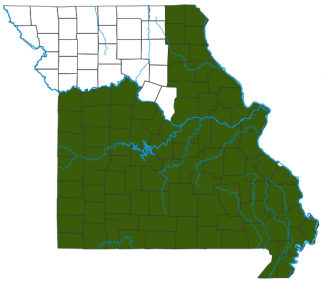
Scattered, mostly in southern and eastern Missouri.
Habitat and Conservation
Water shield is a floating-leaved aquatic that lives in ponds, lakes, and sloughs.
Status
Native North American aquatic plant. Often considered a nuisance aquatic plant.
Control
Human Connections
Young, tender leaves and shoots have served as salad greens and as a delicacy in Japan and China. The tuberous roots were eaten by Native Americans in California.
This native plant is often considered a nuisance in farm ponds and shallow lakes; it grows rapidly and can cover large portions of the water's surface, reducing the amount of light and oxygen that gets into the water.
Ecosystem Connections
The thick, jellylike coating of the submerged parts probably retards drying out of the plants when water levels drop during droughts. It may also deter animals — from mammals to snails — from eating the leaves.
The floating leaves afford shade and shelter for fish and other aquatic organisms. But it is also one of the worst nuisance plants in Missouri’s shallow ponds and lakes. It spreads rapidly and can cover the surface of a pond in a few years, keeping light and oxygen from penetrating the water.
Worldwide, this is the only species in the genus Brasenia. Its closest relatives are in the genus Cabomba, including the fanwort that is a popular, feathery-looking aquarium plant. Except for the flowers, fanwort looks quite different from water shield.