









Spicebush Swallowtail
This colorful caterpillar wears a disguise. The dark spots on its head make it look like a snake, which scares away hungry birds. Caterpillars have special spit glands that make silk. Spicebush cats use the silk to bind leaves into tubes. They hide inside these tiny tents during the day and come out after dark to gobble spicebush and sassafras.
White-Marked Tussock Moth
After hatching from an itty-bitty egg, a tussock moth caterpillar dangles on a thread of silk. When the breeze blows, the silk snaps, and the baby insect gets carried away like a hang glider. Wheee! This cat’s fluffy fuzz makes it look like a Muppet, but don’t touch it! The hairs have barbs that work their way into your skin and cause an itchy rash.
Imperial Moth
The main job of a caterpillar, like this imperial moth, is to eat. In fact, they eat so much, so fast, that they outgrow their skin and have to shed it (molt) several times. Biologists call the periods between molts “instars.” Most caterpillars go through four or five instars before turning into a moth or butterfly.
Io Moth
To hungry birds, caterpillars look like wiggly sausages. Since they’re too slow to wiggle away, many cats, like this io caterpillar, are armed with poison-tipped spines that pack a painful punch. Because of this, it’s smart to avoid touching any caterpillar unless you’re sure it’s safe.
Hickory Horned Devil
This fierce-looking leaf-eater is Missouri’s largest caterpillar. Before turning into fuzzy, colorful regal moths, hickory horned devils can grow nearly 6 inches long — about the size of a hot dog. Though they look dangerous, this cat’s spikes are only for show. They can’t hurt you.
Eastern Tiger Swallowtail
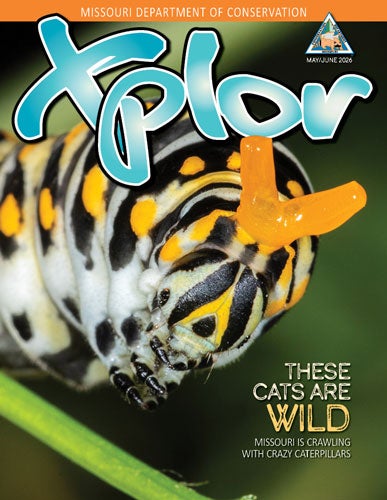
Missouri has six kinds of swallowtail butterflies, and all of the caterpillars have a Y-shaped organ that pops out when they’re scared or angry. It’s called an osmeterium (oz-meh-tear-ee-uhm), but “stink horn” might be a better name. It smells awful and makes predators, like spiders, rethink their meal choice.
Zebra Swallowtail
This pretty caterpillar has an ugly side. Although it loves to munch on the leaves of pawpaw trees, this cat is also a cannibal, which means it eats other caterpillars. That’s why zebra swallowtail moms usually lay only one egg on each plant.
Spotted Apatelodes
This fantastically fluffy fella makes most hairy caterpillars look clean-shaven. Its flowing locks, which can be either white or yellow, are so shaggy that most people never notice the caterpillar’s surprisingly colorful legs. Under the fuzz, each proleg is bright red, as if it were wearing a ruby slipper.
Beautiful Wood-Nymph
Moths and butterflies are often more beautiful than the caterpillars they come from. But that’s not always the case, and the beautiful wood-nymph is a good example of the exception. The stunning orange-and-white-striped caterpillars turn into moths that look like … well, poop.
White-Lined Sphinx Moth
When threatened, sphinx moth caterpillars lift up the front half of their body like a rearing horse. This reminded early biologists of the Sphinx, an enormous statue in Egypt that has the head of a human and the body of a lion.
Saddleback Caterpillar
This caterpillar takes its name from the brown, saddle-shaped spot on its back. But even if you were tiny enough to ride this cat, you wouldn’t want to try. Its spikes are tipped with venom that causes a painful sting, upset stomach, and, in rare cases, life-threatening symptoms.
Black Swallowtail
When it’s time to turn into a butterfly, a black swallowtail caterpillar uses silk to tie both its bottom and its back to a sturdy twig. Then the caterpillar’s skin splits open to reveal a chrysalis (kris-uh-liss), which dangles from the twig like a leaf.
Giant Swallowtail
This caterpillar doesn’t mind being told, “You look like poop.” In fact, it loves looking like poop, specifically bird droppings. Why? Because bird droppings are splattered nearly everywhere, and nothing eats poop. In other words, the scat-tastic camouflage keeps the cat safe from caterpillar crunchers and munchers.
Cecropia Moth
Not only is the cecropia caterpillar brilliantly colored — with red, orange, yellow, and blue bumps on a neon-green body — it also turns into Missouri’s largest moth. Adult cecropia moths have a wingspan that can stretch over 6 inches, which is about as big as a tea saucer.
Isabella Tiger Moth
Some folks think you can predict winter weather by looking at the stripes on an Isabella tiger caterpillar (aka woolly bear). If the brown stripe is wide, winter will be mild. If it’s narrow, winter will be cold. As you might expect, when you compare one woolly bear to another, their stripes are often different sizes, which means they have nothing to do with forecasting the weather.
Curve-Lined Owlet
These perfectly pokey caterpillars are tough to find because they live on (and eat) something just as spiky as they are: greenbrier brambles. When threatened, this camouflaged cat bends the front half of its body into a tight “U.” With its spike sticking up, it looks nearly identical to a brier thorn.
Variegated Fritillary
Variegated fritillaries are stunning at every stage of their life. Adults have wings checkered with orange, tan, and black. Their golden-colored eggs look like tiny cobs of corn. Caterpillars sport black spikes and are lined with orange and white stripes. And the chrysalis, perhaps most stunning of all, gleams like pearl flecked with gold.
Monkey Slug
A monkey slug is neither a monkey nor a slug. It’s the larva of a hag moth. The furry “tentacles” covering its back aren’t legs — the real legs are hidden beneath all that fur. Monkey slugs can lose a tentacle or two without serious injury. This lets them slip away from predators while the predator is busy trying to choke down a furry fake leg.
Polyphemus Moth
A polyphemus caterpillar weathers winter by snuggling inside a sleeping bag made of leaves. In the fall, the chunky hunk of a caterpillar uses silk to lasso leaves and tie them around itself. Then, it spins a silky cocoon. Over time, the silk hardens into a fuzzy, protective shell, which keeps the pupa safe until it emerges as a moth in May.
Eastern Comma Butterfly
Although they’re covered with scary-looking spikes, eastern comma caterpillars are OK to touch. Just don’t try to eat one! The multiple-spiked spines are thought to make these inch-long cats tough to swallow for birds, lizards, and other predators.
Hummingbird Clearwing Moth
Butterflies and moths are insects, and all insects have six legs. So why does this clearwing caterpillar look like it has 10? Biologists call the appendages in the middle and back end “prolegs.” Caterpillars use them to grip and climb. If you look closely, you can see the “true legs.” They’re the little blackish-brown things just behind the cat’s head.
Pipevine Swallowtail
The orange and black colors of a pipevine caterpillar are nature’s way of warning predators to back off! These cats eat pipevine, a poisonous plant. The poisons don’t harm the baby swallowtails, but they do make them taste terrible to would-be predators.
Monarch
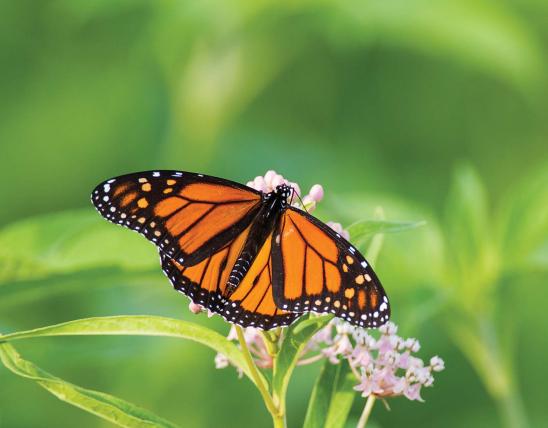
You are what you eat, and the only thing monarch caterpillars munch is milkweed. Over a dozen kinds of milkweed grow in Missouri, and all of them are poisonous. The poisons don’t harm the hungry caterpillars. In fact, they store the poisons in their bodies, which makes them toxic, too.
Geometrid Moth
Can you spot the caterpillar in this photo? It’s the tiny twig sticking up from the branch. Along with their impressive imitation skills, geometrid caterpillars have an interesting way of walking. Also known as inchworms or loopers, they hunch their backs and pull their rear set of legs up to meet the front set, and then they move the front set forward to “inch” along.
Some are huge. Some are hairy. Some are spiky. Some look scary. Some are pretty. Some are not. Some, literally, look like snot. Welcome to the wild world of caterpillars.


Also In This Issue

Lots of critters lay eggs. But what do mom and pop — or, in some cases, other animals — do with the eggs after they’re laid? It depends …
And More...
This Issue's Staff
Photographer – Noppadol Paothong
Photographer – David Stonner
Designer – Marci Porter
Art Director – Ben Nickelson
Editor – Matt Seek
Subscriptions – Marcia Hale
Magazine Manager – Stephanie Thurber