











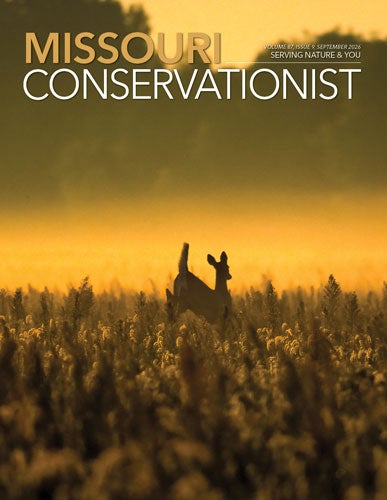

The word “wildlife” conjures up different images for different people. For some, it’s a songbird perching on a branch, a turtle sunning on a log, or a squirrel scampering up an oak tree. But for many, the image that comes to mind is of the white-tailed deer — a staple of our landscape. Many Missourians, like Mike and Dana Blevins, enjoy seeing this large, majestic mammal on their 300-acre property in Perryville.
“We take the side-by-side out with our grandkids, and we will always see deer,” they said. “Watching them year-round is a way we monitor the herd.”
White-tailed deer are an iconic species, one Missourians, including the Blevins and many others, care deeply about.
White-Tailed Deer History
As abundant as white-tailed deer are today, it’s difficult to imagine Missouri without them. However, a century ago deer almost disappeared from the Show-Me State due to widespread habitat destruction and unregulated harvest.
The Blevins have experienced the difference quality habitat can make to the herd.
“The previous owner of the property allowed high hunting pressure, ran cattle in the woods, and didn’t manage the land for a healthy deer herd,” they said.
Since purchasing the property in 1992, they started implementing habitat management practices, recommended by an MDC biologist, to increase deer numbers.
Today, Missouri has an abundant deer herd and nearly half a million people pursue them during hunting seasons. Yet, despite this success story and a now thriving herd, a threat looms large — chronic wasting disease (CWD). Although relatively rare in most areas of the state, if enough deer become infected with the disease, Missouri’s hunting culture and deer herd will be forever altered.
What is CWD?
CWD is a deadly, contagious disease of white-tailed deer and other members of the deer family, including elk, another native Missouri species. CWD can spread when deer encounter each other or from the infectious proteins shed into the environment by an infected deer. At first, the disease spreads slowly within a deer herd. But if not managed, it begins to spread more rapidly, eventually infecting more deer.
What has Missouri Done?
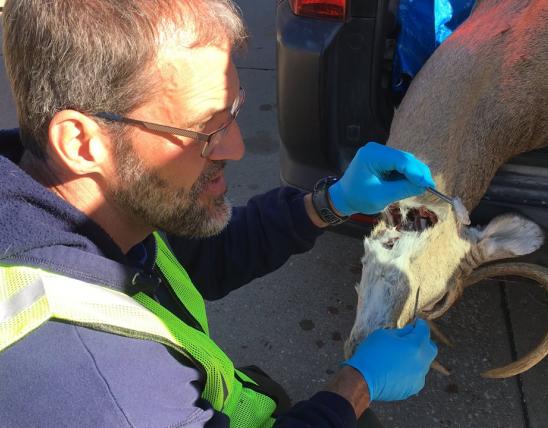
MDC began testing deer for CWD over 20 years ago. Nearly 33,000 deer were tested across the state before the disease was first found in north-central Missouri in 2010. Because CWD was found early, MDC worked with hunters and landowners to embark on what would be the largest localized CWD response effort ever undertaken by a state wildlife agency.
Dave Murphy, a Clark County landowner and former conservation commissioner, has tested every deer harvested off his property since MDC began testing deer for the disease. He also worked with MDC to manage CWD when it was eventually found near his property.
“I liked the ability to figure out [with MDC] what we were comfortable with doing,” Murphy said.
Murphy relied on friends and family to harvest additional deer from his property at a rate where he was comfortable. Landowners have always determined whether CWD management occurs on their property and the number of deer removed.
When the Blevinses heard CWD was discovered in Missouri, they started educating themselves about the disease.
“We owned an archery shop and wanted to make sure we could provide correct information to our customers,” said Mike Blevins.
They have also participated in post-season targeted removal efforts. Even with the removal of additional deer, both Murphy and the Blevinses have successful deer seasons each year, harvesting enough deer to feed their families and donate to the Share the Harvest program.
Over time, thousands of landowners, hunters, and other conservation partners have worked with MDC to safeguard the herd, and these efforts have been recognized nationally as a model of success.
Because of effective management, 15 years after the disease was found in the state, less than 1 percent of deer test positive for CWD. Even in the counties where the disease was first found, less than 3 percent of deer test positive.
This is proof of what can be achieved by working together to address a significant conservation challenge, and it’s good news for Missouri’s deer herd and for those that care about this important natural resource.
Yet despite this success, a significant challenge remains. Science tells us that once CWD becomes well established, management actions to sustain a healthy herd become more difficult. Keeping infection rates below 5 percent is our greatest opportunity to slow the disease. With infection rates still below this level in most areas, we have a window of opportunity, but it will not stay open forever and may already be closing in some areas.
“We’re really counting on biologists to help manage this and we’re willing to help in any way,” said Mike Blevins when asked about the impact of CWD. “Being proactive is the answer. Keep moving forward.”
Looking to the Future
Targeted removal is backed by science and has proven to be effective in Missouri. However, to keep CWD at bay, considerable effort must be sustained through time. Hunter and landowner support for, and participation in, targeted removal has declined. Because of this, MDC paused targeted removal efforts in December 2025. To continue to be successful in this work, at the scale needed, will take a strong public partnership where hunters and landowners work alongside MDC to keep the herd healthy.
Since announcing the targeted removal pause, MDC has continued to engage with the public to gather input on the future of deer management. These efforts included an online comment opportunity following the announcement, as well as eight deer management community conversations held across the state this spring.
These conversations reinforced the public’s shared commitment to a healthy Missouri deer herd. Participants expressed a desire for clearer information about CWD and MDC’s management efforts, as well as a greater opportunity to serve as partners in future deer management decisions.
As a result of this engagement and our continued evaluation, MDC will not conduct targeted removals this winter and currently has no plans to resume this approach. Instead, MDC will work alongside hunters, landowners, and other key partners to develop a localized approach in which hunter harvest is the primary tool to manage the deer herd and CWD during the regular deer season. This decision does not mean CWD is no longer a concern or that MDC is stepping away from disease management. Rather, it reflects the department’s commitment to working collaboratively with hunters and landowners to identify a sustainable path forward for managing CWD while protecting the long-term health of Missouri’s deer herd. It also does not mean that previous efforts were not effective. Many landowners and hunters were dedicated partners and worked tirelessly. These efforts made a difference and Missouri’s deer herd is healthier because of it. It’s simply time to adapt.
What Does the Future Hold for Missouri’s Deer Herd?
We know from the experiences of other states that we must manage CWD or risk having a heavily infected herd and adverse effects on our strong hunting culture.
“It’s a disease,” said Dana Blevins. “Just like cancer in the body or an invasive weed in a field. Our job is to do what the biologists think is best to address the issue.”
And just like other diseases, CWD spreads silently and causes issues before any symptoms even appear, so early intervention leads to the best outcomes. That is why landowners, hunters, and MDC must partner together to minimize the impacts of CWD to keep the herd healthy.
This fall, MDC will partner with landowners to manage the deer population more intentionally in localized areas where CWD has been found. These efforts will involve encouraging landowners and hunters to harvest additional deer during the deer hunting season. By increasing deer harvest in these areas, CWD will spread less, the herd will be healthier, and quality hunting opportunities will be maintained in the long-term.
The Collaboration Continues
Nearly a century ago, Missourians worked together to restore the deer herd, achieving what seemed like an impossible task. Yet, through cooperation, collaboration, and a shared vision, a remarkable success story was achieved. It would be easy to take what we have for granted, but the threat we’re dealing with is very real. It will take hard work, dedication, and perseverance to preserve our legacy. By continuing to work together and remembering our shared goal of a healthy herd now and into the future, we can ensure the Missourians who follow us can be as fortunate as we are today.
What’s at Stake?
At first, CWD spreads slowly within a herd. For years, only a small number of deer have the disease. Eventually a tipping point is reached when about 5 percent of the herd has the disease. Unfortunately, after the tipping point is reached, management actions to sustain a healthy deer herd become more difficult.
By harvesting additional deer where CWD exists, hunters can protect the herd and keep infection rates below the tipping point. Unfortunately, this is no longer an option in areas of high CWD infection rates.
- Northwest Arkansas:
CWD is the third highest leading cause of death of deer, accounting for 1 in 5 deaths. - Northeast West Virginia:
CWD is the leading cause of death of deer, killing more deer than hunters and predators do. - Southwest Tennessee:
Where CWD infection rates are low, buck harvest is increasing; in counties with high
infection rates, buck harvest is declining. - Southwest Wisconsin:
In Iowa County, near where CWD was first found in the state, buck harvest is declining. The 2024 buck harvest total there was the lowest in 45 years. Just two counties away, where CWD is less common, hunters are harvesting record buck numbers.
These examples paint a bleak picture of what it’s like to hunt in an area with high CWD infection rates. By working together, we can keep CWD infection rates low and maintain a healthy herd and strong hunting culture.
Myth: CWD has never killed a deer
Fact: CWD kills many deer each year where infection rates are high
A study done in Arkansas that tracked deer found that 20% of deer deaths were caused by CWD
Cause Of Death Among Adult Deer in Northwestern Arkansas Where 52% of Deer Have CWD:
Harvest: 32%
Predators: 25%
CWD: 20%
Other Disease: 8%
Other Factors: 6%
Unknown: 9%
Jorge et al. 2025 Arkansas Chronic Wasting Disease Deer Study. University of Georgia
Myth: CWD does not affect deer hunting
Fact: High CWD infection rates result in declining deer harvest
Iowa and Crawford counties, Wisconsin
In 2024, Iowa County, WI, having the higher CWD rate, had the lowest buck harvest in 45 years.
In 2024, Crawford County, WI, having the lower CWD rate, had a record buck harvest.
Myth: CWD management efforts are not effective
Fact: Targeted removal keeps a lid on CWD infection rates
Dane, Sauk, and Iowa counties, WI, stopped targeted removal six years after CWD was detected, and have seen the CWD infection rate rise from below 2% to nearly 12% after targeted removal was stopped. With targeted removal, Linn and Macon counties, MO have seen the CWD infection rate stay below 2% within the 13 years since CWD was detected.
Regulation Changes for 2026
As CWD has expanded, the deer hunting regulations have become more complex. To adapt to changes in CWD distribution and in response to hunter input, the following changes will occur for the 2026 deer season. These changes will continue limiting the effects of CWD on Missouri’s deer herd and simplify regulations for hunters.
- Removing the CWD Management Zone: The CWD Management Zone has been removed. In counties within 10 miles of where CWD has been found, placing feed and minerals for deer continues to be prohibited.
- Changes to Mandatory CWD Sampling: Beginning this fall, MDC will conduct mandatory CWD sampling throughout the state on a four-year rotation. Each county will have mandatory sampling one out of every four years.
- Removing the Antler-Point Restriction (APR): MDC has removed the APR statewide. The APR protects young bucks that travel many miles and can spread CWD long distances.
- Removing the CWD Portion of Firearms Deer Season: Removing this five-day portion of firearms deer season will simplify the structure of the season without significantly affecting harvest.
- Increasing the Acreage for CWD Management Permits: Landowners are now required to have at least 20 contiguous acres in a CWD core area to receive CWD Management Permits. This matches the acreage requirement for Landowner Deer Hunting Permits, reducing potential confusion for landowners.
For more information about deer hunting regulations, visit short.mdc.mo.gov/oce.
What You Can Do to Help
Join MDC to protect Missouri’s deer herd! Hunter, landowner, and partner involvement is critical to managing CWD and protecting Missouri’s deer herd and hunting culture.
- Harvest additional deer if you hunt in an area near where CWD has been found.
- Have your deer tested for CWD.
- Follow the carcass disposal regulations (statewide) and the prohibition of placing feed and minerals for deer (counties within 10 miles of where CWD has been found).
- Educate yourself and others about CWD and the importance of CWD management.
To learn more about the disease and how you can help, visit mdc.mo.gov/cwd.


Also In This Issue

Functional art that echoes through history

A life behind the lens
And More...
This Issue's Staff
Editor – Angie Daly Morfeld
Associate Editor – Larry Archer
Photography Editor – Ben Nickelson
Staff Writer – Kristie Hilgedick
Staff Writer – Joe Jerek
Staff Writer – Dianne Van Dien
Designer – Marci Porter
Designer – Kate Morrow
Photographer – Noppadol Paothong
Photographer – David Stonner
Circulation – Marcia Hale