









Managed Waterfowl Hunts
MDC offers hunting opportunities on intensively managed wetlands across the state
Reservations for managed waterfowl hunts open Sept. 1 and run through Sept. 18. MDC holds managed hunts for waterfowl on 13 intensively managed wetlands. These wetlands offer some of the best public waterfowl hunting opportunities in the state.
There are three ways to obtain a spot on a managed waterfowl hunting area:
- Missouri residents may apply online for a reservation, which guarantees successful applicants a place to hunt on a specific day at a specific area.
- Residents and nonresidents can hunt with a reservation holder for hunting parties up to four people.
- Residents and nonresidents can arrive at a managed waterfowl hunting area and draw for a spot in the morning drawing or “poor-line.”
For more information on managed waterfowl hunts, visit short.mdc.mo.gov/opL.
Waterfowl hunting is also available on numerous conservation areas as well as public and private locations around the state. For more information on waterfowl hunting, check out the Migratory Bird and Waterfowl Hunting Digest 2026–2027 anywhere permits are sold and at short.mdc.mo.gov/4SZ.
by Holly Dentner
Last September, Conservation Agent Makayla Ryan received a call from the local electric cooperative to report suspicious activity near a fiber optic line in Christian County. Technicians had responded to the location due to an outage, and when they arrived, they saw the line had been shot. There were seeds and feathers scattered around a burnt patch of ground, indicating that hunters were shooting doves off the powerline.
“The evidence of the fiber optic line damage and spread seed told us that someone might be hunting over bait,” said Ryan. “I began working the area with Corporal Alex Walker to monitor the situation, and it didn’t take long before we discovered what was going on.”
Shortly after daybreak in mid-September, she heard gunshots coming from the property. She and Walker approached a man and woman who appeared to be dove hunting.
“They were hunting over the baited field and weren’t the property owners,” said Walker. “So, our next step was to contact the landowners to find out more.”
After interviewing everyone involved, the agents learned that both individuals had permission to hunt on the property, and one of them had been hunting on opening day with a larger group of people.
“The landowner had spread the seed and was part of the hunting group on opening day,” said Ryan. “We found out about the additional people involved after speaking with him.”
According to the men, there were seven adults and two juveniles who were hunting on the property on opening day of dove season. They were issued warnings for taking/attempting to take migratory birds by bait. The man caught in person by Agents Ryan and Walker received citations for taking/attempting to take migratory birds by bait and subjecting others to the violations of the baiting rule.
If you have questions about the regulations for hunting doves, contact your local conservation agent. See Page 29 for information.
Dove season runs Sept. 1 through Nov. 29, 2026. For more information, consult the Migratory Bird and Waterfowl Hunting Digest 2026–2027 online at short.mdc.mo.gov/4SZ.
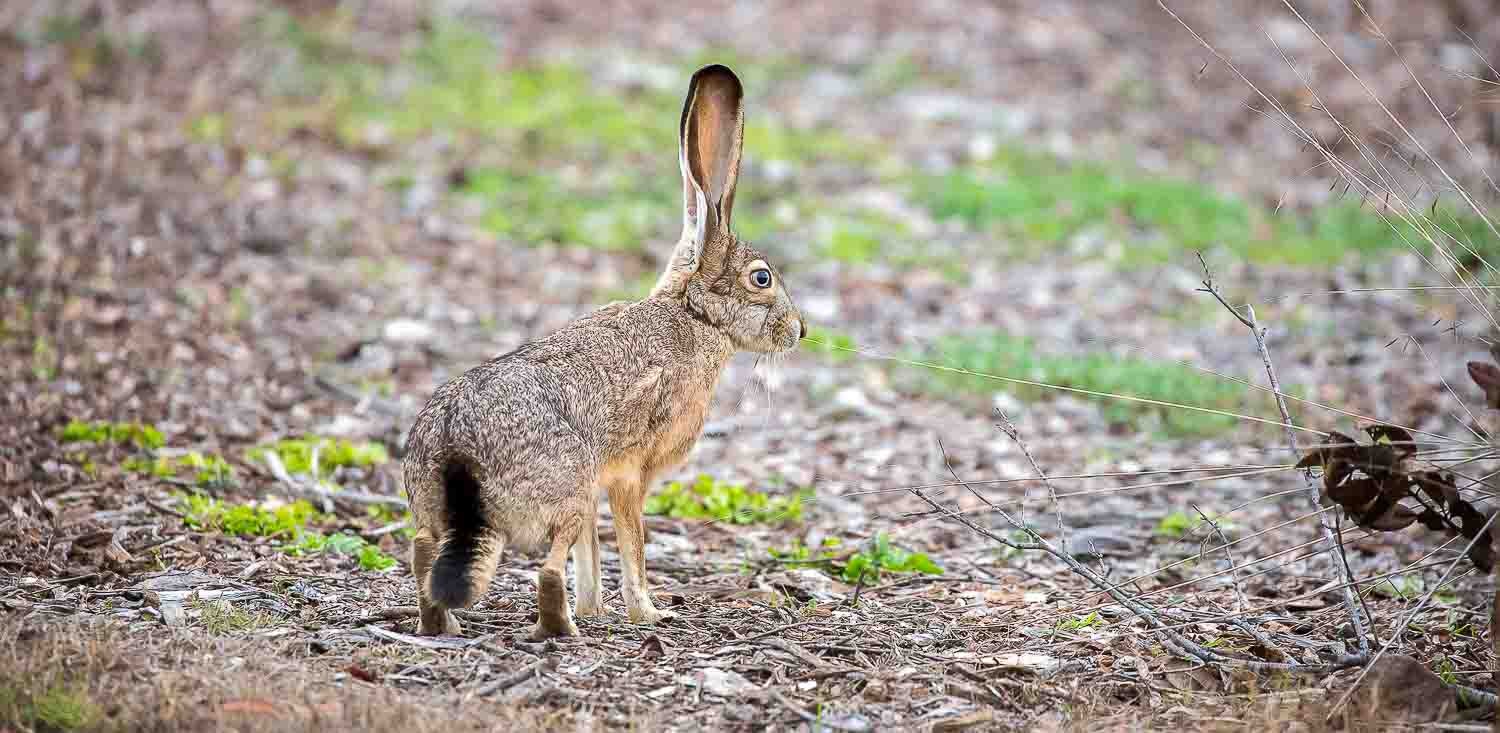
Black-Tailed Jackrabbit
Black-tailed jackrabbits (Lepus californicus) are the largest lagomorph species (rabbits, hares, and pikas) in Missouri. Related to rabbits, the black-tailed jackrabbit is a hare belonging to the genus Lepus (cottontail rabbits are in genus Sylvilagus). Black-tailed jackrabbits, while common in the west and southwest United States, are found only in southwest Missouri in shortgrass prairies, overgrazed dairy farms, and pastures with legumes and crops less than 2 feet tall. A state endangered species, black-tailed jackrabbits have not been officially reported in Missouri since 2009, and most sightings occurred in the 1980s.
Why It’s Imperiled
Since Missouri is on the eastern edge of its range, black-tailed jackrabbits were never common. They likely expanded into Missouri in the 1930s due to the Dust Bowl and overgrazing. The species has likely suffered a natural range reduction due to healthier tallgrass prairie habitats and overhunting. Missouri’s current population may be small to nonexistent.
What Can You Do?
Protect their remaining habitat, including shortgrass prairies and overgrazed agricultural fields, and avoid using nonnative plants such as fescue. Replant fields with native forbs and warm-season grasses and remove woody vegetation in open grasslands. To avoid damage to crops, build rabbit fences using chicken wire or woven wire at least 3 feet high and 6 inches underground.
If you or someone you know has seen a black-tailed jackrabbit in Missouri, please contact Shelly.Colatskie@mdc.mo.gov to report your sighting so MDC can assess their current population.


Title
Answer
Northern Cottonmouth
The northern cottonmouth is a venomous semiaquatic snake. Dark and heavy-bodied, its head is larger than its neck. It gets its name from the whitish lining of its mouth. When alarmed, a cottonmouth typically opens its mouth widely in a defensive posture, showing the cotton-white lining. A bite from a northern cottonmouth is dangerous, requiring immediate medical attention, but most species of venomous snakes are shy and normally avoid people.
George O. White State Forest Nursery
Historically, the Seedling Order Form has been included in the September issue of the Missouri Conservationist. From now on, readers can access the order form online or by calling the nursery to receive a paper copy.
Plan Ahead and Order Early
We accept mail-in orders from Sept. 1, 2026, to April 15, 2027, and online orders from Sept. 1, 2026, to April 30, 2027. We always sell out of some species quickly. To get the plants you want, please submit your order early. Check out our online catalog at mdc.mo.gov/seedlings for all available seedlings.
New This Year
As costs continue to rise for supplies and services, the nursery has made price adjustments due to those increased costs, including those species that take two years to grow.
The price for the following two-year-old species has doubled:
- Eastern white pine
- Hickories
- Pawpaw
- Buckeyes
- Deciduous holly
- American beautyberry
- White fringetree
Due to streamlining inventory, the following nonnative species will not be available:
- Norway spruce
- Loblolly pine
- Pitch x loblolly pine
Due to poor germination or short seed supply, the following species will only be available online while supplies last:
- Pecan
- Red buckeye
- White fringetree
Due to the species not germinating, we will not be able to offer the following species:
- Flowering dogwood
- Mulberry
- Tulip poplar
- Black chokeberry
Cost
Prices range from $0.44 to $2.57 per seedling. Sales tax will be added to all orders unless a tax-exemption certificate is provided. A $9 handling charge is added to each order, regardless of the number of seedlings. In-state shipping is $15 per 100 seedlings with a $15 minimum charge, and out-of-state shipping is $30 per 100 seedlings with a $30 minimum charge.
On the back of this page is an order form that can be mailed or faxed. Visit mdc.mo.gov/seedlings to view seedling descriptions, availability, and pricing.
Three Ways to Order: online, mail, or fax.
Scan the QR code below to place an order online or to download the Seedling Order Form booklet.
If you’d like a paper copy of the Seedling Order Form booklet mailed to you, call 573-674-3229.
To order or check availability, scan the QR code or visit mdc.mo.gov/seedlings
George O. White State Forest Nursery
Missouri Department of Conservation
14027 Shafer Road, PO Box 119 Licking, MO 65542
Fax to: 573-674-4047
You can place your order online starting after midnight on Sept. 1, 2026.
Phone orders are not accepted, but if you have questions about seedlings ordered on this form, or would like to make changes to an existing order, contact the George O. White Nursery at 573-674-3229.
April 15, 2027, last order date
Do not send payment with your order. You will be billed the correct amount.
A convenience fee for any credit/debit card transaction is collected by a third party vendor, Collector Solutions, Inc., not the Missouri Department of Conservation.
Fax your order to 573-674-4047 or mail to:
Trees: Missouri Department of Conservation, PO Box 119, Licking, MO 65542-0119
And More...
This Issue's Staff
Editor – Angie Daly Morfeld
Associate Editor – Larry Archer
Photography Editor – Ben Nickelson
Staff Writer – Kristie Hilgedick
Staff Writer – Joe Jerek
Staff Writer – Dianne Van Dien
Designer – Marci Porter
Designer – Kate Morrow
Photographer – Noppadol Paothong
Photographer – David Stonner
Circulation – Marcia Hale