













Ruby-Throated Hummingbird
Archilochus colubris
Status
Common migrant and summer resident
Size
¾ inches
Distribution
Statewide
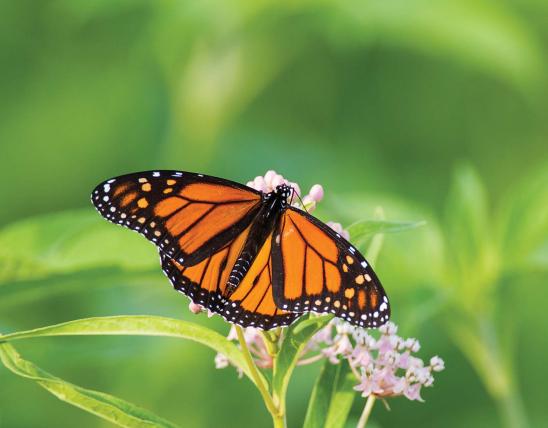
Ruby-throated hummingbirds begin arriving in April, peak in August, and are almost gone by October. These pint-sized birds, with their needlelike bills, hover and fly forward and backward with a humming sound. They also make a variety of chips, squeals, and twitters.
Males are metallic green with a red throat that flashes ruby red in the light but otherwise may look black. Their tails are black and deeply forked. Females are also a metallic green. Their tails are tricolored — green at the base, black in the middle, with three outer tail feathers tipped with white.
Ecosystem Connections
Hummingbirds are important pollinators for many species of plants that require their needlelike bill. For example, hummingbirds serve as the eastern red columbine’s number one pollinator. Their northward migration matches the columbine’s bloom time. In addition, hummingbirds cross-pollinate trumpet creeper as they forage. In fact, the trumpet creeper’s range nearly matches that of the ruby-throated hummingbird.
Human Connections
People love to watch hummingbirds whether they’re buzzing around a nectar feeder or flowers in a garden. Native-plant landscaping is a great way to feed hummers while also decorating your yard. Although red and orange flowers are most attractive to hummingbirds, blue, purple, and white flowers are also visited. Some favorites include beebalm, blazing stars, blue sage, wild columbine, fire pink, foxglove beardtongue, jewelweed, summer phlox, royal catchfly, and Solomon’s seal.


And More...
This Issue's Staff
Editor – Angie Daly Morfeld
Associate Editor – Larry Archer
Photography Editor – Ben Nickelson
Staff Writer – Kristie Hilgedick
Staff Writer – Joe Jerek
Staff Writer – Dianne Van Dien
Designer – Marci Porter
Designer – Kate Morrow
Photographer – Noppadol Paothong
Photographer – David Stonner
Circulation – Marcia Hale