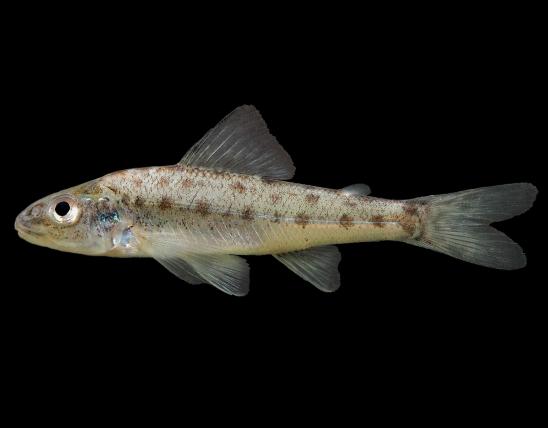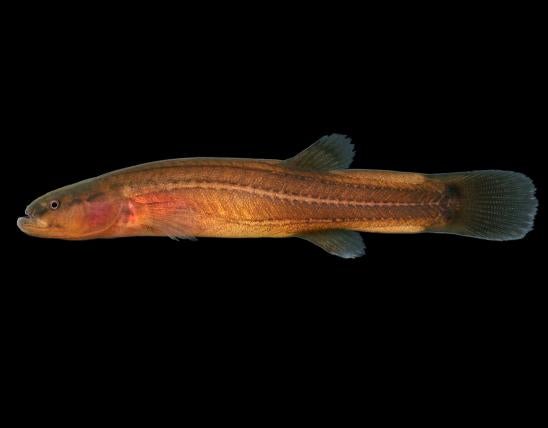













The western pirate perch is a small, grayish fish that is heavily speckled with black. There is a narrow vertical dark bar at the base of the tail fin. another bar is often visible beneath the eye. The fins are dusky. Breeding adults are tinged with purple or violet; breeding males are nearly black. There is only one dorsal fin and no adipose fin. The body is rough to the touch (the scales are rough-edged ctenoid scales); the tail fin is slightly notched, but without a fork. The anus is located far forward on the body, in the throat area; in Missouri, the only other fish with that characteristic are the cavefishes.
Total length: 3 to 5 inches.

Occurs in Missouri's southeastern lowlands and adjacent parts of the Ozarks. Also in a few locations along the Mississippi River.
Habitat and Conservation
Bottomland lakes, overflow ponds, and quiet pools and backwaters of slow-moving streams and ditches. In the Mississippi River, it seems to prefer protected inlets and overflow waters. Inhabits areas with clear, warm water, abundant cover, and no current.
This solitary, secretive fish hides during daylight hours about thick growths of aquatic plants or accumulations of organic debris. Pirate perch venture out to feed at night. Most active at dawn and dusk, living on or near the bottom.
Food
Carnivorous, feeding on aquatic insects, small crustaceans, and small fish. It feeds by sucking in food items when its mouth is opened quickly.
Life Cycle
Pirate perch have a unique spawning method called transbranchioral spawning. As eggs are released from the cloaca, they enter the female’s gill chamber and mouth. The fish then ejects the eggs from its mouth into dense vegetation, where they stick to roots and leaves. The male does the same with milt, ejecting it through his mouth to fertilize the eggs. The location of the cloaca — near the base of the gill chamber — is an adaptation that allows for the easy transfer of eggs from the cloaca to the mouth. Interestingly, in young pirate perch the cloaca is located just in front of the anal fin (as is normal for most fish), but as pirate perch grow and reach sexual maturity, the cloaca gradually moves forward on the body.
More information can be found at Transbranchioral spawning: novel reproductive strategy observed for the pirate perch Aphredoderus sayanaus (Aphredoderidae)
Human Connections
Pirate perch got their name because early observations of these fish noted them eating other fishes. It's clear that pirate perch mainly eat aquatic insect larvae, but the name stuck.
Ecosystem Connections
In Missouri, the pirate perch is most closely related to cavefishes and the trout-perch. It was long thought to be the only species in its family, the Aphredoderidae, and the only other pirate perches were known only as fossils. But in 2024, scientists analyzing genetic data and inspecting fishes from the whole North American range showed that what was once believed to be a single species, Aphredoderus sayanus, "the pirate perch," is actually five species. The species in Missouri has been renamed the western pirate perch, A. gibbosus.
Pirate perches, cavefishes, and trout-perches are thought to be a holdover from an ancient fauna that occupied the Mississippi Valley before the ancestors of most modern-day fishes had migrated into the region. They appear to be the surviving remnants of a larger group that is now mostly extinct.
A study published in 2013 indicated that pirate perches employ an unusual form of camouflage to conceal their presence from their prey. For species such as aquatic beetles and tree frogs that are preparing to lay eggs, it is important to find aquatic habitats without fish, because fish would eat their larvae. They use their sense of smell to detect the presence of fish in the water, and they avoid laying eggs in water that smells like fish. Apparently, however, they cannot detect the presence of pirate perch, so the pirate perch are somehow not emitting an odor, cloaking their odor, or mimicking another odor. It's like a game of espionage between predators and prey.