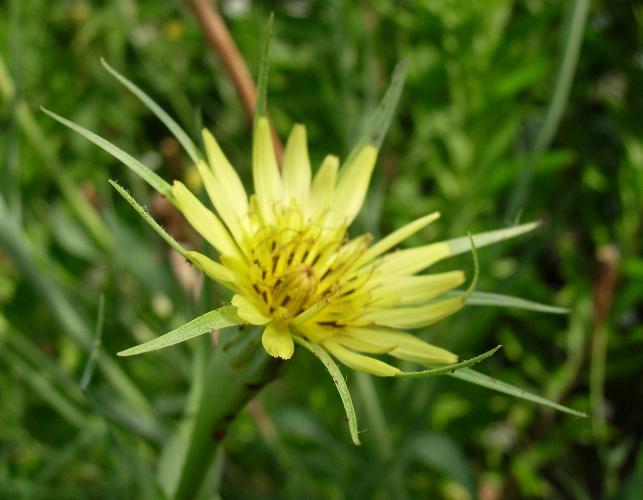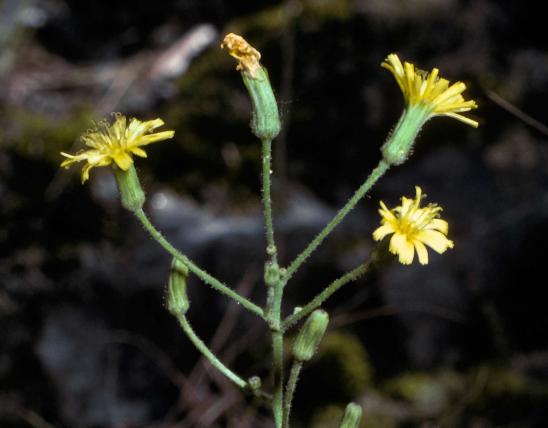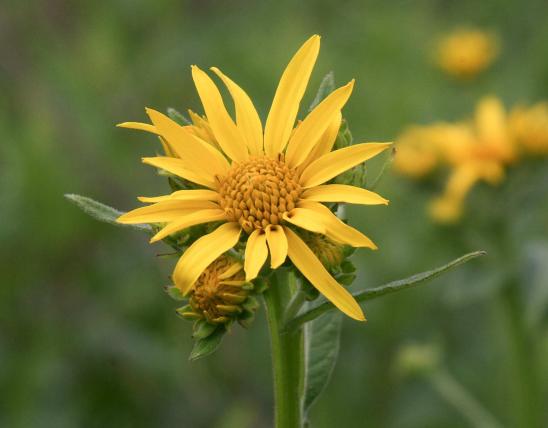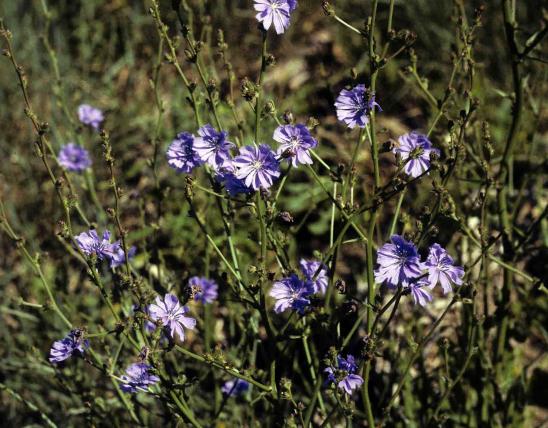













Western goat’s beard, or yellow salsify, has yellow composite flowers and round seedheads of fluffy “parachutes.” It resembles a gigantic dandelion. It's native to Europe, and many people view it as an invasive weed.
Western goat’s beard is a smooth, hairless annual or biennial with one to several fleshy stalks.
The leaves are narrowly linear, both basal and along the stem, the stem leaves clasping and alternate.
The flowerheads are surrounded by narrow green bracts, which are longer than the yellow ray florets. The stems are considerably thickened just below flowerheads, which are large and showy but close by noon on sunny days.
Blooms May–July.
The seedheads are much like those of dandelion, only much larger. Each achene ("seed") is tipped with a 1-inch long feathery bristle that is expanded at the tip into a hairy disk.
Similar species: A close relative, called salsify, oyster plant, or vegetable oyster (Tragopogon porrifolius), is very similar but has purple flowerheads and slightly broader leaves. It is uncommon and widely scattered in Missouri. It is native to southern Europe and has a long history of cultivation for its oyster-flavored, carrot-shaped taproots.
Height: to 2½ feet.

Scattered nearly statewide.
Habitat and Conservation
Occurs in disturbed portions of glades, upland prairies, and marshes; also in pastures, margins of crop fields, banks of ditches, levees, railroads, roadsides, and other open, disturbed areas.
A native of Europe that has spread nearly throughout North America.
Status
Nonnative, introduced wildflower. Often considered a weed. Has been cultivated for its edible roots.
Human Connections
The roots and young stems of this plant are edible but are not considered as desirable as the closely related oyster plant Trapogon porrifolius, whose roots taste like oysters.
Culinary preparations of Trapogon species include cooking the roots in soups and stews or as a relish. The roots have also been dried and ground for use as a substitute for chicory (thus for coffee). The young shoots are sometimes cooked, and the foliage can be eaten raw as a salad green.
The roots of Trapogon species have been used medicinally for liver ailments and as a diuretic.
The large, intricately patterned, globe-shaped seedheads are sometimes carefully dried and then sprayed with an aerosol resin (to prevent the seeds from detaching) and used in dried floral arrangements.
Humans, by moving plants all over the globe, have had an enormous impact on native ecosystems.
Ecosystem Connections
A variety of insects, including bees and flies, seek nectar and pollen from the flowers.
Mammals, including livestock, generally avoid this bitter plant, which is one reason it tends to increase in overgrazed pastures.
The conventional definitions of native versus nonnative don't neatly apply to this genus in North America. It's a fascinating phenomenon:
- Three common species of Trapogon were definitely introduced to North America from Europe, and no Trapogon species are native to North America.
- Researchers, however, found that during the 20th century, some naturally occurring hybrids of the introduced species had become fertile. These act biologically as full species.
- Thus these fertile hybrids have been described as new species: the remarkable goatsbeard (Trapogon mirus) and Moscow salsify (Trapogon miscellus) — plants that are unknown in the Old World and arose only in North America.
- Thus North America now has its own native Trapogon species! (These two new salsifies are found in the western United States, and not in Missouri.)