








Hickory Woods is a 10-acre forested area that offers a calming respite from the surrounding bustle of Bridgeton.
Media

Scientific Name
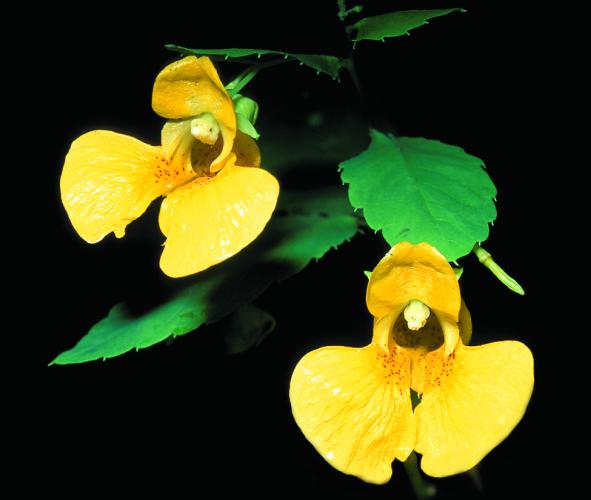
Impatiens pallida
Family
Balsaminaceae (touch-me-nots)
Description
Pale touch-me-not, often called jewelweed, is a soft plant, much-branched, with watery stems. It is common along streambanks and other moist habitats.
The flowers are lemon yellow, occasionally with reddish spots; each one is shaped like a cornucopia; there are 3 unequal sepals, 2 of them small, the third a sack with a spur; 5 petals, appearing as 3 (as the lateral petals are joined), each with 2 lobes; the stamens are joined to the stigma; each flower hangs from a slender stem. The conical portion of the flower is about as long as it is wide.
Blooms June–September.
The leaves are alternate, soft, egg-shaped, bluish green, coarsely toothed, to 3½ inches long.
The fruit is a slender capsule, which, upon drying or when touched, contracts, coils, and splits explosively, casting seeds far away in all directions.
Similar species: Spotted touch-me-not (Impatiens capensis, also called jewelweed), usually has orange flowers with red or reddish-brown spots, and the conical portion of the flower is usually about twice as long as it is wide, with a longer spur. Without seeing the flowers, it is almost impossible to distinguish between the two species.
Size
Height: to 5 feet.
Where To Find

Statewide.
Habitat and Conservation
Occurs in damp, low woods; banks of streams, rivers and springs; swampy places; edges of ponds; ravine bottoms; and bases of bluffs.
Status
Native Missouri wildflower.
Human Connections
Many believe that rubbing the juice from the foliage on the skin will prevent and even cure a poison ivy infection as well as take the sting out of stinging nettle and the itch from chigger bites.
Native Americans had many medicinal uses for these plants.
Today people cultivate them as ornamentals.
Ecosystem Connections
Our two species of jewelweeds are often found growing together, but apparently they do not hybridize. They both have different pollinators: Spotted touch-me-not is visited by hummingbirds and pale touch-me-not by bumblebees. Also, the flowers that produce the most seeds are ones that never open fully and are thus self-pollinating.
The genus name, Impatiens, should be familiar to gardeners, as jewelweeds are in the same genus as the extremely popular landscaping flowers known by that name. The leaves are very similar, and the flowers also have a little "spur."
Title
Media Gallery
Image

Caption
Our two Missouri touch-me-nots, or jewelweeds, occur in the same habitats, often side by side, and even botanists can’t tell them apart without the flowers. Pale touch-me not is the one with lemon-yellow flowers!
Credit
MDC Staff
Right to Use
Photo by MDC Staff, courtesy Missouri Department of Conservation
Image
Caption
Pale touch-me-not (Impatiens pallida)
Credit
Photo by MDC Staff, courtesy Missouri Department of Conservation.
Right to Use
Use of this image is restricted to MDC only
Image

Image

Title
Similar Species
Similar Species
Media
Media

Media
Media
Media
Media

Media

Where to See Species
About Wildflowers, Grasses and Other Nonwoody Plants in Missouri
A very simple way of thinking about the green world is to divide the vascular plants into two groups: woody and nonwoody (or herbaceous). But this is an artificial division; many plant families include some species that are woody and some that are not. The diversity of nonwoody vascular plants is staggering! Think of all the ferns, grasses, sedges, lilies, peas, sunflowers, nightshades, milkweeds, mustards, mints, and mallows — weeds and wildflowers — and many more!