













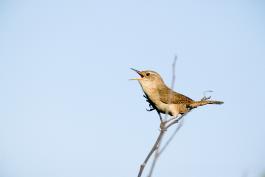
The northern house wren is an audacious little bird. It's a favorite spring arrival, partly because of its bold bursts of song, but also because of its bold habits around people.
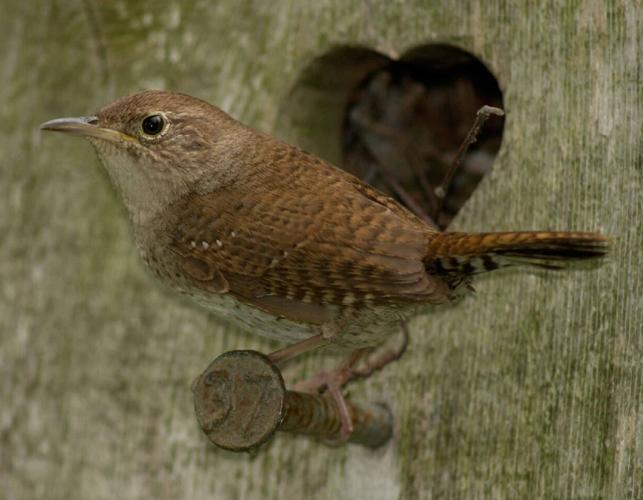
Except for its voice, the northern house wren is very plain. Adults are gray-brown above with an indistinct buffy eye line. The wings and tail are slightly more reddish with fine black barring. The tail is short and often cocked upright. The underparts are lighter brown, with some darker markings along the flanks and under the tail.
The song is a rising jumble of twittering, gurgling, and chattering notes descending toward the end. The calls are a series of stuttering notes, buzzy rattles, and a sharp “tchur.”
Length: 4¾ inches (tip of bill to tip of tail).

Statewide.
Habitat and Conservation
Some studies suggest that the northern house wren may be replacing the Bewick’s wren in much of its range. On the other hand, house wrens have probably declined somewhat due to competition by the exotic house sparrow.
Food
Caterpillars, spiders, and snails are the favorite foods of these busy little predators.
Status
Common summer resident, rarely lingering late into the fall. Only a few have been known to overwinter here.
Life Cycle
Northern house wrens nest in abandoned woodpecker holes, bird boxes, and other cavities around dwellings. They may even nest in mailboxes, porch planters, and rolled-up carpeting in your garage, if you leave the door open too long. Males build the nest with twigs and other miscellaneous materials, and the females line it with various substances including spider webs, hair, moss, and trash. The female incubates the eggs for 12–19 days, and it takes about the same time before the hatchlings fledge.
Human Connections
Many Missourians look forward to the springtime return of these exuberant and energetic singers, and many put up special wren houses to welcome them. Building instructions are available from the Cornell Lab of Ornithology.
Ecosystem Connections
House wrens feed voraciously on worms and other invertebrates, especially when feeding their nestlings. They sometimes compete with bluebirds for nest boxes and sometimes even kill bluebirds; house wrens are, however, a protected species and cannot be killed.
Taxonomy and relatives: In 2024, researchers using genetic analysis, as well as differences in plumage and voice, determined that what were once considered several wide-ranging subspecies of "the house wren" are different enough to be treated as different species:
- Our version of the house wren, which lives in southern Canada, the United States, and Mexico, is now called the northern house wren.
- The seven close relatives in the western hemisphere are now all deemed separate species: the southern house wren (southern Mexico, Central America, and throughout South America); the Cozumel, St. Lucia, St. Vincent, and Grenada wrens (found on their respective islands); the Kalinago wren (Island of Dominica); and the Cobb's wren (Falkland Islands).




About 350 species of birds are likely to be seen in Missouri, though nearly 400 have been recorded within our borders. Most people know a bird when they see one — it has feathers, wings, and a bill. Birds are warm-blooded, and most species can fly. Many migrate hundreds or thousands of miles. Birds lay hard-shelled eggs (often in a nest), and the parents care for the young. Many communicate with songs and calls.