








When a giant floater dies, this large mussel will actually rise to the water surface and float as it decays. It occurs almost statewide, usually in sluggish sections of ponds, reservoirs, creeks, and rivers in mud or silt.
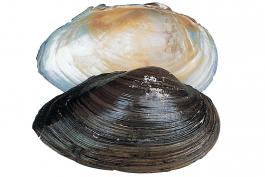
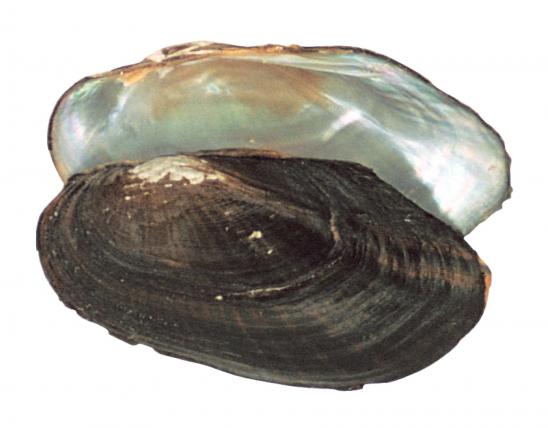
Externally, the giant floater's shell is large and elongated to suboval; it is very inflated. The umbo (beak) is swollen and elevated above the hinge line. The periostracum (thin outer layer) is shiny and light tan to light green or brown; it becomes black to greenish black with age; in young, it often has faint green rays.
Inside the shell, the beak cavity is broad; teeth are absent; the nacre (mother-of-pearl layer) is iridescent and variable, often silvery white, tinged with pink or salmon.
For a fuller introduction to Missouri’s native freshwater mussels, and to learn the terms for their anatomy, see their group page.
Similar species: The flat floater (Utterbackiana suborbiculata) is more circular, and its umbo is almost flush to the hinge line. The paper pondshell has a thinner shell and a flatter umbo. The creeper (Strophitus undulatus), cylindrical papershell (Anodontoides ferussacianus), and pondhorn (Uniomerus tetralasmus) are also similar.
Adult length: 3–8 inches.

Found in almost all rivers south of the Missouri River except for a few in the south-central area along the Arkansas border. Also found in five rivers north of the Missouri River.
Habitat and Conservation
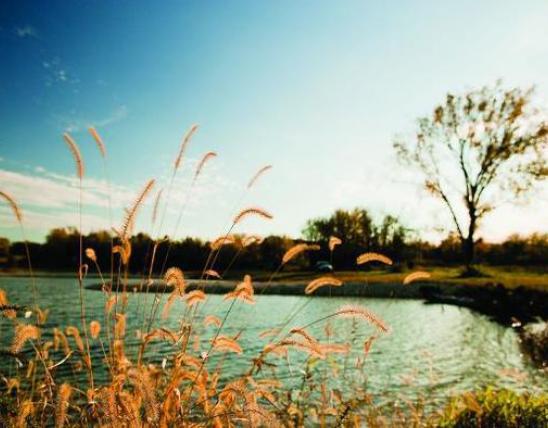
Most common in sluggish sections of ponds, reservoirs, creeks, and rivers in mud or silt.
Food
Freshwater mussels consume algae, bacteria, and fine particles of decaying organic matter. They extract nutrients and oxygen from water drawn into the body cavity through a specialized structure called the incurrent siphon; sediment, undigested food, and waste (called pseudofeces) are expelled through the excurrent siphon.
Status
Common, although degrading water quality and watershed destabilization interfere with the survival of this and all freshwater mussels.
Life Cycle
Males release sperm directly into water. Females downstream siphon sperm into the gill chamber, where eggs are fertilized. Eggs mature into larvae (called glochidia), which discharge into the water and attach to host fish; in this species, carp, yellow perch, and others. The tiny mussel eventually breaks away and floats to the bottom of the stream, and the cycle repeats.
For its larval hosts, the giant floater uses several types of fish. It has been recorded using about 12 species of New World minnows, plus largemouth bass, bluegill, white and black crappie, and some of the sunfishes. It also uses freshwater drum, common carp, yellow perch, and several more.
Human Connections
Mussels play important roles in maintaining the health of Missouri’s water resources:
- As food for fish, they are important for Missouri’s fisheries. Small mammals and some birds eat them, as well.
- They filter algae, bacteria, and other particles from the water, improving water quality and cycling nutrients and energy in streams and lakes. Clean water is necessary for people and nature.
- Because mussels are sensitive to habitat disturbance and pollution, they are good indicators of the overall health of aquatic ecosystems and water quality.
The shells of several types of mussels were an important resource historically for button manufacture. Some species are still commercially important in the cultured pearl and jewelry industries.
Ecosystem Connections
Mussels play important roles in maintaining the health of Missouri’s water resources:
- As food for fish, they are important for Missouri’s fisheries. Small mammals and some birds eat them, as well.
- They filter algae, bacteria, and other particles from the water, improving water quality and cycling nutrients and energy in streams and lakes. Clean water is necessary for people and nature.
- Because mussels are sensitive to habitat disturbance and pollution, they are good indicators of the overall health of aquatic ecosystems and water quality.
The shells of several types of mussels were an important resource historically for button manufacture. This species is one that was used to make buttons. Some species are still commercially important in the cultured pearl and jewelry industries.
Species like the giant floater, which can use a wide variety of fish hosts in its tiny larval stages, can have a survival advantage compared to mussel species whose larvae must develop attached to only a certain single species of fish.