







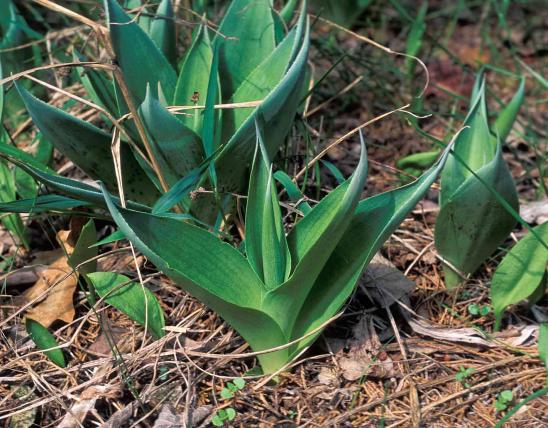
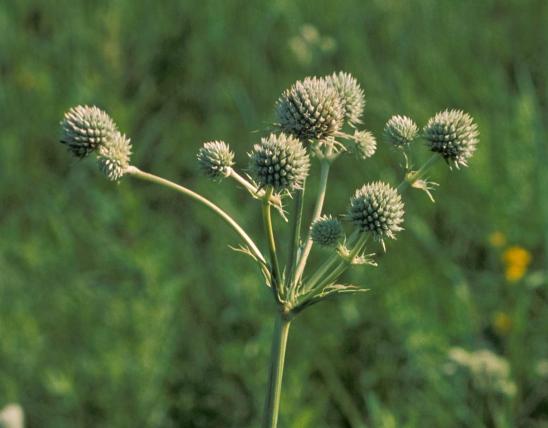
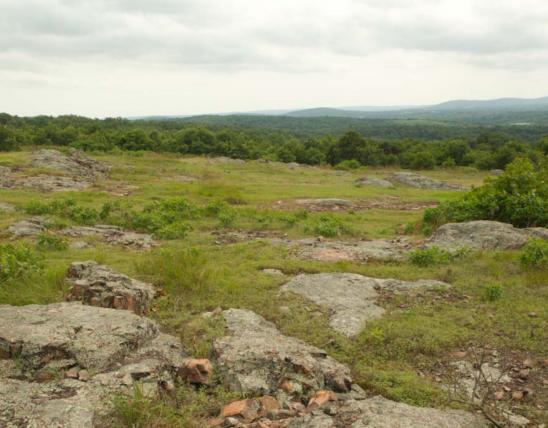
Hughes Mountain entices explorers with some of the most unique geological features in the Show-Me-State.
Media

Safety Concerns
Name
Thorny
Name
Edible
Scientific Name
Opuntia humifusa (formerly O. compressa)
Family
Cactaceae (cacti)
Description
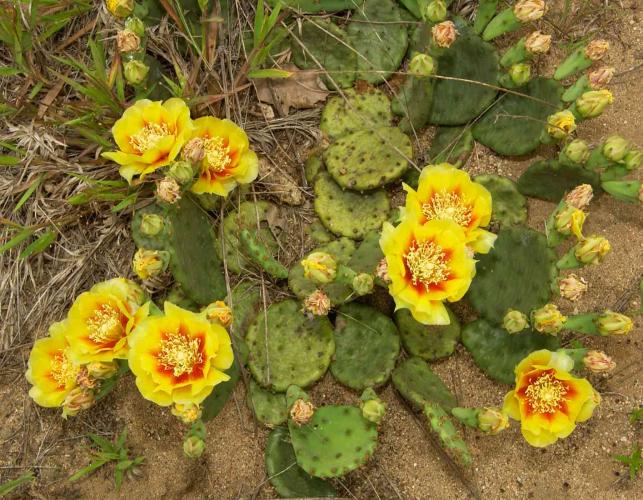
Cacti make us think of the desert southwest, but at least one species is native to Missouri. Eastern prickly pear grows in glades, sand prairies, rocky open hillsides, and other dry, sun-soaked areas.
The eastern prickly per is a low, spreading, succulent cactus growing from fibrous roots.
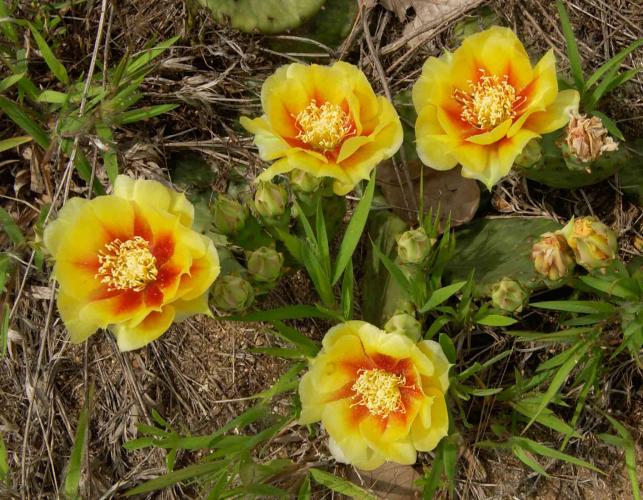
The flowers are numerous, yellow, with many similar-looking sepals and petals, the innermost often with an orange splotch, to 3 inches across, with many stamens.
Blooms May–July.
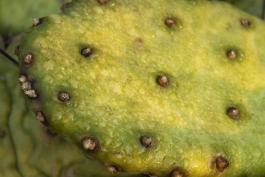
The large, paddlelike green parts (pads) are technically the thickened, flattened stems. New pads have tiny, soft, conical protuberances that are the true leaves; these persist only briefly before drying and falling off.
At the base of each leaf is a cluster (areole) of bristles and spines develops. Each areole has a tuft of many tiny, hairlike bristles (called glochids, pron. GLAH-kidz) that are very difficult to remove from the skin once they are embedded; any larger, needlelike spines are more sporadic, usually with at most only 1 per areole.
The fruit is edible, purplish red, and pear-shaped, with tufts or bristles. The seeds are embedded in a pale, mucilaginous substance.
Similar species: A few other prickly pear cacti have been recorded in Missouri:
- Plains prickly pear (Opuntia macrorhiza) is uncommon and found mostly in southwestern Missouri. It is a species of conservation concern, ranked as Imperiled. It has thicker roots, usually up to 6 stout spines per areole, and the stout spines are pointed downward. Its occurs widely in the Great Plains, as far west as New Mexico and Utah, as far north as Minnesota, and as far south as Texas and northern Mexico; Missouri is on the eastern edge of this range. There are also disjunct populations in the Mississippi and Ohio river valleys.
- Starvation cactus (Opuntia polyacantha) was once found in Jasper County but has apparently been extirpated from our state. Its areoles of glochids are more closely spaced on the pad surfaces; the flowers are yellow, magenta, or red. Its broader distribution is in the Great Plains west of Missouri.
Other Common Names
Prickly Pear Cactus
Low Prickly Pear
Pricklypear
Size
Height: about 6 to 14 inches tall. This cactus grows along the ground and sometimes forms low mounds.
Where To Find
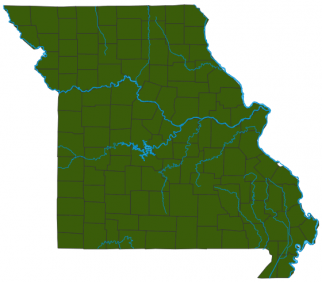
Scattered nearly statewide.
Habitat and Conservation
Grows in sunny, dry places: rocky areas of upland prairies, sand prairies, glades, tops and exposed ledges of bluffs, and rocky stream terraces; also pastures, roadsides, railroads, and open, disturbed areas.
Status
Native Missouri cactus. This is the most common cactus in the eastern United States.
Human Connections
The fruits and young pads of some species of prickly pears are eaten in regions where cacti are more common. Prickly pear candy is made in the desert southwest, and canned, sliced nopales (the pads) can be bought in the Hispanic section in grocery stores. Try them in Mexican-style scrambled eggs!
This species of prickly pear is often cultivated in rock gardens, on rock walls, and other landscaping situations that suit its needs: dry, sunny, with well-drained substrates. Don't take plants from natural settings; get them from reputable native plant nurseries, or propagate them from seeds. This plant spreads along the ground, sending down roots where the pads touch the soil.
When you travel to the southwest, make sure you visit a botanical garden so you can enjoy and learn about the huge variety of cacti and succulents.
The next time you're poked by prickly pear spines or bristles, try to chuckle, and remember the words of Arizona State University botanist Donald Pinkava, who specialized in cacti and who used to quip: "You've got to roll with the opuntias!"
Ecosystem Connections
The spines of prickly pears serve the plant in at least two ways. First, they deter herbivores such as rabbits from eating them. Second, since the pads easily break off at the joints and can take root elsewhere, the spines can facilitate their distribution by hooking on to the feet of animals.
Prickly pears and nearly all other members of the cactus family are indigenous to the Americas. There are about 200 species in genus Opuntia. Another large genus of cacti, Cylindropuntia, the chollas, have a similar growth habit but have cylindrical and not paddle-shaped stems; the chollas used to be considered members of the Opuntia genus.
Title
Media Gallery
Image
Caption
Cacti make us think of the desert southwest, but at least one species is native to Missouri. The eastern prickly pear grows in glades, sand prairies, rocky open hillsides, and other dry, sun-soaked areas.
Credit
MDC Staff
Right to Use
Photo by MDC Staff, courtesy Missouri Department of Conservation
Image
Caption
The flowers of eastern prickly pear are numerous, yellow, with many similar-looking sepals and petals, the innermost often with an orange splotch, to 3 inches across, with many stamens. It blooms May–July.
Credit
MDC Staff
Right to Use
Photo by MDC Staff, courtesy Missouri Department of Conservation
Image

Caption
The green pads of prickly pear cacti are thickened, flattened stems. New pads have tiny, soft, conical structures that are the true leaves; these persist briefly before drying and falling off. At the base of each leaf is a cluster of tiny, hairlike bristles that are very difficult to remove from the skin once they are embedded.
Credit
David Stonner
Right to Use
Photo by David Stonner, courtesy Missouri Department of Conservation
Image

Caption
Eastern prickly pear is scattered throughout Missouri. It grows in sunny, dry places: rocky areas of upland prairies, sand prairies, glades, tops and exposed ledges of bluffs, and rocky stream terraces; also pastures, roadsides, railroads, and open, disturbed areas.
Credit
MDC Staff
Right to Use
Photo by MDC Staff, courtesy Missouri Department of Conservation
Image

Caption
Eastern prickly pear cactus
Credit
Don Kurz
Right to Use
Use of this image is restricted to MDC only
Image
Image

Image
Image

Image

Title
Similar Species
Similar Species
Where to See Species

Blackjack Access contains a unique complex of grassland, savanna, and woodland. Small glade communities can be found with stunted post and blackjack oak adapted to dry, shallow soil conditions.


This area was donated to the Department in 1993 by Mrs.

In 1996, seven tracts totaling 916 acres were acquired as part of the Emergency Wetland Reserve Program (EWRP), which was initiated after the flood of 1993 which lasted for 175 days.
About Wildflowers, Grasses and Other Nonwoody Plants in Missouri
A very simple way of thinking about the green world is to divide the vascular plants into two groups: woody and nonwoody (or herbaceous). But this is an artificial division; many plant families include some species that are woody and some that are not. The diversity of nonwoody vascular plants is staggering! Think of all the ferns, grasses, sedges, lilies, peas, sunflowers, nightshades, milkweeds, mustards, mints, and mallows — weeds and wildflowers — and many more!