










Bonfire moss, or common cord-moss, is a very common, widely distributed, pioneer species that is almost always seen with sporophyte capsules. It typically grows on moist, disturbed soils, especially in places where fires have recently occurred, as well as on damp walls and rocks.
This moss’s stems are upright, to about ½ inch tall, unbranched, and increasingly leafy toward the tip. The leaves are largest at the stem tip (to 4 mm long), concave, wide spreading, the bases sessile (wrapped around the bulblike stem tip), the leaf tips pointed. The midribs are conspicuous and run the whole length of the leaf to the tip. With age, the green leaves often become orangish.
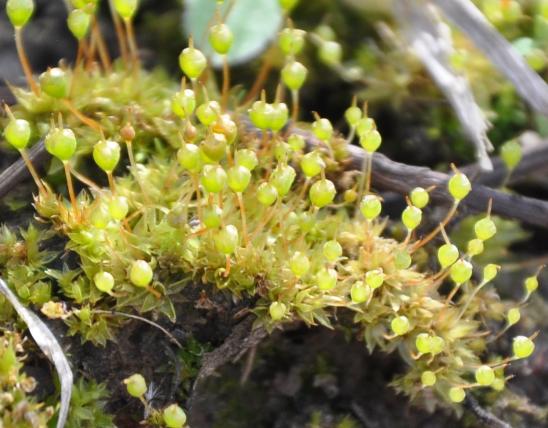
Sporophytes are almost always present with this moss. The capsules are pear-shaped, asymmetrical and often curved, to 3.5 mm long, and may be hanging (nodding), inclined, or nearly erect. Immature capsules are green and have a hood (calyptra) with a long, narrow beak that is as long as the capsule itself. The hood soon falls off. The mature capsules turn red and shrivel. The capsule stalks (setae) are slender and can be more than 3 inches tall, though the usual maximum is 1¾ inches. The stalks start off green but become reddish when mature; often, a mass of fallen old, reddish stalks are strewn on the ground around this moss.
Key identifiers:
- Grows in disturbed habitats
- Capsules pear-shaped, uneven, usually nodding
- Capsules start off green, with long narrow beak that will fall off
- Mature capsules dry, turn reddish, and shrivel
- Capsule stalks easily to 1¾ inches long, become reddish
- Often multitudes of old sporophyte stalks lying on the ground.
Learn more about Missouri’s mosses on their group page.
Forms colonies several inches wide, especially on disturbed soils.
Statewide.
Habitat and Conservation
This moss is often described as “weedy,” since it rapidly and easily becomes established on exposed soils such as places where fire has occurred (hence the name). It also occurs along railroads and roadsides, overgrazed pastures, old fields, and a very wide variety of disturbed areas.
Life Cycle
As with other mosses, this species has alternating generations. The plant we usually think of as the moss is the gametophyte. In separate organs, it produces sperm and eggs. When water, even a thin layer of rainwater, is present, the sperm can swim to the eggs and fertilization occurs. The resulting offspring plant, called a sporophyte, grows out of the female organs of the gametophyte.
In this species, the sporophyte takes the form of a stalked capsule growing out of the gametophyte stem. It obtains nutrients from the gametophyte. When mature, the capsule opens to release spores, which can grow into new gametophyte plants.
This moss grows vigorously in spring. The mature, downward-pointing capsules release spores that are readily distributed in the wind in late spring and into summer.
Mosses also commonly reproduce asexually when a portion of the plant breaks away, gets moved elsewhere, and continues growing as a separate plant.
Human Connections
Because bonfire moss is very common worldwide, and because it is almost always seen with sporophyte capsules, it is literally a “textbook example” of a moss, especially when educators are illustrating the general life cycle of mosses.
Pioneer species are sometimes called “weedy” because they share some of the growth and survival characteristics of many plants that commonly invade our gardens. In nature, and with native plants, however, these characteristics help heal landscapes after natural disasters (such as floods, landslides, or natural fires) or that humans have disrupted through construction, mining, overgrazing, and so on.
Bonfire moss is often found in greenhouses. Another moss common in greenhouses is silvery bryum (or silvergreen bryum, Bryum argenteum). In greenhouses, both mosses can be cultivated, though they may also be viewed as weeds.
Ecosystem Connections
As a pioneer species, bonfire moss plays an important role in stabilizing disturbed soils, whether it is after a fire, a flood, dirt slide, excavation, or other circumstances that strip the land of its vegetation. They function like band-aids to cover soils soon after a gouge. With the moss and other quick-growing early colonizers in place, the soil is protected against further erosion, allowing other plants to become established.




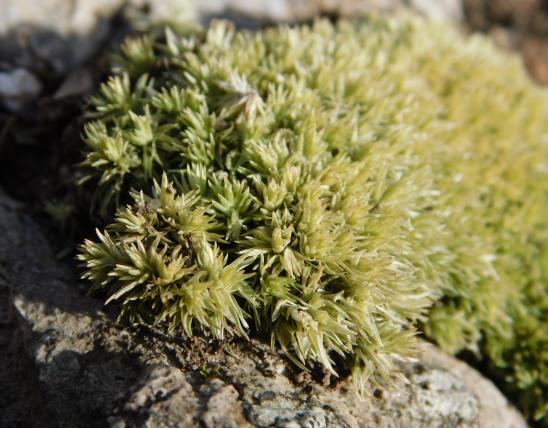


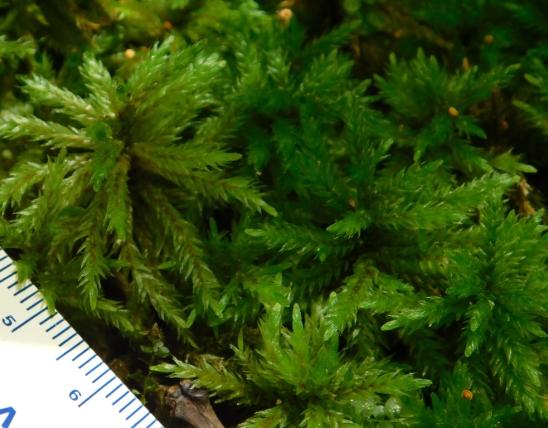


Mosses, liverworts, hornworts, and lichens seem rather similar, but these organisms are in very different groups. Mosses, liverworts, and hornworts are small, low plants usually found in damp habitats. Unlike more familiar plants, they lack veinlike structures and do not produce flowers or seeds — instead, they produce spores. Meanwhile, lichens are not plants at all: they are a collection of different fungi that have photosynthetic algae living within their tissues.