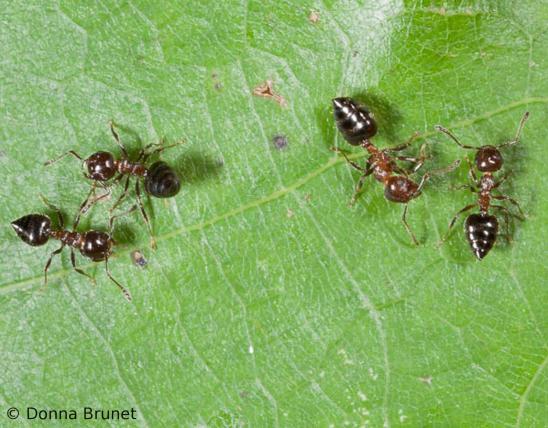










Asian needle ants are small to medium-sized ants with dark brown to black bodies, and their legs and mandibles are light brown to amber orange. Like other ants, they have 6 legs, 2 elbowed antennae, and a constricted waist, but Asian needle ants are longer and thinner than other commonly seen ants. Workers and queens are very similar in appearance.
Asian needle ants are incapable of climbing smooth surfaces such as glass due to the shape of their feet, and if trapped in a smooth glass container, they cannot easily escape.
When disturbed, Asian needle ants can sting people, causing a range of reactions similar to those of bees or wasps. People allergic to bee and wasp venom should be especially careful with these invasive ants. See Human Connections for more information.
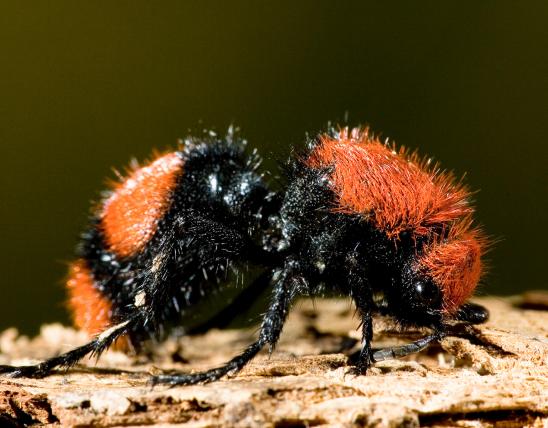
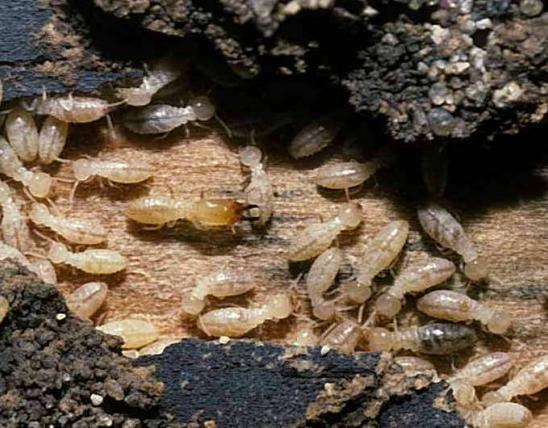
Similar species: Wingless wasps (such as velvet ants) and termites do not have elbowed antennae. Termites also do not have a constricted waist. Other ant species appear more compact and are not proportionally as long and thin as Asian needle ants.
Length: to ¼ inch (approx. 5 to 7 mm).
Currently not known in Missouri. Have been detected in several U.S. states, including Kentucky, Tennessee, and Arkansas.
Habitat and Conservation
First reported in 1932 in Decatur, Georgia, Asian needle ants have now been reported in at least 20 states, with notable infestations in North Carolina, South Carolina, and Georgia. Researchers have suggested that the range of this species may continue to expand within the United States.
Asian needle ants nest in moist, damp areas ranging from near sprinkler systems and sidewalk cracks to within rotting logs, termite nests, leaf litter, loose soil, potted plants, mulch, and similar places.
Colonies in the southeastern United States often consist of a few hundred workers and are most active once daily temperatures are greater than 65 degrees Fahrenheit, with activity peaking in August.
Asian needle ant colonies may inhabit only one nest site or many, sharing food and individuals across multiple nest locations.
Food
Asian needle ants prefer to eat termites but also eat other insects and carrion. Foods may include other ants, termites, earthworms, crickets, beetles, grasshoppers, and crumbs from human foods.
Worker ants explore the area surrounding the nest to find food and bring it back to the colony.
Status
Invasive species; not presently in Missouri.
If you think you have found this insect in Missouri, report it as quickly as possible to MDC at forest.health@mdc.mo.gov.
Asian needle ants are home and forest pests:
- They can damage our forests by diminishing or eliminating populations of native ants and termites, which are important for healthy native ecosystems. Asian needle ants decrease the numbers of native ants and termites by directly preying on them and by outcompeting them for food and nest sites. Our native ants, in particular, are crucial for dispersing seeds of wildflowers and other plants, and for controlling forest pests; when their numbers decline or disappear, woodland ecosystems suffer.
- Asian needle ants are pests to people and people's homes because they sting defensively, and the resulting welt is often painful (see Human Connections for more about their stings). When Asian needle ants reside in homes, the chances of people being stung are higher.
Life Cycle
Ants begin life as eggs, go through grublike larval stages, pupate, and then become adults.
As with other ants, the queens of Asian needle ants stay in the nest laying eggs, most of which become workers, which cannot reproduce. Though they are incapable of mating and reproducing, workers help the colony (and the queen's reproductive success) by foraging for food, caring for eggs and young, digging and maintaining nest tunnels, and defending against enemies.
Some of the eggs laid by the queen become males and new queens. Males and queens are capable of reproduction; they have wings, leave the nest, fly away, and mate. After mating, the queens tear off their own wings, start digging, and create a new colony.
Human Connections
While ants are a complex and fascinating group of insects that fill many essential ecological roles, invasive Asian needle ants are pests to both natural ecosystems and to people.
People can accidentally spread Asian needle ants, as they are easily carried to new areas in soil, potted plants, mulch, and other outdoor items such as firewood. The species apparently arrived in the United States through international shipping.
Stings from these ants may cause mild, moderate, or even severe reactions, including painful, itchy welts that may swell and persist from hours to days, like those from bees or wasps.
- As with bee, wasp, and other insect venoms, the sting of Asian needle ants can be serious for individuals who are especially allergic. If you are stung by any insect and within 15 minutes to an hour experience rash, itching, trouble breathing, swollen tongue, trouble swallowing, and/or chest tightness, seek emergency treatment.
- An Asian needle ant is most likely to sting if it becomes trapped between clothing and skin.
- People may encounter them when gardening, moving logs, or sitting on the ground in a nesting area.
Ecosystem Connections
As an invasive species, Asian needle ants can easily invade undisturbed woodlands and forests (not just disturbed environments such as roadsides and sidewalks). In natural habitats, they can easily take up residence in rotten logs, under rocks, and in the tunnels of native decomposer insects; they can outcompete native ants.
These ants are carrion scavengers and predators of other insects, including native ants that serve vital ecosystem roles such as seed dispersal. Researchers have shown a dramatic effect on seed dispersal in forested areas invaded by Asian needle ants, which could have profound negative impacts on the understory of Missouri forests.
- Violets, Dutchman's breeches, and dogtooth violets (trout lilies) are just some of the Missouri wildflowers that rely on native ants to disperse their seeds into suitable growing places.