






Spanish needles is a taprooted annual with upright, usually smooth stems. It is a familiar garden weed, most notable for its rounded clusters of slender, barb-tipped seeds that cling to fur and clothes.
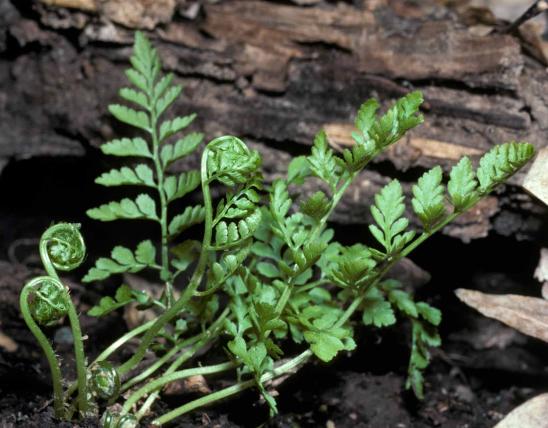
The leaves are opposite, with petioles, the blades deeply divided and lobed (2 or 3 times pinnately lobed); the ultimate lobes or segments are angled or tapered at the base, have a pointed tip, with a few coarse teeth on the margins. The leaves are fernlike and somewhat resemble flatleaf parsley.
The flowerheads are solitary at the stem tips and are not showy, being only about ¼ inch wide and ½ inch long. They usually lack the petal-like ray florets that make many other members of the sunflower family showy; when ray florets are present, they are small, yellow, and number only 1–5. The rest of the flowerhead comprises 12–27 yellowish disk florets, which will mature into the barb-tipped fruits.
Blooms August–October.
The fruits are the most remarkable aspect of Spanish needles: they mature into slender achenes (structurally similar to sunflower "seeds") that spread out in all directions from the tip of the plant stem; they are black or brown, about ½ inch long, square in cross-section, with 2–4 stiff, barbed awns at the outer tip. These awns catch onto fur and clothing, and the achene readily breaks free from the flowerhead, to be carried away from the parent plant.
Similar species: Spanish needles has several close relatives in Missouri, but this fairly common plant has distinctive fernlike foliage, nonshowy flowers, and spherical clusters of dark stick-tight “needles” that resemble miniature pitchforks or tridents (our other Bidens species have shorter and wider, more tick-shaped achenes).
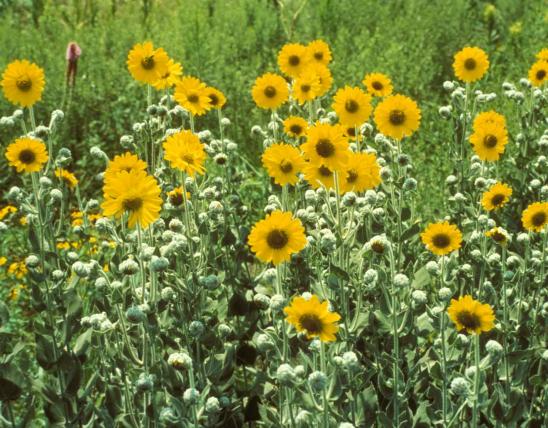
Missouri has 11 species in genus Bidens (beggar’s ticks). Tickseed sunflower, or bearded beggarticks (Bidens aristosa), is one example. See Ecosystem Connections for a list of Missouri’s other Bidens species.
Height: usually 6–24 inches.
Scattered, mostly south of the Missouri River.
Habitat and Conservation
Occurs in upland prairies, glades, openings of moist to dry upland woodlands, bottomland forests, and banks of streams and rivers; also in ditches, pastures, fallow fields, gardens, railroads, roadsides, and other open, disturbed areas.
The natural range of this species is not well understood because long ago, it became established as a weed in many parts of the world. It may have originated in parts of the eastern United States and eastern Asia.
Status
Possibly a native wildflower; the original global range is uncertain. Commonly considered a garden weed.
Human Connections
“Good grief, what are these things?” After a late summer or fall hike, the achenes of Spanish needles are one of several kinds of “stick-tights” or “beggar's ticks” you may find on your clothing. They can be annoying. Now you know where these particular doodads come from.
Dog and cat owners often find the narrow achenes stuck in their pet’s fur. The sharp points can cause skin irritation, and if left in the fur, they can create mats.
It is unlikely that many people would cultivate this plant, but it is likely that a garden could hold a few Spanish needles plants, anyway. They easily reseed themselves, abundantly.
Ecosystem Connections
Fruits in the form of stick-tights, or beggar’s ticks, are a plant’s way of dispersing its offspring to new places. By sending its progeny hither and yon, it increases its odds of having at least some of the next generation end up in a suitable, safe habitat. Dispersing the offspring plants also reduces inbreeding and the possibility of them competing with each other.
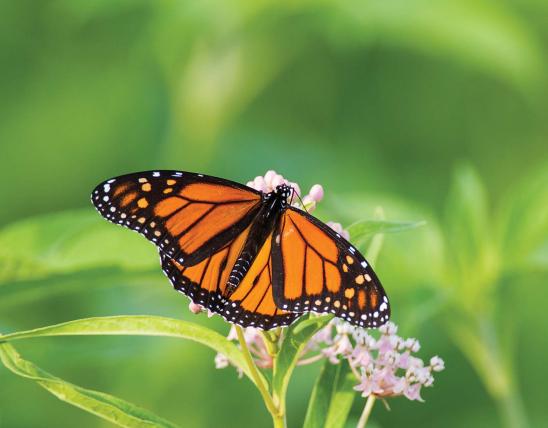
Although the flowers aren’t much to look at, the disk florets attract insect pollinators anyway: a wide variety of bees, flower flies, and butterflies commonly visit Spanish needles.
Several types of insects feed on the foliage, stems, roots, or sap: the caterpillars of certain moth species, plus leaf beetles and aphids. These insects, in turn, become food for birds and other animals.
The achenes are consumed by a variety of birds, and rabbits and other herbivorous mammals may chew the foliage.
Fast-growing plants that quickly colonize disturbed soils and self-seed abundantly and easily are often described as “weedy.” We usually think of “weeds” in human terms (as plants growing in places where we don’t want them). But ecologically, “weedy” plants — such as many grasses, dandelions, and so forth — have a superpower. They quickly get established, covering and binding bare soil, like a bandage over a wound. These fast-growing pioneer colonies prevent erosion and prepare the way for larger, more exacting plants to return: wildflowers, shrubs, and trees.
Relatives: The subject of this page, Spanish needles (Bidens bipinnata), is one of eleven species of Bidens recorded in Missouri. Six of them range from common to scattered to uncommon:
- Tickseed sunflower, or bearded beggarticks (Bidens aristosa)
- Sticktight, or nodding bur marigold (Bidens cernua)
- Few-bracted bur marigold (Bidens discoidea)
- Common beggarticks (Bidens frondosa)
- Three-lobed beggarticks, or swamp beggarticks (Bidens tripartita)
- Big devil’s beggarticks (Bidens vulgata)
The following are rare and only known from a few collections in our state:
- Common beggarticks (Bidens alba)
- Water marigold (Bidens beckii), a Missouri species of conservation concern
- Showy bur marigold (Bidens laevis), a Missouri species of conservation concern
- Crowned beggarticks (Bidens trichosperma)