








The Missouri Department of Conservation team is diverse and dedicated to conserving, protecting, and improving our fish, forest, and wildlife resources.
By Angie Daly Morfeld
Joe DeBold
Wildlife Damage Biologist
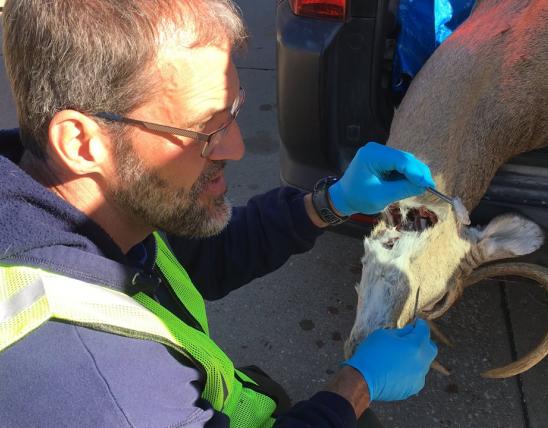
As a wildlife damage biologist for MDC, Joe DeBold could be described as a mediator, solving conflicts that arise between humans and wildlife as they attempt to coexist. DeBold works out of the Burr Oak Woods Conservation Nature Center in Blue Springs.
A Typical Day
DeBold said many inquiries come in each day from the public, either by phone or email, regarding beavers, muskrats, otters, coyotes, and other critters.
“Every day is different,” DeBold said. “And there are no typical 8 a.m. to 5 p.m. work hours. A wildlife damage biologist is on the wildlife schedule, not people’s schedule. Day and night work detail.”
Notable Projects
DeBold identifies the removal of the peregrine falcon from Missouri’s endangered species list as most notable in his career.
Historically, peregrine falcons nested in small numbers on bluffs along the Mississippi, Missouri, and Gasconade rivers. By the late 1800s, only a few pairs remained in the state. Due to restoration efforts coordinated by federal, state, and private wildlife entities, including MDC, populations of peregrines have been established. In cities, peregrines now nest on ledges of tall buildings and other tall structures, including bridges, in lieu of cliff nesting sites. They also use nest boxes placed in these locations. Peregrines are also returning to former nest sites on suitable bluffs.
“We recovered an endangered species,” said DeBold, who previously served as MDC’s falcon recovery leader. “And they are useful in my role as a wildlife damage biologist. We have seen the falcons demonstrate a biological tool in locations where there’s a nuisance pigeon problem, usually at industrial sites.”
How You Can Help
Research and learn about animal behavior. The best way to do this is by watching animals in their native habitat while hiking, camping, fishing, hunting, or just enjoying nature, DeBold said. Ultimately, this will help you navigate future conflicts with wildlife.
Education
Bachelor’s degree, Western Illinois University: agricultural science
Master’s degree, Western Illinois University: wildlife ecology
Having an issue with a nuisance animal?
Visit short.mdc.mo.gov/Z5L. Or call your local wildlife damage biologist
And More...
This Issue's Staff
Editor – Angie Daly Morfeld
Associate Editor – Larry Archer
Photography Editor – Ben Nickelson
Staff Writer – Kristie Hilgedick
Staff Writer – Joe Jerek
Staff Writer – Dianne Van Dien
Designer – Marci Porter
Designer – Kate Morrow
Photographer – Noppadol Paothong
Photographer – David Stonner
Circulation – Marcia Hale