










Let’s Go Birding
Polish off your binoculars — it’s time for another birding challenge
The Missouri Birding Challenge (MBC) is back! MDC, the U.S. Fish and Wildlife Service (USFWS), and the Missouri Conservation Heritage Foundation (MCHF) invite both new and experienced birders to join the 2026 MBC May 1–22.
In preparation for the 2026 MBC, join MDC and USFWS birding experts and enthusiasts for this special series of webinars on birding and key issues facing birds and bird conservation in Missouri:
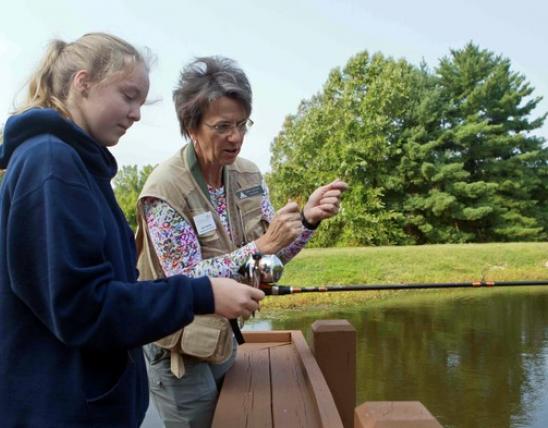
- Birding for (and with) Kids with MDC Naturalist Austin Lambert, March 12, 6–7 p.m. — See Get Outside [Page 29] for all the details.
- Missouri Birds and Habitats with Missouri State Ornithologist Kristen Heath-Acre, April 16, 6–7 p.m. — New to birding or need a refresher? Join Kristen for a primer on identification of Missouri’s common birds by sight and sound and their associated habitats. Whether new to birding or experienced, there are always tips and tricks to learn in the world of birds. Register at short.mdc.mo.gov/o3A.
MBC participants will compete alone or in teams in five categories based on age, birding location, or experience. Birders will use eBird (eBird.org) to record their lists of birds identified in public natural areas around the state or even in their own backyards.
There is a fee of $15 per person, or $10 per team in the youth Fledgling category. Fees are collected by MCHF and contribute to migratory bird conservation efforts and projects. Registration fees were reduced from last year, based on participant feedback, and a new Big Day category will challenge registrants to record as many bird species as possible in the 24 hours of May 9 — World Migratory Bird Day — a global birding event.
Once participants complete a category and submit their team’s mandatory eBird report, they will be entered into a drawing for fun, bird-related prizes, such as binoculars and gift cards. The Missouri Birding Society (mobirds.org), Columbia Audubon Society (columbia-audubon.org), and the Burroughs Audubon Society of Greater Kansas City (burroughs.org) are prize sponsors of the 2026 MBC.
Register for the 2026 MBC April 1–30. Watch Birdwatching: Introduction and Benefits, a webinar about the 2026 MBC, at mdc.mo.gov/MObirdingchallenge.
Agents in Action
By Holly Dentner
March 15 marks the start of paddlefish season, when thousands of snaggers hope to encounter this giant, ancient sport fish, which is also Missouri’s official state aquatic animal. The start of this season also means our conservation agents are busy with enforcement to prevent the poaching of paddlefish eggs for illegal caviar sales.
“Paddlefish are a valuable resource and poaching for their eggs, or roe, is a significant threat,” said Lieutenant Tyler Brown, Lake of the Ozarks district. “Missouri has strict regulations on the number and size of the paddlefish you can snag, but there are additional laws that apply to their eggs, too.”
The Wildlife Code of Missouri says that extracted paddlefish eggs may not be possessed while on waters of the state or adjacent banks, and may not be transported, bought, sold, or offered for sale.
That means if you snag a paddlefish, you must transport the whole fish from the water to your destination. Once there, you can process the fish, including extracting any eggs. But it is illegal to buy, sell, or offer paddlefish eggs for sale in Missouri.
Unfortunately, poachers still try to steal valuable roe. A couple of incidents occurred last year at the Lake of the Ozarks. In both cases, agents received intelligence that paddlefish egg violations were underway and mobilized to gather evidence.
In one instance, agents spent 19 hours conducting covert surveillance before conducting a traffic stop to catch the suspects as they headed out of town. Agents issued the appropriate citations and seized 265 containers of processed caviar, 13 gallon-size bags of unprocessed paddlefish eggs, and 24 bags of paddlefish filets (see image above).
Another instance led agents to a group of people staying at a short-term rental. Once the group hit the road, traffic stops were made, citations issued, and evidence seized. In total, the suspects had over 120 pounds of processed caviar and unprocessed paddlefish eggs.
“Stealing hundreds of pounds of fish and eggs is an egregious violation of the laws intended to protect the paddlefish population in Missouri,” said Brown. “It also affects the quality of fishing for everyone. These people are stealing from every citizen in the state.”
This is just another example of our agents in action.
MoNASP State Archery Championship
Get ready for another exciting year of archery competition and fun at the 2026 Missouri National Archery in the Schools Program (MoNASP) State Archery Championship March 18–21 at the Branson Convention Center on the Landing in Branson.
Every March, the MoNASP State Archery Championship brings together talented youth archers from across the state to compete in a celebration of skill, sportsmanship, and teamwork. The MoNASP State Championship has seen tremendous growth and is the second- largest state archery tournament in the nation.
More than 4,300 student archers are expected to compete after working hard throughout the school year to achieve qualifying scores through various local MoNASP tournaments.
For more information and tournament details from our MoNASP partner, the Missouri Conservation Heritage Foundation, visit short.mdc.mo.gov/oUE.
Hunting and Fishing Booklets Available
Missouri hunters, trappers, anglers, and others can get free copies of MDC’s updated booklets on spring turkey hunting, hunting and trapping, and fishing starting in March. Booklets are available at MDC regional offices, MDC nature centers, and other places where permits are sold. The handy booklets have information on related permits, seasons, species, regulations, limits, conservation areas, sunrise and sunset tables, and more. Get booklet information online at mdc.mo.gov using the search tool at the top of the homepage.
Paddlefish Season Begins March 15
Paddlefish, named for their large, paddle-shaped snouts, are an ancient species that can grow to 7 feet and weigh more than 100 pounds.
Missouri’s major paddlefish snagging waters include Lake of the Ozarks, Harry S. Truman Reservoir, and Table Rock Lake. The paddlefish snagging season for these and most other waters in the state runs March 15 through April 30. The season for the Mississippi River is March 15 through May 15, with a fall season of Sept. 15 through Dec. 15.
A fishing permit is required, unless exempt. The daily limit is two paddlefish, and the possession limit is four. No person shall continue to snag after taking a daily limit of two paddlefish on these waters. Learn more about paddlefish, snagging regulations, minimum lengths, snagging reports, and more at short.mdc.mo.gov/Z9B.
By Emily Franklin
John Haefner

John Haefner of Iron County seized the opportunity to acquire the 600-acre property where he enjoyed countless childhood adventures. Driven by a desire to honor the land that holds his cherished memories, he collaborated with MDC to restore the property to its pristine state. The results exceeded his expectations.
Honoring the past, managing for the future
Over the past decade, John has worked closely with Julie Norris, MDC priority habitat specialist, and engaged a forestry consultant to develop a comprehensive forest management plan for his land. He leveraged cost-share assistance to implement various management activities, including glade restoration, timber stand improvement, firebreak installation, prescribed burns, and the establishment of wildlife water facilities.
In his own words
“I am hooked and I couldn’t have done any of it without MDC. It is truly a dream come true.”


Title
Answer
Greater Yellowlegs
Named for their prominent, bright, stiltlike legs, greater yellowlegs are large shorebirds that forage for worms and other invertebrates in flooded pastures, flooded row-crop stubble, mudflats, shorelines, and marshes. Their call is a loud series of tew, tew, tew, usually three or more in a row. Greater yellowlegs are often the first to sound the alarm when danger threatens, earning them the nickname tattlers or tell-tales.
And More...
This Issue's Staff
Editor – Angie Daly Morfeld
Associate Editor – Larry Archer
Photography Editor – Ben Nickelson
Staff Writer – Kristie Hilgedick
Staff Writer – Joe Jerek
Staff Writer – Dianne Van Dien
Designer – Marci Porter
Designer – Kate Morrow
Photographer – Noppadol Paothong
Photographer – David Stonner
Circulation – Marcia Hale