









Free Fishing Days
Get hooked on fishing June 7 and 8
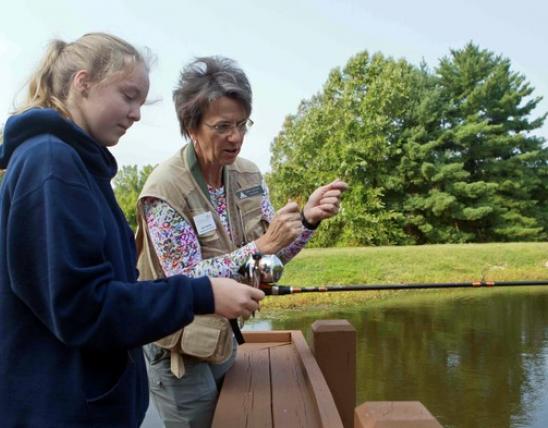
Missouri is a great place to fish, and MDC invites everyone to experience it during Free Fishing Days, June 7 and 8. Anyone may fish in the Show-Me State during this time without purchasing a fishing permit, trout permit, or trout park daily tag. This is an annual MDC event that takes place statewide on the Saturday and Sunday following the first Monday in June.
All other fishing regulations remain in effect during Free Fishing Days, such as limits on size and number of fish an angler may keep. Special permits may still be required at some county, city, or private fishing areas. Trespass laws remain in effect on private property.
For information on Missouri fishing regulations, fish identification, and more, get a copy of the 2025 Summary of Missouri Fishing Regulations, available where permits are sold or online at short.mdc.mo.gov/4gy.
MDC’s free MO Fishing app can help anglers find the best places to fish in Missouri, access regulation information, identify fish by species, and more. Anglers can also store and show fishing permits right on their mobile devices. MO Fishing is available for download through Google Play for Android devices or the App Store for Apple devices. Learn more at short.mdc.mo.gov/ZJZ.
Want to learn to fish?
MDC’s Discover Nature — Fishing provides a series of free lessons throughout the state. All fishing gear is provided. Learn more at mdc.mo.gov/dnf.
Need fishing gear?
MDC works with numerous libraries and other locations around the state to loan fishing gear for free. Loaner gear includes fishing poles and simple tackle box with hooks, sinkers, and bobbers. Worms, minnows, or other bait are not provided. Find MDC Rod and Reel Loaner Program locations at short.mdc.mo.gov/ZVc.
MO Fishing lets you view permits, find great places to fish, and ID your catch. Get it for Android or iPhone platforms at short.mdc.mo.gov/Zi2.
Give Turtles a Brake
Be cautious on the roads this spring and give turtles a brake. These reptiles are often hit by cars during the warmer months but are at special risk this time of year because they are more active. Common turtles crossing Missouri roads include three-toed box turtles, ornate box turtles, and snapping turtles.
Being struck by vehicles is a leading threat to box turtles in Missouri, so be cautious and slow down if you see a turtle in the road. If helping a turtle make it safely across, check for traffic and always move the turtle in the direction it is traveling.
Additionally, MDC urges the public to leave turtles in the wild. Taking wildlife, regardless of species, and keeping it as a pet normally ends in a slow death for the animal. Leave turtles in the wild, follow the speed limit, and keep your eyes on the road.
Make a Splash During Frogging Season
Discover nature this summer during frogging season. Beginning June 30 at sunset through Oct. 31, those with a fishing permit or small-game hunting permit may harvest bullfrogs and green frogs. Learn more at
mdc.mo.gov/hunting-trapping/species/frog.
The fun does not have to end after catching frogs. Tasty recipes can be found online at short.mdc.mo.gov/Zxz.
Buy Missouri hunting and fishing permits from numerous vendors around the state or online at mdc.mo.gov/buypermits. Once purchased, permits may be carried electronically through MDC’s free mobile apps, MO Hunting and MO Fishing, available for download through Google Play or the App Store.
Migratory Game Bird and Waterfowl Seasons
The Missouri Conservation Commission approved recommendations at its April meeting for the upcoming 2025 migratory game bird hunting seasons and 2025–2026 waterfowl hunting seasons.
Title
2025 Migratory Game Bird Hunting
Mourning Doves, Eurasian Collared Doves, and White-Winged Doves
Season: Sept. 1–Nov. 29
Limits: 15 daily and 45 in possession combined total for all three species
Hours: One-half hour before sunrise to sunset
Sora and Virginia Rails
Season: Sept. 1–Nov. 9
Limits: 25 daily and 75 in possession combined for both species
Hours: One-half hour before sunrise to sunset
Wilson’s (Common) Snipe
Season: Sept. 1–Dec. 16
Limits: 8 daily and 24 in possession
Hours: One-half hour before sunrise to sunset
American Woodcock
Season: Oct. 18–Dec. 1
Limits: 3 daily and 9 in possession
Hours: One-half hour before sunrise to sunset
Coots
Season: Same as duck season dates in the respective zones (See dates under Waterfowl Hunting for Ducks)
Limits: 15 daily and 45 in possession
Hours: One-half hour before sunrise to sunset
Title
2025–2026 Waterfowl Hunting
Teal
Season: Sept. 13–21
Limits: 6 daily and 18 in possession
Hours: Sunrise to sunset
Ducks
Season:
- North Zone: Nov. 1–Dec. 30
- Middle Zone: Nov. 1–9, 2025 and Nov. 15, 2025–Jan. 4, 2026
- South Zone: Nov. 27–30 and Dec. 7, 2025–Jan. 31, 2026
Bag Limit: 6 ducks daily with species restrictions of:
- 4 mallards (no more than 2 hens)
- 3 pintails
- 3 wood ducks
- 2 black ducks
- 2 canvasbacks
- 2 hooded mergansers
- 2 redheads
- 2 scaup for first 45 days
and 1 scaup for last 15 days - 1 mottled duck
Possession Limit: Three times the daily bag or 18 total, varies by species
Hours: One-half hour before sunrise to sunset
Snow Geese (White and Blue Phases) and Ross’s Geese
Season: Nov. 11, 2025–Feb. 6, 2026
Limits: 20 blue, snow, or Ross’s geese daily with no possession limit
Hours: One-half hour before sunrise to sunset
White-Fronted Geese
Season: Nov. 11, 2025–Feb. 6, 2026
Limits: 2 daily and 6 in possession
Hours: One-half hour before sunrise to sunset
Canada Geese and Brant
Season: Oct. 4–12 and Nov. 11, 2025–Feb. 6, 2026
Limits: 3 Canada geese and brant in aggregate daily, 9 in possession
Hours: One-half hour before sunrise to sunset
Light Goose Conservation Order
Season: Feb. 7–April 30, 2026
Limits: No daily or possession limits
Hours: One-half hour before sunrise to one-half hour after sunset
Methods: For the taking of blue, snow, and Ross’s geese, hunters may use shotguns capable of holding more than three shells and recorded or electronically amplified bird calls or sounds or imitations of bird calls or sounds.
Title
2025 Youth Hunting Days
North Zone: Oct. 25–26
Middle Zone: Oct. 25–26
South Zone: Nov. 22–23
Limits: Same as during regular waterfowl season
Hours: Same as during regular waterfowl season
Requirements: Any person 15 or younger may participate in youth waterfowl hunting days without a permit provided they are in the immediate presence of an adult 18 or older. If the youth hunter is not certified in hunter education, the adult must have the required permits and have in his or her possession proof of hunter education, unless exempt. The adult may not hunt ducks but may participate in other seasons that are open on youth hunting days.
Title
2025−2026 Falconry Seasons
Falconry Season for Doves
Season: Sept. 1–Dec. 16
Limits: 3 daily and 9 in possession, singly or in the aggregate (any ducks, coots, or mergansers taken by falconers must be included in these limits)
Hours: One-half hour before sunrise to sunset
Falconry Season for Ducks, Coots, and Mergansers
Season: Open statewide during early teal season, in each zone during duck season (including youth days), and statewide Feb. 11–March 10, 2026.
Limits: 3 daily and 9 in possession, singly or in the aggregate during the regular duck hunting seasons (including teal and youth seasons) and extended falconry seasons (any doves taken by falconers must be included in these limits)
Hours: Sunrise to sunset during the September teal season, one-half hour before sunrise to sunset during the remaining seasons
Hunting Zones
Waterfowl hunting in Missouri is divided into three zones: North, Middle, and South. For a map and more information, visit MDC online at short.mdc.mo.gov/49R or refer to MDC’s 2025-2026 Migratory Bird and Waterfowl Hunting Digest, available beginning in July where hunting permits are sold.
Nontoxic Shot Requirements
Shells possessed or used while hunting waterfowl and coots statewide, and for other species as designated by posting on public areas, must be loaded with material approved as nontoxic by the U.S. Fish and Wildlife Service. Get more information on nontoxic-shot requirements, allowed types, and conservation areas requiring use at short.mdc.mo.gov/Z9b.
Title
Change to Federal Duck Stamp
Per the Federal Duck Stamp Modernization Act of 2023, the Federal Duck Stamp has been converted to a digital version and hunters are no longer required to carry a paper copy. Hunters must have a digital version in their possession.
For more information on migratory bird and waterfowl hunting, visit MDC online at short.mdc.mo.gov/4J9, or get MDC’s Migratory Bird and Waterfowl Hunting Digest 2025–2026, available in July, online and where hunting permits are sold.
Corporal Kevin Zielke
Greene County
Conservation Agent
In today’s hectic world, the demands on our time and attention can be overwhelming. That’s why it is more important than ever to take time out to enjoy nature. There are so many activities to pursue in our great outdoors from hunting and foraging, kayaking and fishing, to birdwatching and outdoor photography. Why not take someone along for the adventure? There are people who would love to experience the outdoors but just need someone to show them the way. Be a mentor! Passing on your skills and knowledge is priceless and instills in others the importance of conserving and preserving our natural resources. Remember, time spent with others in the outdoors is always time well spent.
Japanese Stiltgrass
by Angela Sokolowski and Susan Farrington


Japanese stiltgrass (Microstegium vimineum) is an invasive annual grass that grows 1–3 feet tall, sprawling in dense mats. Leaves are 1–3 inches long, lance shaped, with a distinct silver stripe of tiny hairs down the center. It germinates in spring, goes to seed early to late fall, and then dies back.
Why It’s Bad
Stiltgrass invades a variety of habitats, creating dense mats that replace other plants over a short period, which disrupt soil nutrient cycling and impact tree health. Deer avoid eating it, and it displaces higher-quality resources for other wildlife. Dried thatch increases fire danger.
How to Control It
Perform all control methods before the plants go to seed.
Mechanical: Small patches can be hand pulled, as this annual has weak, shallow roots. On larger areas, use a weed whip to cut to ground-level, which inhibits resprouting. Mowing can prevent seed production, but higher cuts allow regrowth and require repeated treatments. Equipment easily transports seeds, so clean off all debris on site.
Chemical: Spray late August to mid-September using non-selective herbicides with glyphosate. Always read and follow the herbicide label.


Lichen Grasshopper
The lichen grasshopper sticks to sunny, rocky areas, such as the rocky glades and hilltops in the Ozarks, where its mottled and speckled pattern keeps it perfectly camouflaged. Within the species, color patterns may vary depending on the color of the rocks in a particular area. Individuals may be greenish, tan, brown, gray, yellowish, or slightly rusty. Lichen grasshoppers appear in late spring or early summer and remain until the first hard freeze
And More...
This Issue's Staff
Editor – Angie Daly Morfeld
Associate Editor – Larry Archer
Photography Editor – Ben Nickelson
Staff Writer – Kristie Hilgedick
Staff Writer – Joe Jerek
Staff Writer – Dianne Van Dien
Designer – Marci Porter
Designer – Kate Morrow
Photographer – Noppadol Paothong
Photographer – David Stonner
Circulation – Marcia Hale