






NatureBoost Episode 74: Rise and Fall of the Callery Pear
March 2026
SMA
[Intro music ♫]
>> Hey there, and welcome back to NatureBoost! The podcast where we explore the outdoors in Missouri, one adventure at a time. I'm Jill Pritchard with the Missouri Department of Conservation, and it's early spring in the Show-Me State! The woods are waking up, oaks and hickories are bare, the redbuds are just starting to blush purple . . . and then, bam! Along highways, in subdivisions, lining parking lots, explosions of white blooms . . . at first glance, it looks almost magical, like snowfall clinging to tree branches. But step a little closer, and you notice something else.
[Music ♪]
Missouri, you've been catfished by a tree! Today on NatureBoost, we're talking about one of Missouri's most recognizable and controversial trees, the Callery pear. How it became the darling of suburban landscaping, how it escaped into our wild spaces, and how just last year Missouri lawmakers officially said "enough."
[Music ♪]
The Callery pear wasn't always the villain in this story. In fact, when it gained popularity in the 1950s and 60s, it was practically the hero of modern landscaping. Fast-growing, perfectly shaped, covered in those bright, white blossoms each spring . . . even tolerant of heat and poor soil. Developers loved it. Homeowners loved it. Cities planted them by the thousands. The most popular variety? The Bradford pear. But as we now know, sometimes the traits that make something successful are the very things that make it problematic.
[Music ♪]
I think it's kind of funny, because I was thinking about this, and I think you'll agree . . .
[2:03.]
Bradford pear trees are like the Nickelback of nature.
>> [Laughing.]
>> Bear with me here, follow me through on this thought. So, they were wildly popular, right? Whenever they first came out, they were aggressively overplayed. Now, everyone pretends like they never liked them in the first place, right?
>> Yeah, there's some truth to that, yeah.
>> You can see where my mind is going here.
>> Yes.
>> Russell Hinnah is MDC's Forestry Program Supervisor, and actually a huge Chad Kroeger fan, it turns out. I sat down with him to learn with him "why this tree, reminds me of rotting fish, yeah yeah yeah!" [Impersonating Chad Kroeger.]
[Music ♪]
>> Russell . . . Callery pear, probably more commonly known as Bradford pear, it's an invasive. It's not from here, and it's a real problem in Missouri.
>> Correct, yes.
>> So how did it get here, originally?
>> My understanding . . . the Callery pear was brought to the United States in the early 1900s. They were using it to do crossbreeding with fruiting pear trees to get a genetically superior tree. And then, people saw that it produced white flowers that people liked, so it started being planted as an ornamental tree in the 1950s.
>> It came here to try to cross pollinate with actual fruiting pear trees?
>> Yeah. To get some sort of genetically superior tree that grew really well.
>> And then it really gained popularity as an ornamental tree?
>> Yes.
>> And landscaping . . . because it grew fast?
>> All the things that make it bad, it can grow anywhere, it grew fast, didn't have to have the best soil . . . most people thought that they were sterile, that they would not produce fruit and spread. That's the case if it's just planted in small quantities, but as you've got all these different varieties planted close to each other, then all those varieties started cross pollinating.
[4:04.]
Also, the trees were grafted. The top part of the tree was grafted to a different set of roots. That root may sprout, and it's sprouting a branch that is not the same as the top, so that part may not be sterile, when the top part was sterile.
>> And that's where it starts to unravel. When different varieties of Callery pear were planted near each other, they cross pollinated. The sterile trees were producing fruit. Birds ate the fruit, seeds spread into fence rows, old fields, prairies, forests . . . overtaking landscapes, forming dense thickets, and crowding out native plants and seedlings.
When did they finally classify it as invasive?
>> I've worked for the Department of Conservation for 25 years. I would say . . . it's sort of gaining, I shouldn't say "popularity" as an invasive . . . maybe 15 years ago? I knew about it back when I first started, but it wasn't talked about like it has been in the past 15 to 20 years.
>> Let's talk more about why specifically it's invasive. It spreads fast, right?
>> Yes. It leafs out earlier than a lot of our other trees, so then it shades out plants. It colonizes in areas that are disturbed, and also into pastures. It grows aggressively, and forms these dense thickets that you pretty much can't walk through, and where other plants can't grow. Then what we thought were sterile plants, they cross pollinate. They grow, they hybridize, they start producing thorns that weren't on the original trees. Their branching structure makes them very weak.
>> Yeah. They have really thin branches.
>> They get a lot of included bark, which is a very weak joint from the stem to the branch. So, ice and wind damage is very common. They also get these dense canopies, very thick.
[6:02.]
In certain places, that can attract lots of birds, and cause problems that way. Birds use them as roost trees, and then you have starlings, hundreds and hundreds of birds roosting in these trees by your house or business or whatever.
>> Starlings are another invasive species, aren't they?
>> Yeah.
>> Like attracts like, doesn't it? Wow. I think the only way you can kind of eradicate or control this species is to one, either not plant it in the first place, right? Or . . . chop it down! [Laughing.]
>> Yeah.
>> Chop it down.
>> Yeah. It can be difficult to control, just because it gets so thick. There are different ways to control it, like if the sprouts first come up, you can pull them up by hand if the ground is moist, you can pull them up. If not, you have to start using mechanical means, and chemical means. If you just cut the tree off, it'll sprout back again, the stump will . . . like many tree species do.
>> I think the biggest drawback is that gross smell.
>> See, that's the funny thing. I don't really smell that.
>> Well, lucky you! Good for you, Russell.
[Music ♪]
Unfortunately for the rest of us with functioning noses, the smell isn't the only thing that lingered. Because while some could ignore it, as time went on, conservationists couldn't ignore what this tree was doing to Missouri's landscapes. As the ecological impacts became clearer, states began taking action. In 2025, Missouri joined them. The Missouri legislature passed Senate Bill 105. Legislation that bans the sale of several invasive plant species, including the Callery pear. The bill was cosponsored by Missouri Representative Bruce Sassmann, who calls it the first step in the battle against invasives.
[8:00.]
>> There are so many invasive species, and some that will never . . . the genie was never put back in the bottle, right? You can't do anything about them. But, it does raise awareness. Maybe the next time we buy something off of the internet, or in a catalog, or we bring something home from another state or some vacation . . . that we'll think "maybe that's not the smartest thing to do, turn this monster loose in our pastures, our fields, our woods." So, it's a first step.
>> Representative Sassmann has built a reputation as a strong conservation advocate, and said this may end up being one of his signature bills. But he's quick to point out, it wouldn't have happened without Carol Davit, executive director of the Missouri Prairie Foundation and chair of Missouri's Invasive Plant Council, who helped lead the charge.
>> I had to get Carol Davit off of my back . . . can I say that?
>> [Laughing.]
>> Yeah . . . so . . .
>> That's where it all started. She was a big champion of this bill.
>> Of course. Yeah. I don't really think it would have happened without Carol. I don't. I'd like to say I was the muscle, but she was doing all of the pushing. There are a lot of people who . . . who influenced the outcome of this. And, if you have that obsessive kind of personality, obsessive compulsive, you start something and have to finish it. Right? You can't take no. People will tell you no, but you can't accept that. You just have to keep pushing and doing and doing . . . and try to reach the outcome that you wanted. We're still not there. We're talking about invasive species, right? We're talking about not just the Callery pear, or the Bradford pear, but all invasive species. There's a whole lot to be done, and this is a tiny first step.
[Music ♪]
>> The new law doesn't magically erase all the millions of Callery pears already planted across the state. It's like Representative Sassmann said, you can't put the genie back in the bottle. But it does stop the pipeline, and it sends a bigger message.
[10:00.]
Attractive doesn't always mean beneficial. So, what do we do now? Well, there's no law requiring you to cut down your existing tree, but there is an incentive. Enter Carol Davit, with the Missouri Invasive Plant Council.
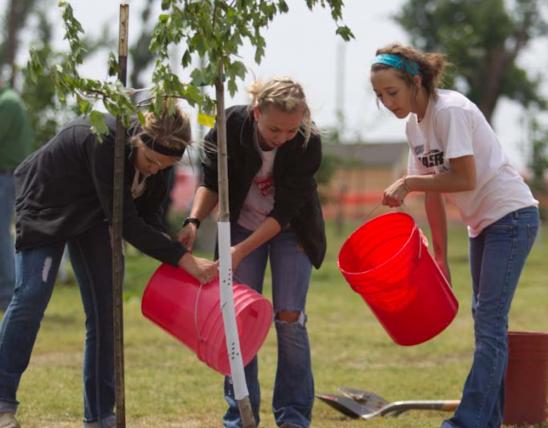
>> The Missouri Invasive Plant Council, which is a group of professionals from agriculture, conservation . . . lots of different fields, who are concerned about invasive plants . . . came up with this idea of a Callery pear buyback as a way to draw attention to the threats that Callery pear trees pose to many different aspects of Missouri, and Missouri's landscapes. So, the idea is that we engage citizens to take part in cutting down one or more Callery pear trees on their property. They take a photo of it, they send in their photo, and they can receive a free replacement native tree in its place. So, it does help remove some Callery trees from the landscape. But what's really important is that it's allowing people to take action, to be engaged, and to start paying attention to invasive plants.
A lot of people are unaware of invasive plants, so this helps raise awareness. Other people are very aware of them, and it gives them some satisfaction, and some motivation, and it rewards them for taking action.
>> Carol told me the buyback program is still a fairly new event, first established in 2019 with just one location providing free native trees to participants. But it has gained such popularity that it's now offered in 23 locations across Missouri. Registration is open now through April 16th with the free tree pickup events happening all across the state, on April 21st.
[12:00.]
>> And so . . . you know, Callery pear trees will bloom at different times, in different parts of Missouri. It's a big state, and of course things are generally in bloom sooner in the southern part of the state, and then moving northward. We have those 23 locations for the event, throughout the state.
So, I invite listeners to go to moinvasives.org, the website of the Missouri Invasive Plant Council. You'll find a tab about the buyback, and they will learn all about it, all of the locations, how they can apply . . . and they will also find details for each location, including the kinds of tree species that will be available at each location.
>> That was going to be my question. Do they get to pick a certain species?
>> They can pick, as long as the supplies last. We make every attempt to honor their choice. But when we run out of one species, we run out.
>> Whenever they plant a native tree in replacement of an invasive tree, how soon do they start seeing the impacts of that? Is that almost instant?
>> Yes. There's several ways to answer this question. You know, if you have a tree in your yard . . . it can feel a bit shocking to cut a tree down, you know? In your yard. But Callery pear trees, if you have a Callery pear in your yard, say it's a Bradford cultivar . . . and a mile away, a neighbor has a chanticleer variety of a Callery pear . . . if bees are flying that mile from one residence to another, they can be pollinating the flowers of the one cultivar, and flying to the next. So, an individual cultivar . . . if all we had were Bradfords, they're all clones of the same tree, the same Callery pear.
[14:04.]
So they can't reproduce, but when you have different cultivars, those are genetically different. You can have cross pollination, and then the flowers are fertilized, and you have fruits for them with seeds, and birds carry the seeds, and so forth. When you cut down your Callery pear, you're helping to stop the reproduction of that tree. You're immediately taking a positive step to cutting down on the future invasive potential.
So, that's one immediate effect. Now, the trees that we provide are small. They're between 2 and 4 feet tall, in 3 gallon containers. We choose that size for a few reasons. One, a lot of people don't have pickup trucks. They have cars, and they come to collect their tree. That size will fit in your car. Two, smaller trees have a better rate of success of surviving, because it's less stress on the plant if you're planting a smaller tree. Third, we are getting many of the trees donated, but we also are purchasing a number of the trees. The smaller the tree, the less expensive they are, and the more we can provide to people. So, you get a 2 to 4 foot tall tree, you plant it, and you think "oh gosh, this is going to take forever to grow."
But in fact, these trees, depending on the species and of course how much they're watered, and the growing conditions . . . they can grow 12 to 24 inches in a year. That's a foot to 2 feet a year. I like to think of it as . . . it is going to take several years to grow, but what if you did nothing? The best time to start is now. Time goes pretty quickly, and that tree will soon be providing shade. Even before it gets sizable enough to provide shade, it may be a host plant for many native insects that will feed on the leaves.
[16:02.]
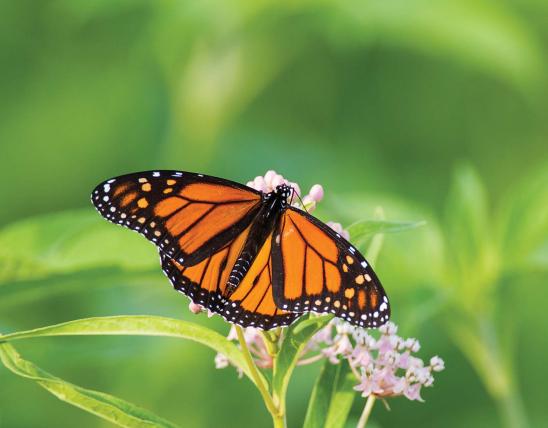
They're not going to hurt the tree. This has been happening for thousands of years. For example, suppose you choose a pawpaw. Well, even when it's rather small, it's still going to have leaves that can provide food for caterpillars of zebra swallowtail butterflies. There are so many specific relationships between specific insects, and specific plants that they use as their host plant, or their food source. Those benefits are pretty quick as well.
I do want to really thank our partners in making this possible. Many of the locations for the buyback are being staffed by the Missouri Department of Conservation staff. Also, trees are being donated by Forest Relief of Missouri, and also by Forrest Keeling Nursery. We are purchasing some trees as well, but those two entities are donating many trees. The Missouri Community Forestry Council is providing some funding to us, and also Magnificent Missouri has provided some funding to the Missouri Invasive Plant Council. We're using some of that to help purchase trees and to offset our coordinating costs. The Missouri Prairie Foundation, which administers the Missouri Invasive Plant Council, is also providing administrative cost assistance as well.
>> Carol, last question for you, what would you say to somebody who actually likes their Callery pear tree?
>> I would say, let's look at this in a positive light. When anybody pays attention to any plant, and likes any plant, I think that's a good sign. That means people are connecting with nature. They're connecting with a plant. So, I would start there, and maybe talk to them about what it is that they like about it. Do they like the flowers? Do they like the fall foliage?
[18:00.]
Do they like to see birds perched in it? Start finding out more about why they like it. And then, have a conversation. "Oh yes, I can see where you might really appreciate that attribute of the plant . . . but you know, we have many other plants that have those same qualities, but they have so many other benefits to birds that you like to see . . . or butterflies you like to see", or whatever it might be. So I would start with their love of plants, and then go from there.
>> That is a great entry point! I love that you said that. Just the fact that they're noticing nature, and noticing the tree, is a positive that needs to be acknowledged.
Carol, anything else you would like to talk about with the buyback program?
>> I just invite everyone to think about the plants that are all around them, whether you are a homeowner, and you have a yard . . . look at what's growing. Learn what's there . . . or maybe you have a business, and there are trees and shrubs in the back of it, and you didn't plant those. Just to be curious about what's growing on my property. When we own or manage property, we're responsible for that vegetation as well. I think we can all play a role in the early detection of invasive plants, and in their management. There's so, so many benefits to managing and removing invasive plants and replacing them with native plants. The time to start is now. There are just so many benefits, and it's something that I think everybody can be involved in at some level.
[Music ♪]
>> The story of the Callery pear is a reminder that nature is . . . complex. What looks like a success story in one decade can become a cautionary tale in the next. From suburban sweetheart of the 1950s, to invasive scourge of the 2000s, to a "prohibited plant" in 2025. It's a full circle moment for a tree that once symbolized perfect landscaping. And maybe, it's also a lesson in choosing beauty that belongs.
I want to thank today's guests . . . MDC Forestry Program Supervisor Russell Hinnah, Missouri House Representative Bruce Sassmann, and executive director of the Missouri Prairie Foundation, and Chair of Missouri's Invasive Plant Council Carol Davit. And of course, thank you for listening to another episode of NatureBoost! Next month, we're sharing another way you can connect with Missouri's native wildlife, this one by taking part in the Missouri Birding Challenge. Be sure to check it out on the third Thursday of the month!
I'm Jill Pritchard with the Missouri Department of Conservation, encouraging you to plant a native tree, and get your daily dose of the outdoors!
[Outro music ♫]
I still do like that one song that they played in the Spiderman soundtrack . . .
>> [Laughing.]
>> Do you know which one?
>> I think so.
>> With Tobey Maguire, he was the 2002 spiderman . . . "and they say that a hero . . ." [impersonating Chad Kroeger.] You remember that one?
>> Yeah.
>> That was a good one. I still like that song. No shade to Chad Kroeger!
[End of podcast.]