






NatureBoost Episode 73: Spotted Salamanders
February 2026
SMA
[Nature sounds, birds/frogs chirping.]
>> One time in the Ozarks, it was I think Valentine's Day weekend ... the wood frogs were calling a lot, and the rain had stopped. I wanted to sit back and just listen to the wood frogs calling. I'll tell you, I kept hearing this little rustling, and rustling. I was like, "what is that little noise I can faintly hear?" Then I turned on my light, and there was a spotted salamander heading to the pond. And then another one, and another one ... I'm not kidding you, I could hear these salamanders marching to this pond, probably more than a thousand spotted salamanders were in there. It's the biggest event I've ever seen in my life.
[Intro music ♫]
>> Hey there, and welcome back to NatureBoost! The podcast where we explore the outdoors in Missouri, one adventure at a time. I'm Jill Pritchard with the Missouri Department of Conservation. I first want to begin this month's episode thanking everyone for all of the kind messages about our first true crime episode we launched in January. NatureBoost Investigates has been an idea that we've had for a long time, and it really could not have happened without the support of MDC's Protection Unit. Again, I wanted to give a huge thank you to Lawrence County Agent Andy Barnes, and of course Protection Unit Chief Travis McLain for sitting down with me. And be sure to keep listening, because we have more NatureBoost Investigates to come!
[Nature sounds.]
In February, we celebrate Black History Month, Groundhog Day, which we covered last year ... and the popular, or dreaded Valentine's Day. Hearts, flowers and chocolate fill up local grocery stores, and kids in classrooms make sweet memories exchanging valentines and candy. Except ... me in third grade when I gave a freckle-faced boy named Josh a valentine, and instead of just being nice and saying thank you, he told me he didn't like me ... but I'm on a podcast now, and where are you, Josh?
[2:03.]
That's what I thought.
So yeah, February and Valentine's Day can be a really sweet, or traumatic time for you. But here on NatureBoost, we want to know what's going down in the animal kingdom. And what's going down, is that they're getting down. It's true. For wildlife, it's one of the busiest times for romance, or at least reproduction. From nighttime serenades and sky dances to mass underwater spawning events, Missouri's native species have some truly strange, and actually kind of cool ways of finding a mate. Later in this episode, we're going to hear from our favorite herpetologist, Dr. Jeff Briggler, about one of the craziest mating rituals we have in Missouri ... the spotted salamander's so called "breeding frenzy."
But first, let's dive into a few of Missouri's weird wildlife romances.
[Music ♪]
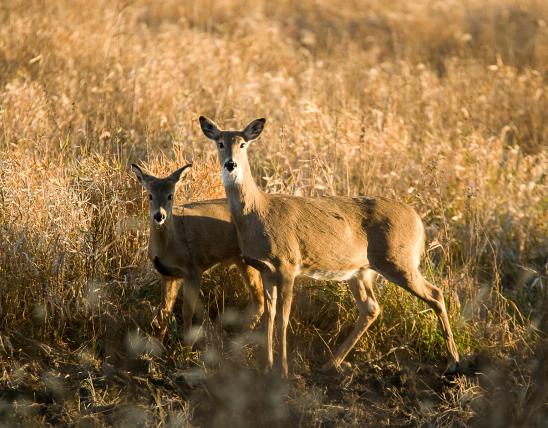
Winter may seem like a slow and quiet time, but behind the scenes a surprising number of species are actively breeding. Animals have evolved to mate during late winter and early spring because food will be more available when their babies arrive in the warmer months. So, it's actually pretty smart! One example is North America's only native marsupial, the Virginia possum. Do you say "possum" or "opossum"? I just say "possum." So, these guys are weirdly "efficient" at breeding ... I'll explain. So, possums will start breeding in wooded areas along streams in early February. And, they're only pregnant for about 12 days before they give birth. Minutes ... minutes after they're born, the babies crawl into the mom's pouch, because she's a marsupial, and they stay there for the next 70 days where they continue developing.
[4:08.]
Which is ... insane! Oh, and something else which is kind of cool ... just like their Australian relative the kangaroo, baby possums are called joeys. I did not know that! So, of course I had to share that.
[Music ♪]
So you like love songs? Name this artist. [Coyote howling sound.] This wild canine couple is going exclusive this season. And to celebrate, they're making sweet, sweet music together. Coyotes, or "coyotes" [different pronunciations], both are acceptable, live alone in couples or in family groups. And come February, they start howling to communicate, defend territory, and strengthen their bonds. So, don't think of these vocalizations as unsettling nighttime screams. They're love songs, baby! They're love songs.
[Coyotes howling.]
[Music ♪]
With its short neck, plump little body, long bill and big, blank eyes that sit really far back on its tiny head ... the American woodcock in my opinion is the goofiest looking bird we have in Missouri. So was I surprised when I heard their mating ritual was called a "sky dance"? I'm not going to lie, yes I was. Because, I'm shocked these birds can actually fly given their weird bodies. I thought they were kind of like penguins, you know? Like flightless birds. But I was wrong. So, back to the sky dance.
In late winter, the male will perform this super dramatic display to attract females. He first starts doing this iconic, nasally "peent" call from the ground.
[6:00.]
Then, he spirals hundreds of feet into the air before zigzagging back down. That's the sky dance, all to impress a mate. And ladies, we know what works because we love a man who can dance, right? If you're looking to get a peek at this romantic display, look for open spaces near shrubby woods. Places like pastures, power line rights of way, or even recently logged clearings. The best chance is right around sunset, but sometimes you can even see this show right before dawn. But just be mindful to be respectful and keep your distance, and don't laugh! He's trying to make a move!
[Music ♪]
And of course, valentines aren't just for the land-dwellers. Even fish get in on the February breeding action. As water temps begin to rise towards late winter and early spring, walleye move into shallow, rocky areas to spawn. Unlike birds and mammals, there's no nest building or parental care. Instead, multiple fish release eggs and milt, which is a fluid that contains sperm, into the water at the same time. Thus, letting nature take it from there.
Which brings us to an even more extreme version of this same strategy. Some animals take group spawning to an entirely different level. In Missouri, one small amphibian gathers by the hundreds, sometimes even thousands, for a single explosive mating event. It's messy, loud, and fast. So much so, it's known as a "breeding frenzy", and I brought back Dr. Jeff Briggler to tell us about this insane secret life of the spotted salamander.
[Music ♪]
[8:00.]
>> So, the spotted salamanders are well known for what's called a "breeding frenzy." What they do in late winter, early spring after heavy rainfalls, they migrate to ponds by hundreds of individuals. Males arrive first, and then females arrive later. And they're arriving at the ponds to actually mate, breed, and deposit eggs.
>> Dr. Briggler, I have to back up for a second. Why do they wait for these very specific conditions in late winter to move to these breeding ponds?
>> Well, spotted salamanders are amphibian. They're going to dry out, so they got to have wet conditions. Come January, February ... it could be a snow melt, or 2 or 3 inches of rain that occurs into nightfall. They don't want to migrate during the daytime. These heavy rain events will stimulate these animals to come out of the ground, and then they'll march towards that pond. Most of the population of the pond that they're breeding in is about 200 meters away. And, the males always arrive first. So the first couple of rain events, they're there, and then maybe a few weeks later the next rain events ... the females will start arriving.
So the pond already has a couple of hundred male spotted salamanders in the pond, and they're just waiting for these females. Just think about when the first females arrive. All of these males are there, swimming around her in this frenzy, trying to attract her by nudging her, by dancing with her in the water ... eventually she's going to select one of those that she's going to mate with. But mating in salamanders, and most of the species, is totally different in salamanders. Because, it's considered external. And, the male lays what's called a "sperm packet." It's just a little gelatinous stock with a white cap the size of a BB on the top. That's the sperm in that BB, so that female, she'll come along if she liked that male, she'll pick up that into her vent, and then she will lay her eggs through that, and they get fertilized as they come out of her, and then they're attached to limbs and other debris in the pond.
[10:13.]
>> So they depend on fishless, temporary ponds right? They need those specific habitats for the success of the egg?
>> Well, they need the temporary or semi-permanent ponds not even for the success of the eggs, but really success for the larvae. No predators. There's no fish in these ponds. They're very shallow, because they get really cold, or they dry up. So you don't have predators to eat their larvae. After this breeding happens over a few week period, all of these animals leave the pond. They go back out into the forest. So, you've got these egg masses out there. One female spotted salamander, she can lay 200 to 400 eggs. Their eggs are very easy to ID, because they swell up with this big like, jelly mass around them. They can be the size of a golf ball, to as big as a soft ball.
>> Are you serious?
>> With hundreds of eggs embedded. And the pond can be filled with these.
>> So ... it's almost like a jelly, like eggs covering the pond afterwards?
>> Yeah. On the edges, if there's not a lot of sticks and limbs to attach them to, they're just going to lay them in the shallow water, they'll swell up and get very large. The little tiny eggs in there, about the size of a BB, will start developing. They'll hatch in about 4 to 6 weeks, this little larval salamander will hatch out. They're only like a half inch in size. And then after they hatch out, they forage and feed in the pond. They're eating zooplankton, mosquito larvae, other little salamanders that are smaller. They're definitely meat eaters. Then, they'll keep growing and growing, and in mid to late summer they'll metamorphose. Their gills will recede, their tails ... they'll transform on to land.
[12:02.]
And when they leave, they're a couple of inches in size, and they're usually solid black. Within a few weeks, the spots will start appearing on their tail, and work its way up their back. Eventually in about a month or two, they'll have little yellow and orange spots all over their body.
>> Is it true that those salamanders who hatched from that same pond will come back to that pond to breed?
>> In most cases, the brunt of the population do return to that pond. Usually what happens, some of the young will disperse ... but in a lot of cases, wherever that female or male breeds for the first time, they're probably going to return to that pond for the rest of their life. And here in Jeff City, when I moved here almost 25 years ago, there was a pond in the neighborhood where I was at that was developed. It had spotted salamanders in it. They were building the store, asphalting the whole parking lot and everything where a pond used to be.
I went out there the next year, on the rainy night when these salamanders should be migrating, and I went to that spot where that pond was, and there was 200 spotted salamanders sitting there, wondering where their pond was.
>> Oh!
>> Because they're always going to try to return to their natal pond that they reproduced in.
>> That is so heartbreaking! I almost wish you hadn't told me that story.
>> Well, the good thing is we can pick those up, hopefully transport them to another pond, and maybe they'll imprint on that pond. There are some things we can do. Unfortunately, they do have sight fidelity to specific locations. But some animals do move to other ponds, especially the younger ones. You do want that to happen. You want genetic exchange. You want adventurers going somewhere else to colonize new locations.
>> Are these kind of mass migrations synchronized across the state, or ... does the timing and behaviors vary by region?
>> Because Missouri is a very large state ... I mean, southwest Missouri up to kind of northeast Missouri is a lot different in weather.
[14:07.]
Typically in southern Missouri, you're going to see a lot of spotted salamanders, maybe even start breeding in late January into February. As you go north towards St. Louis and that, it's going to be a little bit delayed. That's because winter hangs on in the farther north.
However, you've got to also realize the weather is different across the state. Who knows if southwest Missouri is going to get 2 or 3 inches of rain in February? If they don't get the rain, then those salamanders aren't going to migrate to the pond. It's all going to depend on that weather, and where it's at. For someone like me that studies these synchronized breedings and stuff, you have to watch the weather a lot. You've got to pay attention to it. Somewhere in the state, there's going to be really good reproduction. Sometimes, it's the whole state, and sometimes it's just a regional effect. Every year is different.
>> After they breed in the ponds, do they immediately return to their burrows, or do they stay in those ponds after breeding?
>> After they breed in their pond, they leave the pond. We don't know a lot about what they do on land. They probably are going back to specific burrows somewhere. They can't make them themselves. They don't have claws or fingernails to dig, so they're using rodents ... other holes that are made by maybe cicadas. The holes that they emerge from are the perfect locations for these animals. Then they're there for the rest of the year. So, here's the spotted salamander. Probably the most common salamander in our state, that very few people will ever encounter.
If you ever want to see one, you just have to go out in February, March ... find a pond on a rainy night, because that's where you're going to find them. If you miss that, you're not going to find them. I can go out there and look all summer long, and I'm not going to find one. You've got to get it at that time period. It's really fascinating to do this, because you're sitting out there after this rain quits.
[16:03.]
And ... hundreds of these animals are moving! If you really pay attention and listen, you may even hear them walking through the leaves. When you've got that many animals marching to a pond and using your light, and entering that pond ... and then if you're really fortunate, you can see this breeding frenzy that occurs. What happens in a lot of cases when it rains a lot, the pond is kind of muddy. But if you get that perfect night where they've migrated, the pond is real clear, and you're just standing there with a flashlight, seeing hundreds of salamanders swimming back and forth ... it looks like total chaos to us, but to them it's not. This is what they do to mate, to reproduce, to carry on for their futures.
>> So it's important to note that if you want to see this event, you have to look in a very smaller pond ...
>> Yes.
>> With no fish.
>> Yeah. If you own some land, and you have a pond with fish that you fish in, don't even waste your time going there. It could be, I hate to say this ... your sewage lagoon could be a place where they will breed. A lot of frogs will breed at that location. Or, it could be a roadside ditch that when you're driving on your farm, it always holds a little bit of water in it. That could be the location, too. You've just got to pay attention to the different types of water on your area. Now ... and spotted salamanders are 4 species. So, you're not going to find them out in the grasslands. You're going to have to have a lot of trees around them, in kind of a forest, woodland landscape. That's where they have to be, underneath that leaf litter, and in the ground there.
>> What should listeners know if they do find a place where they can watch this breeding event? What should they know about watching it responsibly?
>> Well, to me, you don't want to disturb it, honestly. It's such an event that if you get to really witness it, stand back, just have a flashlight on that you can just see. If they're in their breeding frenzy, they're not going to care. Now if you start getting in the pond, disturbing them and messing with them, then they're probably going to go deeper where you can't see them.
[18:08.]
So, I would definitely say just stand back, watch nature take its course. It is fascinating to watch this, when you see hundreds of these salamanders that you will never see at any other time of the year. It might be the first time you've ever seen one in your life, and you're like "I can't believe I've never seen one of these, and now there's hundreds of them swimming right beneath my feet here."
>> Do you have any favorite stories to share from your years of watching these breeding events and courtship behaviors?
>> I remember one time in the Ozarks, I was actually out looking for wood frogs. It was I think Valentine's Day weekend. The wood frogs were calling a lot. The rain had stopped, so I wanted to sit back and just listen to the wood frogs calling. I'll tell you, I kept hearing this little rustling, and rustling, and I was like "what is that little noise I can faintly hear?" Then I turned on my light, and there was a spotted salamander heading to the pond. And then another one, and another one ... and I have a field notebook that I write down stuff in. After a while, I'm not kidding you, I could hear these salamanders marching to this pond.
I wrote in my field notebook on this one pond probably more than a thousand spotted salamanders were in there. I try my best to count them ... at some point, you give up. This one, it's the biggest event I've ever seen in my life. I don't know if I'll ever see that again. But I will never forget that! It's all because I was patient, I wanted to hear the frogs call, and I was listening to try to see ... it was the perfect night. This was 20 something years ago, and I don't know if I'll see that kind of night again, at that volume.
>> That is magical!
>> I will say this. When I was trying to determine what I wanted to do in grad school, studying different animals ... a project came along for me to study pond breeding amphibians.
[20:00.]
I really did not know much about them. And that intrigued me, because I like to learn about new things. I will tell you, when I was working on my master's degree, the first adult spotted salamander I ever held in my hand, I knew I was hooked as a herpetologist that day. It meant a lot to me, and that drove me down my career path today.
[Music ♪]
>> And there you have it! From coyotes serenading under the moon, to woodcock's crazy sky dance, to salamanders piling into ponds ... February is for lovers, both human and animal. And, it can also be a little weird. But who am I to judge? I'm still waiting for my 3rd grade crush to make amends. You hear that, Josh? I'm waiting for you!
Thanks to Dr. Jeff Briggler for taking the time to speak with me, and thanks to you for tuning in to another episode of NatureBoost! If you liked this episode, subscribe! Leave us a review, maybe share it with a friend, a lover, your mail lady ... whoever. And, be sure to join us next month when we'll be talking about the grossest smelling tree in Missouri, why it was once a popular neighborhood ornamental, and how we finally came to our senses and made it illegal to buy. It will be an interesting history of the Callery pear tree, so be sure to tune in. I'm Jill Pritchard with the Missouri Department of Conservation, encouraging you to get your daily dose of the outdoors!
[Outro music ♫]
[End of podcast.]