





NatureBoost Episode 67: Tree Health
August 2025
SMA
[Intro music ♫]
>> Hey there, and welcome back to NatureBoost! The podcast where we explore the outdoors in Missouri, one adventure at a time. I'm Jill Pritchard, with the Missouri Department of Conservation. So far in 2025, we've focused a few episodes on trees, and I gotta say, I'm not mad about it! In March, we toured the state forest nursery, and learned how that facility has been restoring green spaces for more than 90 years. In April, we celebrated Arbor Day by visiting the famous Hammons Black Walnuts, the company that has been supplying the country with black walnuts for over 70 years, most of which are harvested right here in Missouri. And this month, we're discussing the health of our trees. Whether you're walking under the shade of a maple on a morning stroll, or relying on a forest ecosystem miles away, trees are a part of your life.
But, here's the thing. They need our help, now more than ever.
[Music ♪]
Trees are more than just background scenery. They are the lungs of our planet. A single mature tree can absorb up to 48 pounds of carbon dioxide a year. They cool our cities, prevent soil erosion, purify water, and create habitats for thousands of species. They're also crucial components of our nature boost, right? They improve our mental and physical health by lowering stress, increasing focus, and even speeding up healing. But, for all they do, trees don't always get the care that they need. I brought back MDC's forest entomologist Robbie Doerhoff to learn why tree health matters, and how it's linked to human health.
>> Here at MDC, we are starting to approach things from a "one health" concept. Which is, you know, wildlife and the environment and human health . . .
[2:04.]
It's interconnected. We're not separate, even if some of us may live in urban areas. We're still part of the environment and the ecosystem. This is all together. So, tree health is very much a public health issue. Places that have canopy cover in urban areas often have better high school graduation rates and better school attendance by students. And, there's just lots of links to different aspects of public health and trees and a healthy surrounding environment.
>> When cities lose tree cover, there are measurable effects such as increased energy bills, higher asthma rates, and more heat-related illness. The data confirms just how crucial trees are to human health. But sadly, trees are facing their own threats. From invasive pets and disease, to urban development and climate change. But also, we humans may need to reevaluate our own tree care practices.
>> We love our trees to death. That's probably the nicest way to put it. Most of us don't intend to harm that amazing tree in our front yard, because we love it. We absolutely love the tree, we don't want to inflict any damage to it. But, we can love them to death. One of the ways we love them to death, and this is with a new home owner especially . . . you buy that cute little house, maybe it's your first home. You're just loving it, there's a beautiful tree in the front yard, and you go to your local box store, and you buy a bunch of blocks, and you make this beautiful ring around that tree, and then fill it up with 18 inches of soil. And, you plant some hopefully native plants in there . . . but, maybe not. You make a flower bed in your front yard, and you're so proud of it, and it looks so good. Then about two or three years later, you notice that your tree is starting to look like garbage.
[4:03.]
The canopy is not as full, the leaves are off color, maybe you're starting to see some insect or disease issues . . . and you don't realize that you are the reason that all of this is occurring. You, putting that flower bed around that tree, is why that tree began to decline. The majority of that was caused by the damage you did to the root system. Now, most of us think that tree root systems are more like a carrot. Okay? That's usually how . . . when I'm speaking with the public especially, the idea is that trees have this big, long taproot. And, it taps into some magical water supply, you know, 15 feet underground.
>> There's not a pool underground where it's getting water? [Laughing.]
>> Well, way underground maybe . . . but not where trees are accessing the water. Plus, the roots aren't designed to do that. Unless you're a bald cypress and you live in a swamp, you don't want to live in water. Your roots can't handle that, and that can actually cause stress and death of roots if they are in standing water. That's why we sometimes see damage along flooded areas to trees, and it's because of root stress. So, what tree roots actually look like is a wide, flat mat. Yes, there are some structural roots about . . . they may extend 3 or 4 feet into the ground, to help anchor that tree to the ground right under its trunk.
But over time, the majority of the root system is this wide, flat mat about 6 to 18 inches deep at the most. Okay? And in our urban areas where the soil is very compacted, after years of humans being over that soil, then the tree roots are even more shallow. So, tree roots are only going to go as deep into the soil as they can access oxygen. We think of trees as producing oxygen, and they do, above ground . . . but underground, they actually need oxygen for the root system to do its proper respiration.
[6:03.]
So, when the soil is really compacted it's almost like concrete. There's not a lot of pore space in that soil for oxygen or water to exist. So, the roots are going to be more and more shallow when that soil is more and more compacted. If you have, let's say a maple tree in your front yard and it has all these surface roots, a lot of people want to cover that up, or somehow, you know . . . kill those roots because they don't like the way they look. But, that tree is doing that in an effort to stay alive. You may put a little mulch over that, but you don't want to bury those roots because that will actually cause the tree a lot of stress. It's trying to access oxygen, and in order to do that, some of those roots are going to have to be surface-level.
>> It was enlightening to learn that tree roots grow outward, running parallel to the ground, instead of growing straight down into the soil. And, by covering up the base of the tree with planting beds, we're hurting the tree because those roots need oxygen too. And, those herbicides that kill the dandelions and other weeds in your yard, those are slowly hurting your trees.
>> It's sort of a "weed and feed", a pelletized thing that you put down a couple of times a year. Or, maybe you're actually spraying the grass to kill the broadleaf weeds. Just know that a tree is essentially a giant broadleaf weed. And when you put down those herbicides, particularly those pelletized, slow-release ones, they're going to leech into the soil, and they're not going to kill your grass . . . but they are going to kill your tree's roots that are really close to the surface. So, now your tree is operating with a compromised root system, and you didn't intend that, I know . . . but you didn't think of your tree as potentially being harmed by that weed killer that was pictured as killing dandelions, right?
Over time, it can be, and I've seen a lot of homeowners that really didn't mean to do that, but they did . . . I rarely recommend any kind of pesticide. I always tell people to keep the herbicides away from their trees.
[8:03.]
Particularly . . . you know, you want to avoid string trimming around it, you don't want to mow near it, but maybe you don't have the ability or the time to put mulch around it. So, people will take herbicides and spray around the base of the tree so there's this bare area. That is super detrimental to your trees. Maybe it's worked in the past, but a lot of these herbicide formulations are changing right now. So, unless you're keeping up with what those different chemicals do, you may use the same branded product you've always used, but the active ingredients are different now. So, you accidentally kill your tree doing something you've always done in the past, but it's actually with a different chemical . . . and you didn't realize it. So, we want to avoid that.
When it comes to insects and diseases, there's only very specific situations where I'm like "okay, yep, it is worth it to treat this tree for this particular pest." An example would be emerald ash borer. There's some really great, scientifically proven insecticides out there that will protect a healthy ash tree from emerald ash borer infestation. You're going to have to be on a regular schedule with that for the rest of that tree's life, but you can keep that tree in your front yard if it's, you know, your favorite tree. You can keep it alive.
However, most of these chemicals, these insecticides, they turn that tree, essentially . . . into a poison stick, from the perspective of the insects. Yes, you keep emerald ash borer out, but that insecticide doesn't care if it's emerald ash borer, or a tiger swallowtail, or anything else. It's going to kill whatever eats it. So, in some situations, it may be worth doing that. In a lot of situations, it is just not. Okay? And, it is never a good idea from a conservation perspective to just treat your trees in advance of an issue. I see people that will go in and buy certain products that are labeled "for systemic, year-long control of insects on trees."
[10:04.]
They don't know what they're controlling on their tree. They just like the idea of insects not eating their trees. So, they will treat their trees early in the growing season, just in hopes of killing all the bugs that might nibble on it. But I can tell you that this big, tall white oak we're sitting under right now, it looks great, it looks very healthy. But this tree probably has thousands of insects on it right now.
>> Oh, yeah.
>> And, it is full of life, there are birds eating these insects . . . that is nature. Unless you have a true pest outbreak that is going to truly be detrimental to that tree, there's no reason to keep every day bugs off of it.
>> They're treating a problem that doesn't exist!
>> Exactly. And, it's actually environmentally detrimental to do that. And, some of these insecticides, especially when they're applied to the soil . . . it's not like just the tree's roots are going to take those up. If you have coneflower planted nearby, that coneflower may take up that insecticide, and then kill all the bees and butterflies that visit it. So, really keep in mind when you're treating for insect issues in your own yard that you truly know what you're treating for, that you're using the right active ingredient, that you're following the label on that, and that the timing is proper, you've properly identified it . . . all of these things.
That's how you're going to do the least amount of environmental damage, with an insecticide, a fungicide, any of the pesticides. And if you need help identifying what the damage might be, the University of Missouri Plant Diagnostic Clinic, Dr. Tien, is awesome. For a very nominal fee of $15 to $20, or even less, he can identify exactly what you're seeing, and give you the proper treatment recommendations. So, just google "MU plant diagnostic clinic."
>> We'll put that link in our episode description, so people can easily find that.
[Running water sounds.]
[12:00.]
>> The best chemical you can treat your tree with is that good old fashioned H2O! If you have a newly planted tree, keep an eye on the weather with a rain gauge, and water every week or so, depending. And, don't just water in the warmer months either! Roots are still active in the winter, so if the ground isn't frozen, be sure to give trees a drink in the winter time too. And, it's not just the new trees. Even older, mature trees need watering, especially in times of drought.
>> But then, when we start talking about the more established, mature trees in our landscape . . . there are certain diseases that will come in and kill trees during bad droughts. But, they're only there because the tree is stressed by a water deficit. So, if you water your tree a couple of times a month during a drought, or like later this year . . . you know, we've gotten a lot of water here recently, but July, August, we may not see water again for 6 months, honestly, the way it's been going the last few years. Keep in mind that these trees could really use a drink every now and again. And, I don't mean just putting the sprinkler out there and watering your grass. Your grass' roots are going down about 6 inches, and they're in direct competition with your tree's roots. Okay? What you want to do is take that sprinkler head off your hose, walk over to your tree, and give it a bear hug. At about bear hug height, estimate the diameter, not the circumference . . . the diameter. Let's say this tree is 20 inches in diameter. That's from the outer edge, to the outer edge, through the middle of it.
And, we want to take that 20 inches diameter and times it by 10 gallons. So, 20 gallons of water per inch of trunk diameter. So, we're looking at 200 gallons of water. Now, I have a big fish tank, so I can think about that in fish tank terms. You know . . . think about, we could probably google what the average shower uses.
[14:00.]
Honestly, that tree only needs 200 gallons of water? That's not that much.
>> It sounds like a lot!
>> It sounds like a lot, but look at your water bill next time and just realize . . . say you water that tree twice in July, 400 gallons of water. It's probably only going to cost you like $4. [Laughing.]
>> Yeah.
>> Maybe $5, you know? Unless there's some kind of watering ban because we're super droughty . . . you will save yourself thousands by not having to, number 1, lose that tree, but to have to take it down . . .
>> To take it down! Tree work is expensive.
>> It's super expensive, and rightfully so. It's dangerous work. But okay . . . this tree is going to need 200 gallons of water, and what I'm going to do is turn my hose on, and I'm going to take 2 milk jugs, and I'm going to set it at about medium pressure which is roughly 2 gallons per minute. See where I'm going with this? It helps you do the math a lot easier. So, you know that you're going to need X number of minutes to get the right amount of gallons. So what I do is kind of spread it out . . . I'm going to look at the tree, and we call the dripline, you know . . . where the canopy is. And, it comes straight down. Envision this canopy just having a shower curtain coming down from the edges.
>> Okay, yeah!
>> That's the dripline of a tree. Remember, we talked earlier about how wide these root systems are. But, the further they get from the tree, the more unpredictable they are in that greater area. So if we really want to target getting the most roots possible, then we're going to stay within the drip line of that tree.
>> Okay.
>> With our watering . . . I usually pick the 4 cardinal directions. Like, "alright, I need say 80 minutes of water at 2 gallons, or 100 minutes of water." That would be the right thing for our 20 inch example here. So, every 15 or 20 minutes, I'm going to set a timer on my phone and I'm going to let the hose run in a spot for 20 minutes. Then I'm going to move it around until I get my 100 minutes.
[16:02.]
>> That's under the dripline . . .?
>> Under the dripline.
>> Which is just kind of under the canopy . . .
>> The canopy edges.
>> Okay, gotcha. Okay!
>> So, that is enough, and I often get questions of "is that enough water to actually keep the tree alive?" Yeah, it's enough to keep it alive. And if you change where you do that every couple of weeks within that dripline, then eventually you're going to deep water most of that area there. What you want to avoid is completely saturating to where it's ponding on the surface. Because depending on your soil type, if it's heavy clay, you could cause overwatering damage.
>> And, what about mulch? Helping, hurting? Good, bad? Too little, too much? Where do we stand?
>> So, mulch can be done properly and have a lot of benefits. Mulch can be done improperly, too. Now, if it's a Callery or Bradford pear, please mulch all the way up the trunk, as high as you can! [Laughing.]
>> [Laughing.]
>> There's no amount of mulch that's too much for those, right?
>> Yep!
>> In hopes of killing it.
>> I love that you said that.
>> But, for the trees that we love and that we want to keep, we want to keep our mulch as a wide, flat mat. Think of it as, you know, more like a shallow doughnut, and less like a volcano.
>> Yeah.
>> So, most people that are into trees have heard "mulch volcanoes are bad." Okay. Let's lay out the good things about mulch. What I mean by "mulch", is something organic and coarse. Sawdust is organic, but it's really fine, right? So in most situations, we won't use a product like that. What we're going to use is maybe a shredded wood and/or bark mulch. Most of the time, there's not really a pest or disease concern with bringing small pieces of wood like that. I get that question a lot, "is this going to bring oak wilt to my neighborhood, or some other disease issue?"
[18:01.]
Generally no, because a lot of insects and diseases can't live on dry, tiny pieces of wood.
>> Okay.
>> In general. Anyways, the shredded wood or bark mulch . . . if you keep it at 3 or 4 inches deep, it will help moderate soil temperatures, okay? When it gets hot during the summer, or really cold during the winter, it will insulate that soil from those temperature extremes, which means that those roots right underneath there will have a better environment to live in. Right? Mulch is also great at moderating soil moisture, so it'll shed some of the excess water that comes down in say, a 4 inch rain event in . . . 2 hours? But it'll also help keep some water retained in that soil longer than if it was just bare soil baking in the sun. Right? So, mulch is really great for that.
Then in a lot of our yards, we have really compacted soil . . . but mulch is habitat for roly polys, and worms and creatures that will then help aerate the soil. So, even ant colonies, I know we all think that ants are terrible . . . but ant colonies will set up shop in mulch, and that's a good thing! They're one of the major soil aerators. And, they provide some fertilizer too, in the form of their droppings. So, having that habitat around your tree will only help create a healthier root environment if you have 3 or 4 inches of mulch.
This will probably have to be replaced every year or two, so yes . . . it is some maintenance, I agree. But if someone calls me and they're like "hey, I have this really amazing tree, we think there's maybe some root damage there . . . what do we do to help maybe slow the decline, or change the trajectory of decline on this tree?" I'll tell them, put the biggest, widest mulch ring you can under that tree. You know? Eliminate the grass, because that's just competition with your tree's roots. If you put mulch down and the soil organisms start churning it, start breaking it down . . .
[20:04.]
That's just a more favorable environment for your tree's root system to make fine feeder roots, to actually right the ship of this tree's decline, potentially. So, mulch is amazing. Do not use landscape fabric under it. That only locks in moisture, depletes oxygen, the air exchange with the atmosphere, and can actually cause root damage over time.
>> Okay.
>> Don't use landscaping plastic, ever, for any reason! That stuff is the worst. But, just a nice, healthy mulch environment is great. If you stack the mulch way too high, like 12 inches . . . if you've ever stuck your hand in a mulch volcano, most haven't, I understand. . . . [laughing.]
>> [Laughing.] I nodded my head, like "oh yeah, I've done that" . . . no, I've never done that!
>> I have! It's hot in there, because that mulch is breaking down. When it's a big wad of mulch, it gets really hot. It doesn't allow water to pass through it. It can actually get fungal material that will mat it all together, and then that is an even worse situation. So, you have to do it right. But mulch can be super beneficial when done right. 3 inches deep, don't let it touch the actual trunk of your tree, just kind of, you know . . . keep it pushed away from the bark. Yeah. As wide as you want it.
[Music ♪]
>> So, we covered how we humans are contributing to tree declines. What about the other threats? Robbie says one of the biggest issues here in Missouri is the emerald ash borer. It's a tiny green beetle that attacks all species of ash trees, killing more than 99 percent of trees it attacks. You usually don't see the green beetles. What happens is the females lay eggs in the bark and the larvae hatch from the egg, and then that larvae bores into the tree. Many times, the first indication that the ash tree is infested is that part of the tree canopy is starting to thin and doesn't look as healthy.
[22:00.]
Emerald ash borer is a major species foresters are concerned about, but there are other pests they're tracking.
>> We also have some others that we keep an eye out for, spongy moth being one of them. If you ever see those little cardboard traps hanging from trees . . . we do this all across the state every year, in different counties every year . . . but statewide. Those are trying to detect the presence of spongy moth populations. We don't have that pest here, as far as we know, at a breeding level. Occasionally we catch the male moths that are drawn to that really innocuous pheromone lure in that trap. Most of the time, you know, we don't catch anything, and we feel good that that pest is not in Missouri currently. If it ever was here, that would be a major thing that we would have to deal with.
But, there are other forest pests. I have a list as long as my arm of things that we are concerned about, and we're looking for. Another one we're likely to get in the next few years that would be very difficult for us to eradicate is called spotted lantern fly. It feeds on about 80 different tree and plant species. It's going to be a nuisance pest. It'll build up in our cities, and on our urban trees. They're going to be very into weighing, and there's really not a lot we can do to slow that down too much. We do ask the public to report things like that.
There are other pests like the Asian longhorn beetle. It has a lot of trees it will attack, but it loves red maple. If you think about, well . . . if this were to enter into any of our major Missouri cities, red maple is a very common tree. And, that one is so serious that the USDA would come in and start cutting down all of the host trees. It's one that if we find it, we want to find it early, so the fewest amount of trees die. If you ever see something that you're like, "that came out of a tree", or it's on a tree and it looks like it's a problem . . . "I've never seen that before . . ." please, please, please report it to the Conservation Department, the Missouri Department of Ag, the USDA office in Jeff City . . .
[24:05.]
Report it to one of us, and we'll figure out if it's something native that we shouldn't worry about, or if it's something invasive that we need to take action on.
>> Robbie says even native species can have outbreak years that can attack our trees.
>> One thing though, that this year we're seeing a lot of . . . is a little tiny wasp called jumping oak gall. It's on the white oak leaves, and it looks like a teeny tiny button, but there's dozens of buttons, button galls on these white oak leaves. When it is a locally high population, it will cause those leaves to brown up and fall prematurely. So, a lot of people are reporting that right now, saying "oh my gosh, my tree looks terrible." Well, it'll probably be fine. It's probably just a one or two year thing, and then your tree will be okay.
Anthracnose, that's a common fungal disease that we see on sycamore. There's another one that hits oak, but if you see a sycamore looking real shabby this year, it's because we had kind of a warm-ish start to our spring, and the sycamores started leafing out. Then it got cool and wet, and that activated that fungus. What you'll see is the leaf starting to get some brown areas, maybe the veins of the leaf will brown . . . and the new growth that has come on this spring will start to brown up and sort of look dead on that tree. Then that tree will have to put out a new bud, a secondary bud, in order to get leaves out. Some trees are more resistant to it than others. There's just sort of spectrum in there of genetic resistance to sycamore anthracnose.
I've definitely seen a lot of it this year, and unfortunately the poor sycamores, as they were starting to leaf out and look okay, we had the second cool, wet spell about 10 days ago, and some of them got it again!
>> Oh no!
>> One thing . . . I love sycamore, it's such a cool tree. You know how down in the river bottoms, the twisty, windy, beautiful old sycamores?
[26:00.]
Sycamore anthracnose is what makes that . . . look like that.
>> Really?
>> Yes, because that anthracnose kills back those new twigs to older growth, and that fungal pathogen can't infect that older growth.
>> So, it has to find a new path?
>> Yes. Then it branches off, it sends out a new bud in a new growth pattern, usually at a right angle. So over time, over many decades, sycamore anthracnose essentially shapes these winding, twisting, amazing-looking sycamores.
>> Oh! They're so ethereal looking.
>> Hopefully that doesn't ruin anybody's perspective on it, that a disease essentially did that to them . . . but that is part of why they look so amazing.
[Music ♪]
>> Trees are so essential, and we need to keep planting them! But, it's important that we're planting them the right way.
>> Pick a native species, make sure you've really studied the spot you want to put it in . . . do you need a big tree there? A little tree there? A medium tree? There's lots of options, and we have a guide on the MDC website about "trees for yards", essentially. It lays them all out as far as what they do, how big they can get . . . some of the native species can be a little bit harder to find, but there are nurseries here in Missouri that you can call and find one of these native species, if you've picked the one you want.
Then, plant it properly. So, this is a major thing I'm seeing across . . . especially yards and communities. A lot of people have just not really had much exposure to plants and growing things. So, they don't understand exactly what depth to plant a tree, or how to plant a tree. But, you want to make sure that you kind of pull back the soil and the pot, or if it's a big bald and burlap tree, you know where those first roots are. Then, depending on your soil type, you want to make sure that when you put that tree in the hole, those first roots are not going to be below the surface of the ground.
[28:06.]
Okay? We say, "plant properly." We have a guide on our site talking about that, but that's the major thing I see. People are putting their trees in the ground too deeply.
>> Okay.
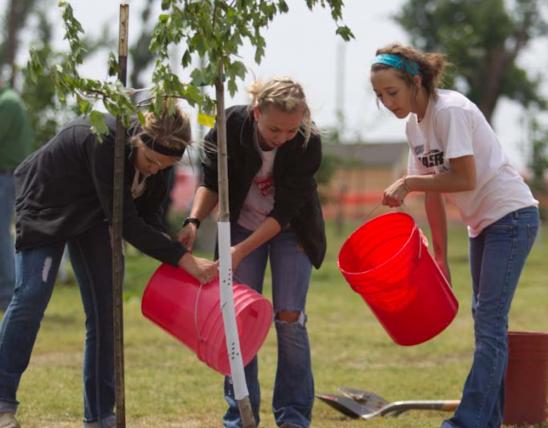
>> So, that can actually cause a lot of root system stress, and eventually within a few years, lead to a dead tree. You're almost better off putting it a little bit higher, especially in a clay soil, and then sort of mounding a little dirt and mulch over the top of that root system . . . than you are putting it too deep in the ground. Keep in mind, there is a right way to plant a tree. And, it really does affect the longevity and the long term health of that tree, how you plant it initially.
[Music ♪]
>> Robbie told me tree care is actually pretty basic. We can keep them thriving by watering wisely, even our mature trees, especially in times of drought . . . mulching, but not a volcano. We can prune dead or damaged branches during the tree's dormant season, in the winter. And, watch for signs of trouble, such as dead branches, leaves browning or falling off early, or stunted growth. If you need an expert opinion, certified arborists can diagnose problems, safely remove dead limbs, and give long-term care advice. They're like your tree's doctor. They're worth the investment. You can find one through the International Society of Arboriculture's Website, at treesaregood.org.
[Music ♪]
>> Tree health is human health. And, it's a powerful way to support the planet. Whether it's planting a tree in your yard, supporting a local tree planting effort, or just giving a little extra water during a dry week . . . your actions add up.
[30:02.]
For more information on planting trees and tree care, visit treeswork.org. Thanks again to forest entomologist Robbie Doerhoff for joining me on this episode, to digital media producer Peg Craft, and to you, for listening to another episode of NatureBoost! Tune into next month's episode, where we're catching up with the Missouri River Bird Observatory to talk about why bird watching is everyone's new favorite hobby! I'm Jill Pritchard with the Missouri Department of Conservation, encouraging you to get your daily dose of the outdoors!
[Outro music ♫]
>> What's your favorite tree?
>> Post oak, and sycamore.
>> Why do you like those so much?
>> So, post oak is an amazing tree that is just so tough, so resilient. I'm from southwest Missouri, where we have a lot of post oak. They're a beautiful, slow growing, long-lived species. It's always been a symbol of just a really strong, resilient species for me. And then sycamore . . .? Come on, that white bark, and those winding branches, and . . . they're just amazing, you know? I grew up fishing along creeks in southwest Missouri, and those big sycamores are just an incredible species.
>> I loved seeing the sycamores too. That was one of the first trees that I was able to identify, you know?
>> Yeah. I actually credit my forest health interest to when I was 8 years old. There was a sycamore anthracnose outbreak. I remember reading in The Conservationist about it . . .
>> Get out!
>> I know! I was so obsessed, because I thought the sycamores were going to die, and it was freaking me out as a small child . . . I've been tree-obsessed my whole life. Yeah, sure enough, here I am, 35 years later, talking about sycamore anthracnose on a podcast! [Laughing.]
>> Your 8 year old self would be so happy, don't you think?
[32:02.]
>> Yes, I think so! I think that 8 year-old would be like, "good job."
[End of podcast.]