






NatureBoost Episode 66: Backpacking Part 2
July 2025
SMA
[Music ♪]
>> This is my backpacking scale, her name is Judge Judy.
>> [Unclear speech in background.]
>> Oh my gosh, this is gorgeous!
>> This is our joy. [Laughing.]
>> We all have our things. It teaches you a little bit of something about yourself.
>> I can do hard things!
>> Woo!
[Intro music ♫]
>> Hey there, and welcome back to NatureBoost! The podcast where we explore Missouri's outdoors, one adventure at a time. I'm Jill Pritchard with the Missouri Department of Conservation. Last month, you heard me prepare and train and seek advice on my first backpacking trip. This month, you get to hear if it all paid off! To recap, I set off to Mark Twain National Forest this April to attend an intro to backpacking program put on by my colleagues, MDC Education Coordinator Marybeth Factor and Conservation Educator Sam Stewart. Our group of 10 met up bright and early on a Saturday morning at Paddy Creek Wilderness Area to hike a portion of the Big Piney Trail. The morning was overcast and cool, and I was optimistic as Marybeth gave us details on the wilderness area, and what type of animal and plant life call it home.
>> Paddy Creek Wilderness Area is 7,035 acres, the most scenic and unique country in the Midwest. It's a lovely claim to fame, I know. Paddy Creek Wilderness is characterized by steep cliffs, rock outcrops along drainages . . . these creeks have water in them throughout most of the year. You will be doing some creek crossings. We can rock hop across them. That means, you do not have to take off your shoes . . .
>> [unclear.]
>> Yeah.
>> There will definitely be water.
>> In the wilderness are a few old fields in the drainages, but the rest is going to be forested.
[2:02.]
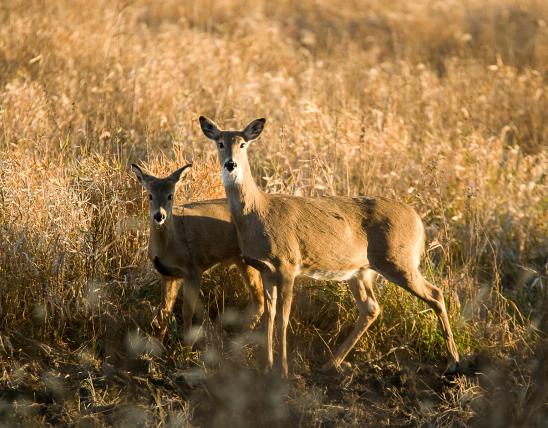
Black, white, post oaks . . . that's mainly what our forest is comprised of, as well as hickories and shortleaf pine. Throughout the area, wildlife typical of the Missouri Ozarks is present. White-tailed deer, wild turkey, squirrel, rabbit, fox, coyote, and bobcat are common. Somebody had asked before about bears. Bears are also common. We are in a bear area as well. We have about 1,035 black bears in the State of Missouri, estimated . . . currently. That's actually up from 850, that was about 2 years ago. Yeah. 2 or 3 years ago.
>> [unclear.]
>> Yes, they're coming! [Laughing.]
>> They're already here.
>> I've worked for MDC for 6 years now. I know Missouri is bear country, and we need to be "bear wise", and be "bear aware." I also know that black bears usually steer clear of humans, but once they smell food, it's a different story. But, we'll get into how we safely stored our food at our campsite later. The next item on the agenda was learning how to properly pack.
>> Alright . . . you got to pack right, to survive the night.
>> [Laughing.]
>> I'm kidding . . . it's not life or death. But, when we get finished with 9 miles, and we have a poorly packed pack, or a heavy pack, it's going to feel a bit like death. So, we don't want to do that. It's more like, "pack right to have a happy hike." Hopefully this will tell you a little bit about maybe what you can leave behind, or remind you of something that you do want to bring. Then, I'm going to pack everything into my pack, so that you can see a little bit about how we should be packing our packs to make it the most comfortable it can be.
I'll start with the backpack. It's granite gear crowned, it's a 60 liter pack. It's really light. It has a plastic internal frame, so it's tending towards that "ultralight" end. It doesn't have a whole lot of bells and whistles. Some of the bells and whistles that it did have, I took off. So, it's very bare bones, essentially just a roll top pack with a belt and shoulder straps on it.
[4:05.]
So, there's not much to it. It weighs about 2 pounds, so it's tending towards pretty light. The first thing that's going to go inside there is this, which is essentially a fancy trash bag. It's made out of something called nylofume. But, it's about 70 or 80 liters, and you can get these for about 30 cents. They weigh absolutely nothing, but they're great for keeping that water out. We will get some of that water. The next thing I've got is my sleeping bag, and for me it's not a sleeping bag. For me, it's a quilt, and everyone sleeps differently . . . I once watched a backpacking video, and it told me something about myself that I did not know before, and that's that I'm a rotisserie sleeper. I go from one side, to the other side, and then the other side . . . I'm a side sleeper, but both sides all the time. So, this is much easier for me. I don't feel constrained in it. It has a [unclear] foot box, which is there at the bottom. Everything else is open. You can just roll around in it differently than a sleeping bag. This one is rated for about 30 degrees as a transition temperature, which means it's going to be comfortable at 35 to 40 degrees. It'll be pretty comfortable.
This is a 700 fill down, and it's about 24 ounces. With down, it compresses so well, that I just want to push it into here. It looks like a lot right now, but when I get it into my pack, and start pushing down on it, I'm creating a base for my backpack. So, I'm going to press it all the way down until it's nice and flat. You can see it going down into the pack, lifting that liner up, and pressing that down down. That "down down."
>> [Laughing.]
>> That's the base of my pack. That's the first thing I put in there. Also, I'm thinking about packing how I'm going to take stuff out. My sleeping bag or my quilt is going to be one of the last things I need in the evening. So, it's okay if it's all the way down at the bottom of the pack. I don't need to get it out for lunch or whatever.
[6:02.]
So, I'm going to pack that all the way down there. The rest of the sleep system is going to be in there with it.
>> The next items to go in are an inflatable sleeping pad, and then Sam's two pillows, which he calls his "luxury items." It was then that I realized I didn't bring any pillows, and I was really wishing that I had. But, I made a mental note that I could ball up my fleece jacket and use that instead. He then packs his clothes, a ditty bag that holds a headlamp and a lightweight air compressor for a sleep pad . . . his kitchen, which is basically a small camping stove and a lighter, then his footprint, which is a small tarp that you put underneath your tent . . . and then his tent. The order of packing is important. You put heavier items towards the bottom, so then that way your bottom half helps carry that weight. He then packs other small things like paracord, a carabiner, a knife, his hygiene bag, his homemade camp shoes . . . [laughing.] Which, at first glance I just thought were a pair of knockoff Tevas. But then when you look closer, you realize that they're sandals that he made out of foam and Velcro, which was pretty impressive. [Laughing.]
Then, the final items he packs are his ziploc bag of food for the weekend, a lightweight jacket, a one and a half pound ultralight camping chair, and then he packs his two water bottles that go in the outside of his pack. And, that's pretty much his pack. Remember, they say your backpack should weigh no more than 20 percent of your current body weight.
>> This is my backpacking scale. Her name is Judge Judy.
>> [Laughing.]
>> She hands down the sentences, not me. So, we have to find out how heavy we are. 21.1. . . .
[Music ♪.]
>> [Applause, laughing.]
>> That's the way you do it!
[Music ♪]
>> 21 pounds? I was flabbergasted. My jaw was on the ground, and then I was immediately full of dread about how much my pack would weigh.
[8:05.]
I had items to bring that others didn't have, or necessarily need, like my recording system, and then charging cables, and my power brick. . . . I was sure that "Judge Judy" was going to throw me out of her courtroom.
[Judge Judy theme ♪]
It feels really heavy, I'm scared . . . oh! Okay!
>> Way to go!
>> Wow. 24.5.
>> So, 4 pounds of that is your water.
>> Yeah. It'll only get lighter as we go, right?
>> That's right. [unclear.]
>> Because we're eating the food, and drinking the water.
>> [unclear.]
>> Oh, I'm relieved.
[Music ♪]
After we all packed our bags and secured them to our backs, we grabbed our hiking poles and set out on the Piney Creek Trail.
>> [unclear.] Together in one, two, three!
>> Though the morning was overcast, and later a good chance of overnight rain, to me it made the forest look even more magical. The shortleaf pine trees towered over us. There was beautiful green moss covering logs and rocks. And, about two miles or so into our hike, we stopped to check out a water fall. And, of course I was so mesmerized by it, distracted, trying to take pictures, that I almost fell about 7 times. [Laughing.]
[Water falling/splashing sounds.]
>> Oh, my gosh. This is gorgeous!
>> [Laughing, shouting.]
>> I'm more concerned with getting pictures than like, "where am I going?"
>> [unclear.]
>> That was smart! That was smart.
[Music ♪]
>> As the day went on, we fell into the rhythm of our hike. I got to connect with some members of the group like Kip, who was preparing for his own adventure.
>> I signed up because I have a backpacking trip in July with my nephews.
[10:03.]
And, I haven't been on a backpacking trip in a long time.
>> Where are you going?
>> We're going out near Lander, Wyoming, near the Wind River Range. I need some refreshers in the proper way to pack a pack, and things to look for . . . for going backpacking. The equipment has changed a lot over the years.
>> Oh gosh. Yeah, back in the day, everything was a lot heavier, that's for sure.
>> Yes. I had to substitute out a lot of my gear this time, for stuff that was provided. Because, it was just too heavy. The tent was half the weight of what mine was.
>> And, that makes a big difference.
>> Oh, it does when you're trying to cut down on the weight. It's a huge difference.
>> And, I spoke with April who came all the way from Oklahoma.
>> I've been wanting to take up backpacking as a hobby. It was the perfect time for me to just start, get going, you know? Yeah. So, I'm in a group called "wildHERness." [sp?]
>> I've heard of wildHERness! [sp?] Yeah.
>> Yeah, it started in Kansas City, that area. It's had a good presence in Kansas City, and we just kind of branched into Oklahoma. I'm one of the new coordinators for Oklahoma.
>> Oh, that's very cool!
>> We're eventually going to get that up and off the ground, and events going and stuff.
>> So, you came here to try this out from another state? I love that! They posted this in that group?
>> Yeah. Actually, I won the pack that I have and most of the equipment that I have, I won it in a raffle for a nonprofit. So . . . I won that in December. And then, this came up, and I said "I really need to get my butt going on making this thing an actual hobby of mine." Instead of, just pretending . . . or, just having the equipment. Just getting it out, making sure it works, breaking it in . . .
>> Right! Exactly.
[Music ♪]
So . . . we're about . . . just a little over an hour into the hike. [Breathing heavily.]
[12:04.]
And . . . [breathing heavily.] It's going good! I will say, having this backpack on is a lot more comfortable on my back . . . than the dumb bells. And, I'm very happy that the lovely marketing specialist, Karen Hudson, let me borrow her walking stick. Because, this is really . . . ooh! [Breathing heavily.] Such a convenience to have, especially for balance on these uneven trails.
[Music ♪]
Another few miles later, we broke for lunch. And, this was also when we were advised to take our hiking shoes and socks off, to let our feet breathe, and to stave off any blisters. It was nice to get a chance to rest and stretch, and eat . . . and I was pretty hungry! [Laughing.] My lunch consisted of a tuna packet, trail mix, a "cutie orange", a protein bar, and lots and lots of water. After lunch and taking a bathroom break, we headed back to the trail. This time, I got to hike alongside Marybeth. She told me she and Sam started this backpacking program a few years ago, after learning they both enjoyed the hobby. And, it's since become pretty popular.
>> That's how it kind of started.
[Sounds of people hiking, walking.]
>> Have they always been pretty popular, like people signing up for them?
>> Yeah. We always have people filling up, and then we usually get, like, a pretty long wait list . . . of at least about 5, 10, 15 people deep. Yeah.
>> What type of people normally sign up for them?
>> So, we get people from everywhere, I remember . . . is it the first one we had done? Either the first or the second one. We had a couple from St. Louis.
[14:01.]
We had a family come in from Kansas City, Liberty . . . and then we had some local folks from West Plains, Texas County area. And at that time, we only had 10 people. So, it was just really neat on its own, that we were within the 10 people we were able to pull from all across Missouri. And, that was kind of the goal too. Being able to share that this is what the Ozark region looks like, because there's so much to offer down here. And, I don't think a lot of people know how special this place is. So, it's neat to be able to share that.
>> As our trip went on, I decided my hiking boots were just way too clean. So, I decided to wash them whenever we crossed a creek.
It's wet, guys!
[Multiple people cheering, shouting.]
Ahh, so wet! Okay, alright. [Laughing.]
[Multiple people cheering, laughing.]
Refreshing for my feet!
[Music ♪]
And, later, while hiking an entire mile uphill, I had just wonderful thoughts of my dear friend, MDC magazine editor Larry Archer.
[Hiking sounds.]
>> We are currently . . . walking. . . . uphill for a mile. [Breathing heavily.] This is what everybody keeps referring to as "murder mountain." And all I have to say, at this point . . . is Larry Archer, I'm going to kill you! [Joke/joking.] [Breathing heavily.]
[Music ♪]
The day was long, my shoulders were a bit stiff, and my feet were a little soggier than I wanted them to be . . . but it was all worth it when we reached our campsite. Because, it was breathtaking! The location was on top of rock bluffs that overlooked the valley and the creek below, with just gorgeous views of the pine trees and the whole forest.
[16:02.]
Sam and Marybeth helped us set up our tents, and then we all gathered around the fire pit to learn how to use our jet boils, so we could make dinner. Pretty much everyone in the group had some type of freeze-dried meal, and I was really anxious to try mine. One, because I was absolutely starving . . . and two, because I had never had a freeze-dried meal before. I've got to say, my beef lasagna did not disappoint! I had actually joked with Sam that it was the best meal I had ever had. When you're moving all day and basically eating nuts and jerky, it is so nice to have something warm and hearty on your stomach.
After dinner was the bear bag demonstration. So, in order to keep our food safe from bears, we put them in grocery sacks, secured them all to a carabiner, and then Sam hung it all up in a tree. But it wasn't just food we were storing, it was anything that had a smell. Toothpaste, sunscreen, wet wipes, even chapstick.
[Rustling sounds.]
>> My snacks! [Laughing.]
[Multiple people laughing.]
>> "My snacks!" [Laughing.]
>> This is for your own good, everyone!
[Laughing.] [Unclear speech.] [Multiple speakers.]
>> Then, you'll tie it off in the tree. The thing is, as to why the dry bags work here in Missouri . . . what we discussed before, our black bear population is not as extensive as in other states. But, if you try doing this in a place like Montana, Colorado, Utah, out West . . . a bear will come and basically figure out that this is the mechanism that's holding up your dry bags. So, it's going to come and just basically chop that off, and get all the food.
>> What if he climbs up there, and the branch breaks, and him and the food come crashing down, and he just stands up and is like . . .?
[Multiple people laughing.]
>> At that point I feel like he deserves it. You did your due diligence!
[Multiple people laughing.]
[18:01.]
>> Free for all.
>> [unclear.]
>> I don't really want to habituate any animal . . . but if you found them from that . . . "you can have my Nerds."
[Multiple people laughing.]
>> By this point, it was close to 8 o'clock and the group was pretty tuckered out, mentally and physically. Possibly me more than anybody! I didn't get it recorded, but before the bear bag hanging, Marybeth and I went to brush our teeth and had a really funny encounter with a whippoorwill. Looking back, it feels like a bizarre fever dream, and I was definitely feeling out of it mentally.
[Bird chirping sounds.]
Am I okay? [Laughing.] I feel delirious.
>> [unclear.] Are you just slightly slap happy from hiking?
>> Yeah, I think it's . . .
>> Yeah.
>> Is that normal on your first backpacking trip?
>> Absolutely, 100%. Did you hear Marybeth at supper? She's losing her mind!
>> [Laughing.]
>> All the nighthawk talk? Spitting the toothpaste?
>> [unclear.]
>> I wish I would have gotten that on record.
>> I think it's just a massive amount of expenditure of calories today, and hard work.
>> Yeah.
>> Combined with a lot of fresh air, and being with our people. It makes us crazy! I don't know. [Laughing.]
>> I also feel like my eyes are kind of sore, almost. Is that weird to say? I feel like I've been really looking where I've been stepping.
>> Oh, yeah. Like, being focused for a long time.
>> Yeah.
>> I think that mentally takes it out of us, too.
>> Yeah.
>> From tomorrow, I want to know how you feel on Monday and Tuesday. Because, you get a backpacking high that will last days.
>> Is that a real thing?
>> It is a real thing, and you'll feel . . . I feel good for days.
>> Really? Okay. Like, explain "good"?
>> [unclear.]
>> No . . . no, yeah.
[Multiple people speaking.]
>> [unclear.]
[20:01.]
>> Yeah. Normally, you maybe feel a little drudgery on a Monday, but . . . I typically feel rejuvenated, focused . . . I feel like I worked hard at something, and earned something.
>> Yeah.
>> And, I don't know, just mentally in a better headspace.
>> Okay, yeah.
>> It's a real thing!
>> I believe you!
>> I want to know how you feel on Monday and Tuesday.
>> I hope I have the backpacker's high . . . not the "runner's high."
>> Yeah, backpacker's high. And . . . when we came out and scouted this, you know . . . we scouted, we hiked over 11 miles in one day and then the next few days, I would wake up and be like "damn, I just feel good. I feel raring to go."
>> In a good mood, motivated . . . I love that.
>> Yeah.
>> I'm excited to feel that!
Okay, a successful first day backpacking.
>> Good job everyone!
[Unclear speech, multiple people.]
>> Good night!
[Music, crickets chirping ♪]
>> I slept hard, and I woke up fairly early to a light rain that was gently plopping on my tent. It was a really peaceful way to wake up. And, luckily it stopped long enough for everyone to wake up and have breakfast, and pack up camp. During breakfast, Marybeth entertained everyone with our whippoorwill story from the night before.
I love the smell of coffee outside camping . . . yeah.
>> [unclear.]
>> It does, it brings good memories. I used to camp with my family. They'd bring an actual coffee pot and so . . . smelling that coffee in the morning and hearing the birds and everything, yeah.
>> That is actually nice . . . [unclear, mumbling.] Although I was laughing, because then the whippoorwill starting singing, and I was like, "Jill!"
>> [Laughing.]
[Multiple people laughing.]
>> So, Jill and I went into the woods to brush our teeth. And, we're brushing our teeth and I was like "let's go find a better spot because we're a little bit close to where the tents are at."
[22:01.]
So, we kept walking in the woods. As we're walking, I'm walking a bit ahead . . . a whippoorwill comes shooting out. At that point, I thought it was a nighthawk. Unfortunately, we can't communicate very well because we had toothpaste in our mouths.
>> We're both . . . [unclear.]
>> [Laughing.]
>> So . . . [shouting, laughing.] [unclear.] And, the thing lands on a log and it starts doing this really weird dance thing.
>> So cool!
>> It was really cool. And . . . "is that normal?"
>> I thought it was injured! I was like . . . is it okay?
[Multiple people laughing.]
>> So, I looked down, about ready to spit, and I see these two eggs. I was like "mama nighthawk!"
>> "Mama . . . mama . . . nighthawk . . ." [Joke/joking.] [Laughing.]
>> I looked it up, and I was like "oh, it's a whippoorwill." Could you imagine, trying to say that with a mouthful?
>> Right. "Whippoorwill." [Laughing.]
[Rain sounds.]
>> We were finishing up breakfast and coffee, and refilling our water bottles, just about to head back out to the trail . . . and then the rain started. So, we donned our rain jackets and ponchos and secured waterproof backpack covers to our backpacks. Then, started our hike back to the trailhead. The rain wasn't ideal, but luckily it was never a total downpour. We were hiking in the forest, so we had a little bit of tree cover. And again, we all came prepared. A wonderful phrase I've learned during my time working on nature boost and working at MDC is "there's no such thing as bad weather, only bad clothing." And again, as we approached the trailhead, the rain stopped, and we were able to unpack, return our loaned gear, and regroup for a post-hike reflection.
[Music ♪]
>> Alright, before we leave, let's take a moment to reassess.
[24:00.]
Did you sleep differently? Did you feel more at ease? Were there moments where you felt more present than usual? Backpacking is one of the most immersive ways we can interact with nature, and research confirms that deeper immersion brings deeper benefits. It not only strengthens our body through physical movement, but it also boosts our mental health through sustained time away from screens, artificial light, and constant input. Studies show that multi-day nature exposure improves memory, mood, and problem solving skills. It helps regulate our circadian rhythm, lowers anxiety, and increases mindfulness. And, often these linger long after the hike ends. What Sam and I often term as . . .
>> The backpacker's high.
>> That's right. So, for this trip, what was your biggest takeaway? Did you notice any changes in your stress level, mood or energy? We can go around the circle on that. What was your biggest takeaway?
>> Biggest takeaway . . . right? Was that I can do hard things!
>> Woo!
[Applause.]
>> I was a little nervous about just . . . the 9 miles, challenging hike, with weight. I didn't train as much as I liked, but I survived. And, I think that was a really good confidence boost for me.
>> My biggest takeaway is . . . equipment ages, and . . .
[Group laughing.]
The modern stuff is a lot lighter, and a lot nicer than some of the older stuff. You kind of have to stay current with the trends. There's a definite advantage to being lighter. And, all of my prep work has helped. I think I could make my trip in Wyoming.
>> Awesome!
>> Mine is very similar to hers. So, I work in a predominately male industry, and all of the guys at work were like "you're crazy, are you sure you can do this . . ." I just wanted to prove to myself that I could do hard things. And, it wasn't as hard as I thought it was going to be. Now I'm ready for the next challenge/adventure.
[26:02.]
>> Hmm . . . similar. I can do hard things. I was a little, like you . . . the 9 miles plus weight was a little intimidating. Also, that I can get by with a lot less stuff than I needed. Or, that I think that I need. You know? If I want a cushy camping experience, that's one thing. Sometimes, just throwing a tent on your back and going is the way to go!
>> I guess my takeaway is, you know . . . 61 isn't too old to start new things.
>> Woohoo!
>> Yeah!
>> Just gotta keep going.
>> Alright.
>> I echo what a lot of you said . . . definitely a confidence boost for sure. I was very nervous about this. Because one, it's something I've never done before, and two, it's kind of like "am I physically fit enough to do this?" So, I was pleasantly surprised. Also, just putting myself out there, doing this really on my own . . . and, I feel like that's kind of a confidence boost too, of meeting new people, and being, you know . . . extroverted and connecting with all of you, I think was just amazing. I agree, it was a really, really good group. I also agree with what Kim said. I have so much stuff! [Laughing.] That was . . . I was worried. Like, "is this the biggest challenge? Overpacking for it?" Really, it was a learning lesson of realizing that you don't really need that much to get by.
>> To make it work.
>> To make it work. I think that's something that I'm going to try to remember, as I go on. Like, do I really need all of this extra? Is it necessary? Yeah.
>> It makes you so much more intentional about what makes you comfortable out here, and then pick that thing.
[28:01.]
For me, it's a good . . . chair! Pillow! We all have our things, right? Or, three pillows, exactly. We all have our things. It teaches you a little bit of something about yourself, and what makes you comfortable, and what you want to bring, versus what can maybe stay at home.
>> I'm very thankful for the program. I'm thankful that there are people willing to take us newbies out there, and show us how to do it. And, not in a judgy, like "oh, I've got to do this again" kind of way.
>> This is our joy! This is my break away from a computer. [Laughing.]
>> And, the sharing of equipment and chairs and coffee and . . . it was just wonderful. I feel like I've learned a lot about what I need out there, and what I don't, which is what I was coming for, to learn. And I did, I learned a lot. So, thank you very much.
>> You're very welcome!
[Music ♪]
>> Alright, so what do you think? Are you thinking of trying out backpacking yourself? As a newbie, here are some things I was really, really thankful to have. First, a good pair of hiking boots, though mine weren't waterproof and I did get them soaked while crossing a creek . . . they were still breathable, and they didn't give me any blisters, because they were worn in. And, speaking of wet feet, extra socks. Preferably merino wool hiking socks that help wick moisture away. Because, your feet will get sweaty, or like me, they'll get wet. I was so thankful I packed two extra pair of socks after my feet got wet. That way, I could change into one, and then I still had the final dry pair for day 2. Also, hiking pants. They are amazing, because they're breathable, very comfortable and easy to move around in, and they dry quickly if they get wet. And also, all of the extra pockets are so handy.
[30:00.]
And, the final and maybe most important item I was really, really happy I had . . . was a hiking pole. The terrain on the trail varied so much. It was a dirt path, and then it was really rocky, it was up, it was down, there were creek crossings, and then there were even downed trees that we had to climb over. Having a hiking pole provided extra stability. I could check the ground in front of me with it to find good footing . . . and it really helped with balance, too. Karen Hudson, who handles marketing for NatureBoost, we've had her on the podcast before . . . let me borrow hers. In the beginning, I really didn't think I was going to need it, but I'm so glad I had it. It was a game changer.
Okay . . . what about items I didn't bring, but wish I had? Okay, a pillow . . . a pillow would have been nice, but I've got to say, my fleece jacket ballad up kind of like a pillow worked fine. Definitely a chair, because sitting on rocks . . . it works okay, but after hiking all day, I was really getting jealous of the other hikers who brought their lightweight chairs. Then, I have to say, I do wish I brought a little bit more food. I had enough, I did, but I was just so hungry. I really had to restrain myself when we stopped for food breaks, because I didn't want to leave myself with no food later on. I will say, I had room for more food in my 1 gallon ziploc bag. So, I could have packed more. But again, I think I was just so focused on packing light and just bringing the absolute necessary items . . . but food is an absolute necessary item. So, the next time I do this, I'll definitely pack a few extra items in my food bag.
Okay, so . . . what about for items I brought, but ended up not needing? Hot hands. Yeah, I brought hot hands. [Laughing.] Okay, I thought it might get chilly at night.
[32:02.]
So, I figured I could throw one in the bottom of my sleeping bag, so my feet didn't get cold. But, it was . . . it was not needed. The sleeping bag I borrowed did a great job of keeping me warm. Also, it wasn't as chilly at night as I anticipated it to be. So, I didn't even open up the hot hands. Also, I'm going to say, my charging brick, my portable charger. I did need to bring it, just in case I needed to charge my audio equipment, but if I had not been recording for this episode on this trip, I think I would have left it at home. I could see how on longer trips it would be beneficial to be able to charge your phone, or maybe you have another piece of gear that needs to be charged . . . but just for an overnight trip, it wasn't necessary.
[Music ♪]
This was such a great episode, a fun episode to record! I hope it inspires you to try out something new, and try out your own adventure. Whether it's backpacking, hiking, or maybe just simply pledging to spend more time in nature. And, if you are interested in backpacking, and if you've never tried it before, I'd strongly encourage you to try out this program. Being able to borrow pretty much all of the gear was so valuable. And, I learned so much. Remember, there is that fall trip! Keep an eye on the MDC website for news on that backpacking program, along the Current River, also led by Sam and Marybeth. I'm actually considering joining that one too, not to record a NatureBoost episode, but just to enjoy a fall backpacking trip. So, maybe I'll see you there!
I want to thank conservation educator Sam Stewart, education coordinator Marybeth Factor . . .
[34:00.]
All the great, wonderful hikers, people who I met who appeared on this episode . . . they were all so nice! So welcoming, just such wonderful people. NatureBoost producer Peg Craft, our marketing specialist Karen Hudson, and of course, I've got to thank you, for tuning in to another episode of NatureBoost! Be sure to check out next month's episode, when we head back to the forest, not just to explore, but to uncover some seriously cool secrets about trees and how they keep our forests healthy. I'm Jill Pritchard with the Missouri Department of Conservation, encouraging you to get your daily dose of the outdoors!
[Outro music ♫]
[Campfire crackling sounds, crickets, unclear chatter, laughing.]
[End of podcast.]