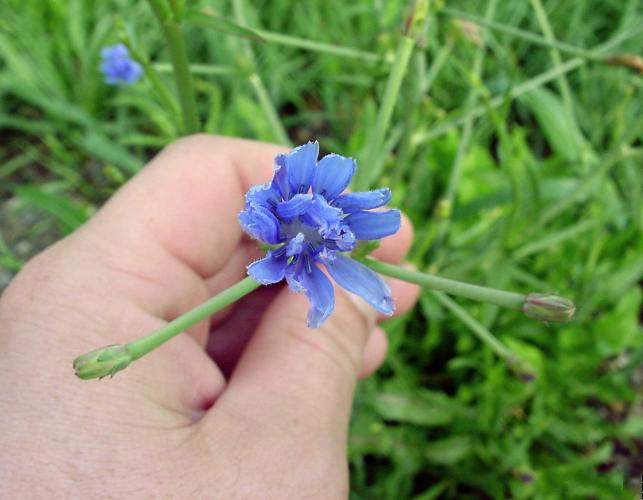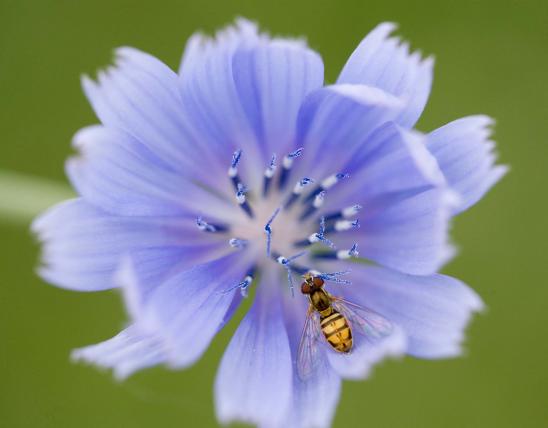













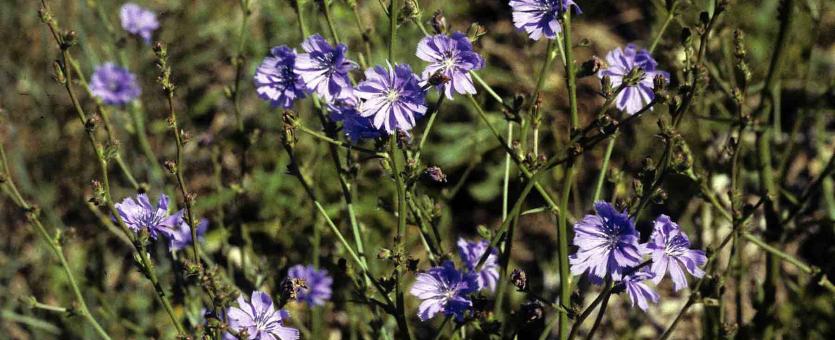
In summer and fall, the pretty blue flowers of common chicory decorate roadsides and other disturbed areas. This weedy member of the sunflower family was introduced from Europe long ago. Its roots have been used as a coffee substitute.
Common chicory is a perennial shrubby herb with stiff, angular branches.
The flowerheads emerge all along the stems with light blue (occasionally white or pink), strap-shaped (ligulate) ray florets that have 5 teeth at the tip.
- Often, on sunny days, the flowerheads open in the morning and close by noon.
Blooms May–October.
The basal leaves resemble those of dandelion, with a prominent center vein, triangular lobes, with deep, rounded sinuses. The leaves become much smaller above the base. The upper branch leaves may be entire, without stems, and narrow.
- This plant bleeds a milky latex.
- The hairs on the leaves and branches may not be very conspicuous.
Similar species: At a glance, the following might be mistaken for chicory, for the flower form and the pure blue color:
- Florida lettuce (Lactuca floridana) has leaves well developed all along the stems, and the seeds have tufts of hair (chicory’s seeds have a low crown of scales); it can be a much larger plant as well.
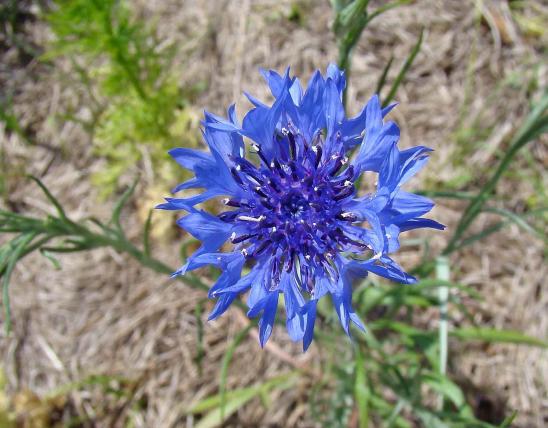
- Cornflower (Centaurea cyanus) has leaves that are narrow and linear; the outer florets of the flowerhead are enlarged and look like ray florets.
Height: to 3 feet, but will flower just inches above ground if mowed down.

Statewide.
Habitat and Conservation
Occurs in fields, pastures, waste areas, roadsides, railroads, and other open, disturbed areas.
A common summertime roadside nonnative wildflower.
Like dandelion, chicory is a native of the Old World that has been introduced globally. Like many other weedy plants, it is one of the first to take root in disturbed ground, but in this case, it does not compete well in habitats full of established native plants.
Status
Nonnative, introduced wildflower. Often considered a weed. Native to Eurasia.
Human Connections
The roots of this species are roasted, ground, and used as a flavoring, extender, and some would say adulterant for coffee.
Chicory has a long history of medicinal uses, as a laxative, diuretic, and antiseptic.
The young greens can be eaten raw or cooked.
The roots are a source for commercial inulin, which is used as a soluble fiber dietary supplement and as a bulking agent and fat substitute in yogurt and other foods.
The pretty blue flowers of chicory are pleasant for drivers to gaze at while waiting at intersections. Despite being nonnative "weeds," they add beauty to roadsides.
A close relative of this plant, in the same genus, is endive (Cichorium endivia), the popular salad vegetable.
Ecosystem Connections
Bees and other insects gather nectar and pollen from the flowers, pollinating them in the process.
The foliage is eaten by a variety of herbivorous insects, including grasshoppers, beetles, and the larvae of butterflies and moths.
Worldwide, there are only 6 species in genus Cichorium. None are native to the New World, though many of them have been introduced.
The sunflower-daisy-aster family (Asteraceae) comprises more than 32,000 species globally. It is the second largest family of vascular plants in the world.
Because family Asteraceae is so huge, botanists have broken it down into several tribes of related genera. Chicory, in genus Cichorium, is the "poster child" of its whole tribe, the Cichorieae (sih-KORE-ee-ee).
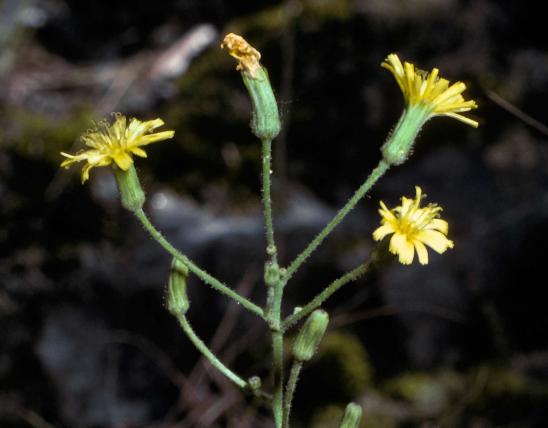
- Other members of tribe Cichorieae include hawkweeds, true dandelions and false dandelions, lettuces, sow thistles, and salsifies.
- A key character of all the members of this tribe are the florets in their flowerheads. Instead of central disk and marginal ray florets (as in sunflowers), they have flowerheads composed only of ligulate florets.
- Ligulate florets somewhat resemble ray florets, but the corolla (conjoined petals) has one portion of the tube extended into a strap-shaped extension with 5 teeth at the tip.
- Also, in ligulate flowerheads, all the florets are perfect (that is, they have both stamens and pistils, and therefore all the florets are fertile, producing seeds).
- Pick apart a dandelion flowerhead to observe the ligulate floral structure that characterizes tribe Cichorieae.
- The common dandelion is economically important for the industries built upon selling people products and ongoing services to keep it eradicated from their lawns.
- Other economically important members of tribe Cichorieae include chicory (as a coffee substitute) and the vegetables endive, lettuce, and salsify.
- Not many members of tribe Cichorieae are used in gardens as ornamentals.
- At least in Missouri, members of tribe Cichorieae are easy to identify: they all have milky sap and all-ligulate flowerheads.