






PURPOSE: This amendment establishes requirements for holding and hunting cervids on big game hunting preserves that were legally imported into the state of Missouri.
Acknowledgements
Title 3 – Department of Conservation
Division 10 – Conservation Commission
Chapter 9— Wildlife Code: Confined Wildlife: Privileges, Permits, Standards
Proposed Amendment
Proposed Amendment
(1) Licensed hunting preserves are subject to inspection by an agent of the department at any reasonable time. Animal health standards and movement activities shall comply with all state and federal regulations. Any person holding a licensed hunting preserve permit may release on his/her licensed hunting preserve only legally obtained and captive-reared pheasants, exotic partridges, quail, mallard ducks, and ungulates (hoofed animals) specifically authorized by the Approved Confined Wildlife Species List in 3 CSR 10-9.105(7) for game bird hunting preserves and big game hunting preserves for hunting throughout the year, under the following conditions:
(B) Big Game Hunting Preserve.
1. A big game hunting preserve for ungulates shall be a fenced single body of land, not dissected by public roads, and not less than three hundred twenty (320) acres and no more than three thousand two hundred (3,200) acres in size. The hunting preserve shall not be cross-fenced into portions of less than three hundred twenty (320) acres. The hunting preserve shall be fenced so as to enclose and contain all released game and exclude all hoofed wildlife of the state from becoming a part of the enterprise and posted with signs specified by the department. Fence requirements shall meet standards specified in 3 CSR 10-9.220. Fencing for hogs shall be constructed of twelve (12) gauge woven wire, at least five feet (5') high, and topped with one (1) strand of electrified wire. An additional two feet (2') of such fencing shall be buried and angled underground toward the enclosure interior. A fence of equivalent or greater strength and design to prevent the escape of hogs may be substituted with written application and approval by an agent of the department.
2. Breeding enclosure(s) contained within or directly adjacent to the big game hunting preserve must obtain a separate Class III Wildlife Breeder Permit for those species (including their hybrids) listed on the Approved Confined Wildlife Species List in 3 CSR 10-9.105 for Class III wildlife breeders. Any animal entering a big game hunting facility may not reenter a breeding facility. All cervids entering a big game hunting preserve must maintain one (1) of the identification requirements contained in 3 CSR 10-9.354(6)(A). Any natural additions must meet one (1) of these identification requirements upon harvest or death for record-keeping purposes. For the purposes of the identification requirement of this paragraph, an animal has entered a big game hunting preserve when it has physically entered the preserve or when the animal has been identified on the Movement Certificate required by this rule, and the big game hunting preserve permittee has used the department-provided database to transfer the animal into their inventory on the same day as movement to the preserve.
3. Any person taking or hunting ungulates on a big game hunting preserve shall have in his/her possession a valid licensed hunting preserve hunting permit. The permittee shall attach to the leg of each ungulate taken on the hunting preserve a locking leg seal purchased from the department by the hunting preserve permit holder. Any packaged or processed meat shall be labeled with the licensed hunting preserve permit number.
4. The holder of a Big Game Hunting Preserve Permit may only receive animals and conduct hunts if they maintain hunt-qualified status. Big Game Hunting Preserve Permit holders will attain and maintain hunt-qualified status if they maintain inventory records (including identification requirements) as required in this chapter, submit Chronic Wasting Disease samples as required in this chapter, and maintain all fences as required in this chapter. A Big Game Hunting Preserve Permit holder will lose hunt-qualified status if, after issuance of a notice of discrepancy by the department indicating violations of any of the requirements of this paragraph, the permit holder fails to correct the deficiency within thirty (30) days, or longer if approved by a conservation agent pursuant to a corrective action plan. Hunt-qualified status will be reinstated when the permit holder receives notice from the department that the discrepancy has been corrected. Receiving animals or conducting hunts in violation of this paragraph or maintaining non-hunt-qualified status for ninety (90) consecutive days or more shall be sufficient cause for permit suspension or revocation.
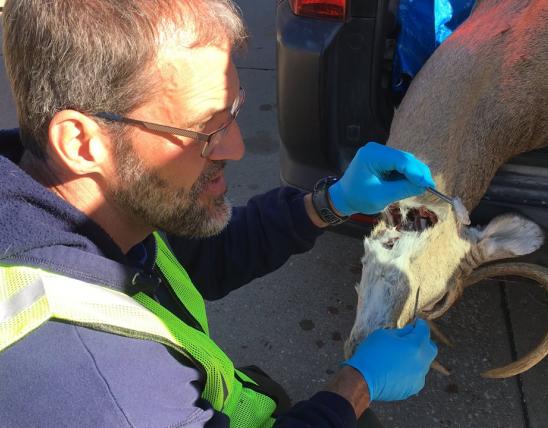
5. The holder of a Big Game Hunting Preserve Permit must test mortalities of male cervids over twelve (12) months of age for Chronic Wasting Disease (CWD), a transmissible spongiform encephalopathy as provided in this rule. Samples must be collected by an accredited veterinarian or department-certified collector. Samples must be submitted to a diagnostic laboratory approved by the United States Department of Agriculture (USDA) for CWD testing within thirty (30) days of death. The department reserves the right to require additional sampling and testing during disease investigations or morbidity/mortality events. Animal health standards and movement activities shall comply with all state and federal regulations.
6. For purposes of this section, eligible mortalities mean mortalities of all male cervids at least 12 months of age occurring between April 1 of the previous permit year and March 31 of the current permit year. Any new permit holder or permit holder as of July 1, 2021, that failed to test one hundred percent (100%) of all mortalities during the previous permit year shall have Tier 1 status, and shall test one hundred percent (100%) of eligible mortalities. Any permit holder as of July 1, 2021, who can demonstrate they tested one hundred percent (100%) of all mortalities during the previous permit year or any Tier 1 permit holder that submits the required valid samples of eligible mortalities during the previous year shall have Tier 2 status, and shall test fifty percent (50%) of eligible mortalities.
7. At least eighty percent (80%) of required tests as described in the previous paragraph must produce valid sample results by the diagnostic laboratory. To be considered a sample that produced a valid test result, the sample must have been suitable, testable, and not rejected by the diagnostic laboratory for any other reason. If less than eighty percent (80%) of samples are valid, then the permit holder must provide sufficient samples to achieve the eighty percent (80%) requirement. Replacement samples may consist of either post-mortem samples at a 1:1 ratio, or ante-mortem samples at a 3:1 ratio from other animal(s) of similar age and time in the facility. For purposes of this rule, an ante-mortem CWD test is not valid unless it is performed by an accredited veterinarian on retropharyngeal lymph node, rectal mucosa, or tonsillar tissue with at least six lymphoid follicles submitted within thirty (30) days of collection on an animal that is at least eighteen (18) months of age and has not been source of ante-mortem testing within the prior twenty-four (24) months.
8. Samples in which the infectious CWD prion is detected will be considered CWD-suspect pending confirmation at the USDA National Veterinary Services Laboratory. Any facility with a CWD-suspect or confirmed positive sample will immediately be quarantined by the state wildlife veterinarian, and no movement certificates allowing movement into the facility will be issued except as authorized by the state wildlife veterinarian in accordance with an approved herd disease response plan. Additionally, any facility that is or has been in possession of a deer that was in a CWD-suspect or CWD-confirmed positive facility shall be quarantined, and no movement certificates allowing movement into the facility will be issued until it is determined that the facility is not epidemiologically linked to the CWD suspect or confirmed positive deer or is determined upon further testing that the suspect deer is not a confirmed positive.
9. Big game hunting preserve permittees shall report escaped animals and entry of any free-ranging cervids into the facility immediately to a conservation agent.
10. The holder of a Big Game Hunting Preserve Permit must ensure that all CWD test results required by this section are submitted to the state wildlife veterinarian by the USDA-approved diagnostic laboratory within seven (7) days of completion of testing. In the event of confirmed positive results from a Chronic Wasting Disease test, the permit holder shall comply with a herd disease response plan approved by the department. The plan may include, but not be limited to, quarantine requirements, testing and depopulation, premises cleaning and disinfection, additional fencing requirements, and restocking guidelines. Failure to comply with an approved herd disease response plan may result in the suspension or revocation of permit privileges.
11. All Class III cervids listed on the Approved Confined Species List in 3 CSR 10-9.105 for Class III wildlife breeders acquired by a holder of a Big Game Hunting Preserve Permit must be individually identified on a Movement Certificate issued by the department. A Movement Certificate must be completed by the breeder and list the official identification, age, gender, species, complete address of both the origin and destination, and the complete name, address, and permit number of all parties to the transaction. The original form must accompany the shipment and a copy shall be maintained for at least five (5) years by the permit holders, unless otherwise documented in a department-provided database. All other cervids and ungulates acquired by a holder of a Big Game Hunting Preserve Permit must be individually identified on a Breeder’s Movement Certificate issued by the Missouri Department of Agriculture. A Breeder’s Movement Certificate must be completed by the breeder and contain complete and accurate information including the official identification, age, gender, species, complete address of birth, origin, and destination, and complete address and name of buyer and seller. The Breeder’s Movement Certificate must accompany the shipment and a copy maintained for at least five (5) years by the permit holder. The source of all Class III cervids listed on the Approved Confined Wildlife Species List in 3 CSR 10-9.105 for Class III wildlife breeders must be a Class III breeder facility. The source of all other cervids must be a herd that is enrolled in a state of Missouri administered Chronic Wasting Disease herd certification program.
12. New permits for big game hunting preserves will not be issued for a period of five (5) years within twenty-five (25) miles of a location where Chronic Wasting Disease-positive animal(s) have been confirmed by the department except as follows:
A. New permits may be issued during this time period for the existing location of a big game hunting preserve with a valid permit; and
B. New permits may be issued during this time period for a big game hunting preserve located more than ten (10) miles and less than twenty-five (25) miles from a location where Chronic Wasting Disease-positive animal(s) have been confirmed by the department, provided—
(I) The perimeter of the preserve is enclosed by a double fence having a minimum distance of ten feet (10') between the interior and exterior fences;
(II) The interior and exterior fences are constructed and maintained in accordance with 3 CSR 10-9.220;
(III) For preserves subject to double fencing requirements as a condition of their permit, all applicable measurements for determining compliance with the minimum acreage requirements of this rule will be based on the interior fence; and
(IV) No animal may be confined, pursued, or taken in the area between the interior and exterior fences on preserves subject to double-fencing requirements as a condition of their permit.
13. [Live cervids imported into the state shall not be held in a licensed big game hunting preserve. Only cervids born inside the state of Missouri may be propagated, held in captivity, and hunted on big game hunting preserves. Prior to accepting any cervid, the big game hunting preserve must obtain evidence that the cervid was born inside the state of Missouri, such as relevant portions of the breeder’s herd certification inventory and movement certificates. The big game hunting preserve shall maintain such documentation for five (5) years and provide to the department upon request. ]Cervids may be held in captivity on big game hunting preserves only in accordance with the following:
A. Cervids born inside the state of Missouri may be propagated, held in captivity, and hunted on big game hunting preserves.
B. Live cervids legally imported into the state may be held in confinement and hunted on big game hunting preserves, provided—
(I) The cervid has been a continuous resident of the state of Missouri for at least two (2) years prior to being held in confinement or hunted on a big game hunting preserve;
(II) Animal health standards and movement activities for such cervids were in compliance with all state and federal regulations;
(III) Such cervids are killed within ninety (90) days of the permittee’s acceptance of the cervid from a breeder, except as authorized by a conservation agent; and
(IV) All mortalities of such cervids, regardless of gender of the animal or the Tier testing status of the permittee, shall be tested for CWD in accordance with this rule. The testing requirements of this paragraph are applicable to attaining and maintaining hunt-qualified status. The department reserves the right to require additional sampling and testing, and/or modify the Tier testing status of the permittee, if testing requirements are not followed for any cervid subject to the provisions of this subsection.
C. Prior to accepting any cervid, the big game hunting preserve must obtain evidence that the cervid qualifies to be held in confinement on a big game hunting preserve. The big game hunting preserve shall maintain such documentation for five (5) years and provide it to the department upon request.
(I) For cervids born in Missouri, evidence the cervid was born inside Missouri is required, such as relevant portions of the breeder’s herd certification inventory and movement certificates.
(II) For cervids imported into Missouri, evidence the cervid has been a continuous resident of Missouri for at least two (2) years and all movement has been in compliance with state and federal regulations is required. Evidence of qualification to be held in confinement shall include a valid certificate of veterinary inspection with an import permit issued by the Missouri Department of Agriculture that includes the date of importation, CWD herd status, and relevant portions of the breeder’s herd certification inventory and movement certificates (if applicable).
14. Within thirty (30) days from the revocation or expiration of a licensed Big Game Hunting Preserve Permit for any reason and prior to the removal of any fencing, the permit holder must remove all animals from the premises either by depopulation with approval by a conservation agent, or transfer to a licensed big game hunting preserve with approval by the state wildlife veterinarian. Facilities with a CWD positive within the past five (5) years must depopulate upon revocation or expiration of their permit.
AUTHORITY: sections 40 and 45 of Art. IV, Mo. Const., and section 252.040, RSMo 2016.* This rule previously filed as 3 CSR 10-10.765. Original rule filed Jan. 19, 1972, effective Feb. 1, 1972. For intervening history, please consult the Code of State Regulations. Amended: Filed October 3, 2025.
PUBLIC ENTITY COST: This proposed amendment will not cost state agencies or political subdivisions more than five hundred dollars ($500) in the aggregate.
PRIVATE ENTITY COST: This proposed amendment will not cost private entities more than five hundred dollars ($500) in the aggregate.
NOTICE TO SUBMIT COMMENTS: Anyone may file a statement in support of or in opposition to this proposed amendment with Regulations Committee Chairman, Department of Conservation, P.O. Box 180, Jefferson City, MO 65102-0180, or via the department’s website at https://short.mdc.mo.gov/Z49. To be considered, comments must be received within thirty (30) days after publication of this notice in the Missouri Register. No public hearing is scheduled.