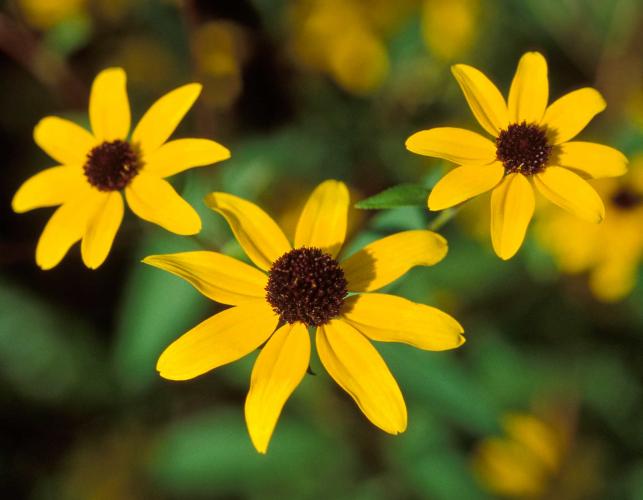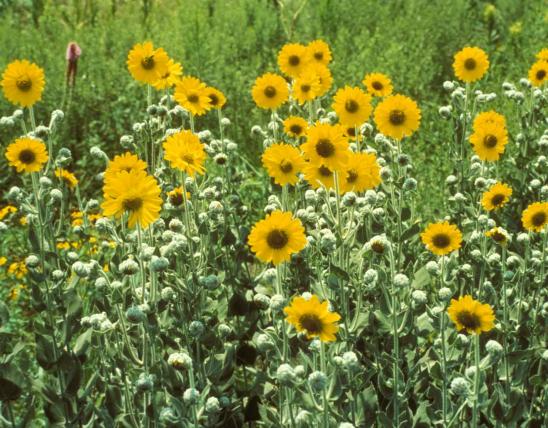








Brown-eyed Susan blooms from June until the freezes of November, in low, wet woods, roadsides, edges of woods, streamsides, and valleys. It produces plenty of flowerheads, which, compared to Missouri’s other <em>Rudbeckia</em> species, are the smallest, only about one inch across.
Brown-eyed Susan is a bushy perennial with much-branching stems.
The leaves are lance-shaped, with fine to coarse teeth, hairy, the bases narrowly winged or clasping. The lower leaves are 3-lobed but are usually shed before flowering time.
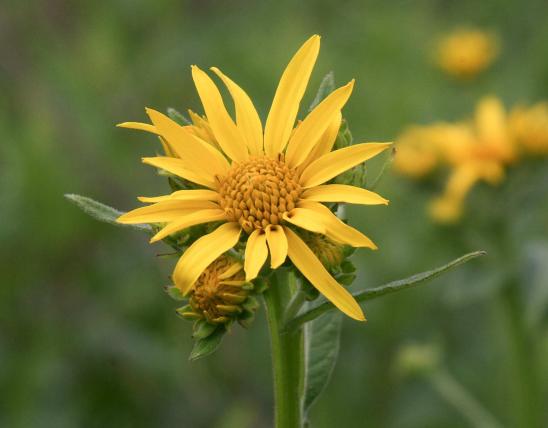
The flowerheads are numerous, much smaller than our other rudbeckias, to 1 inch across. The rays are 10–16, bright yellow; ray florets with a ring of maroon-red around the disk are sometimes seen. The disk is dark brown.
Blooms June–November.
The fruits are achenes (structurally similar to sunflower "seeds"), about ⅛ inch long, wedge-shaped, 4-angled in cross-section.
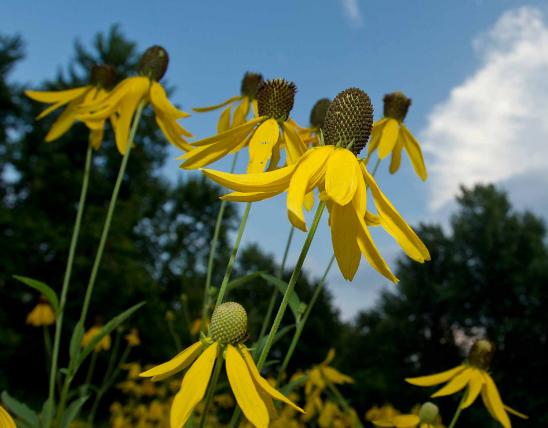
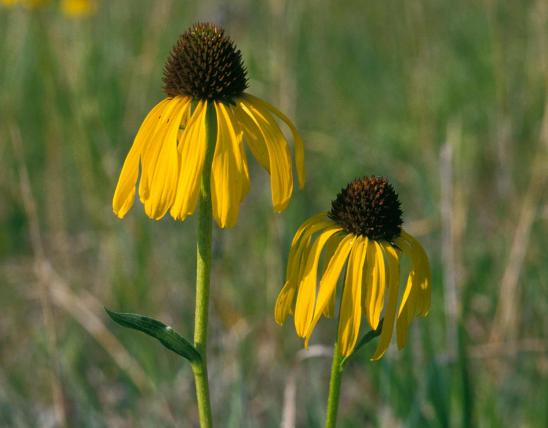
Similar species: Nine Rudbeckia species have been recorded growing wild in Missouri. Brown-eyed Susan is widespread, common, and easy to recognize, with its many, notably small flowerheads.
For more information about Missouri's Rudbeckia species, see the black-eyed Susan page.
Height: to 5 feet.

Scattered statewide, but apparently absent from the Southeast Lowlands, and uncommon in the northwestern quarter of the state.
Habitat and Conservation
Occurs in low, wet woods, roadsides, edges of woods, streamsides, and valleys.
Status
Native Missouri wildflower.
Human Connections
Black-eyed Susan is widely cultivated both in gardens and as a roadside-beautification flower. Several cultivars have been developed, which have, for instance, longer ray florets or ray florets that are reddish.
Native Americans used Rudbeckia species medicinally for a variety of ailments ranging from sores and burns to worms, snakebites, kidney disease, and heart problems.
Some species of Rudbeckia have been implicated in livestock poisoning, but because of their disagreeable flavor, livestock usually avoid eating them.
Ecosystem Connections
The sunflower-daisy-aster family (Asteraceae) is one of the largest families of flowering plants in the world, with at least 23,000 species. It includes sunflowers, goldenrods, thistles, dandelions, and ragweeds. They all produce flowerheads of densely packed florets that function much like an individual flower.
For more information about Missouri's Rudbeckia species, see the black-eyed Susan page.