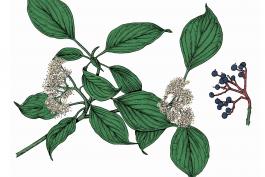







Alternate-leaved dogwood is a shrub or small tree with branches often arranged in distinct, horizontal tierlike layers.
Leaves are simple, mostly alternate, often crowded near the ends of twigs, 2–5 inches long, egg-shaped or widest in the middle; edges are smooth, and the tips are pointed; upper surface is smooth and dark green; lower surface is paler, hairy, with conspicuous lateral veins, 4–6 on each side; leaf stalk is ¾–2¼ inches long.
Bark is thin, dark reddish brown, smooth or grooved, and broken into irregular narrow ridges.
Twigs are often horizontal or ascending, slender, smooth, and green to reddish brown.
Blooms May–June. Flowers are white to cream-colored in broad, flat-topped clusters 1¼–2½ inches wide; sepals minute or absent; petals 4, about ⅛ inch long.
Fruits July–September. Round, fleshy, bluish-black berries are borne on a red stalk. Fruits are about ⅓ inch long.
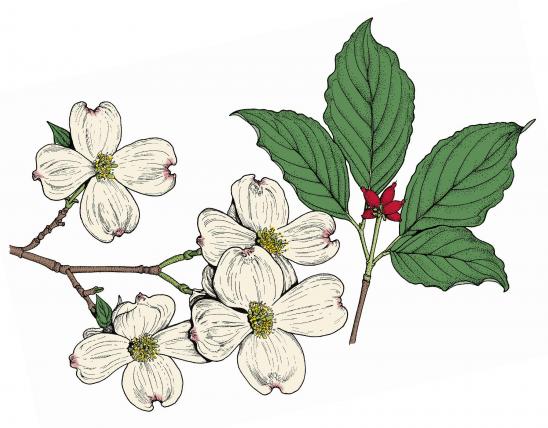
Similar species: When not in flower, this species could be confused with flowering dogwood, but that species has opposite (not alternate) leaves. There are 5 species in the genus Cornus in Missouri. This is the only one with alternate leaves.
Height: typically to 18 feet; occasionally reaching 25 feet in optimal conditions.

Found naturally in central and northeast Missouri, and south through the central Ozarks. Cultivated statewide.
Habitat and Conservation
Grows on wooded, north-facing slopes and along wooded banks of streams. A popular ornamental for its fleshy fruits, which attract birds, and for the yellow to red fall foliage. In cultivation, it prefers naturalized plantings in partial shade.
Status
Native Missouri shrub or small tree. Strong landscaping value as ornamental and for wildlife.
Human Connections
This species is a good landscaping replacement for the cold-sensitive flowering dogwood in the northern part of the state. Its layered silhouette provides visual interest in winter landscapes. Like other dogwoods, the wood is hard and was historically fashioned into many small, durable objects.
Ecosystem Connections
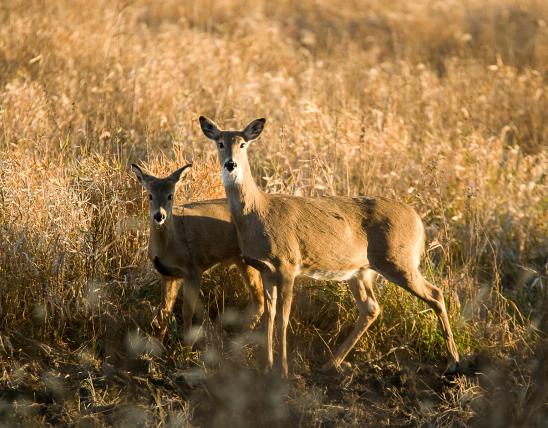
Deer and rabbits browse the leaves, and several types of birds eat the fruits. This species is a larval host for the spring azure butterfly. It also provides important cover and nesting habitat for several types of animals.