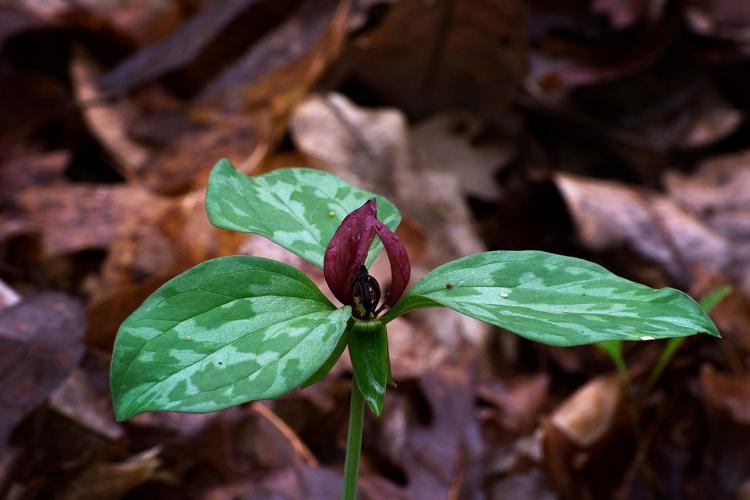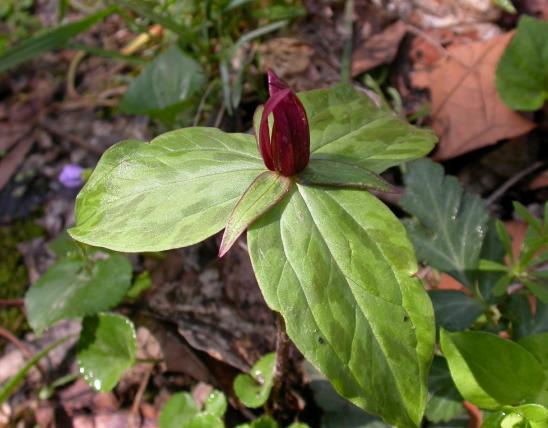









Purple trillium is one of Missouri’s seven species of trilliums. It is most common in the eastern half of the state. Identify it by its sepals, which curve to point downward at flowering time, and by its leaves, whose bases narrow into true leaf-stems.
Habit: As with other trilliums, this species is perennial, and there is a single flower per stem, with a single whorl of 3 leaves at the tip and a single flower at the top of the plant. The root is a short rhizome.
The flowers are solitary, arising stemless from a whorl of leaves. There are 3 sepals, which curve downward, pointing toward the ground at flowering time, and 3 upright petals, which can be maroon, rarely yellow or yellowish green. The flowers of this species sometimes have a faint, fetid aroma that is less strong than that of T. sessile flowers.
Blooms April–May.
The leaves are 3, in a whorl at the top of a bare stalk, ovate, pointed, narrowed at the base so that they have a distinct, short petiole (leaf stem) (they are not sessile), usually mottled. (Note that immature leaves of this species may not yet have developed their characteristic elongated leaf stem.)
The fruits are many-seeded berries.
Similar species: Missouri has 7 species in the genus Trillium. The ones most similar are the following:
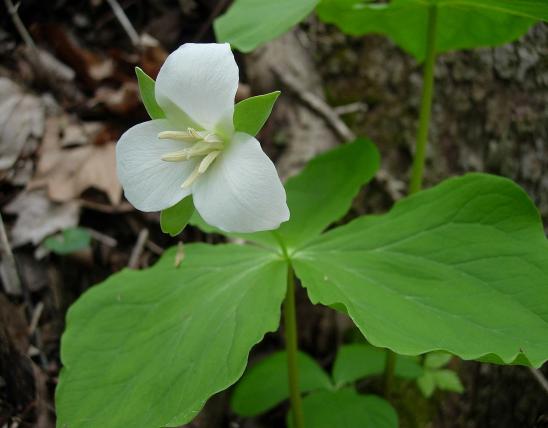
- Wake robin, trillium, or toadshade (T. sessile), has the sepals spreading flat or ascending when the flower opens, and the leaves are sessile (stemless; the blades attached directly to the plant stalk). It occurs nearly statewide and is common in all but the northern third of the state; apparently absent from the Bootheel lowlands.
- Green trillium (T. viride) has green or yellowish-green petals, sometimes with a purplish tinge. The flowers of this species have a musty or spicy odor similar to that of rotting apples. The leaves are blunt or only broadly pointed and are often somewhat mottled. It is scattered in the eastern half of Missouri, both north and south of the Missouri River. Greenish-flowering specimens of T. sessile are often confused with T. viride.
- Green trillium (T. viridescens) has green or yellowish-green petals, sometimes with a purplish tinge. The leaves are sharp-pointed and are usually not mottled. It is scattered mostly in the southwestern Ozarks, with another population in Jefferson County.
In Missouri’s other three trilliums, the flower is on a stalk that raises it beyond the trio of leaves at the top of the plant stem. Also, they tend to have white, pink, or purplish-pink petals.
Height: 6–16 inches.
Common in eastern Missouri; scattered in central and southern Missouri.
Habitat and Conservation
Occurs in moist, rich bottomland forests and moist upland woodlands on lower slopes and bottoms of valleys and ravines; les commonly on shaded, grassy roadsides and edges of old fields.
Status
Native Missouri spring-blooming wildflower.
Human Connections
Some species of trilliums were used historically in herbal medicine, but the most common human use of these flowers today is in gardening.
Trilliums are popular in shade gardens but are difficult to grow from seed. This has led to unethical collecting from the wild. However, many plants do not survive transplanting. Please be aware of the sources for your plants, and insist on nursery-grown plants from cultivated stocks. Please don’t collect from the wild. Instead, buy from reputable native wildflower nurseries.
Ecosystem Connections
Trilliums use their leaves to produce energy to store in their rhizomes, so that they have strength to bloom again the next spring. Because trilliums only have 3 leaves, which are so close to the flowers, picking trillium flowers removes the plant’s ability to feed itself.
Botanists have long debated the relationships among the plants traditionally considered lilies. Formerly placed in the lily family or sometimes in a separate trillium family, this plant and its close relatives are currently in a family called the Melanthiaceae (mel-anth-ee-AY-cee-ee).
- Breaking up the lily family into several other families means they are now organized according to their true genetic relationships. But if you try to describe the differences among these families using the actual forms of the plants, it is very difficult, since they share so many characteristics.
- Globally, there are about 17 genera in the Melanthiaceae.