






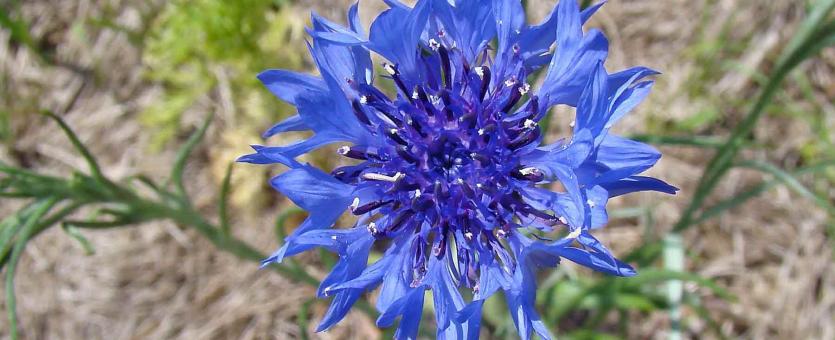
A native of Europe, cornflower, or bachelor's button, is a popular garden flower that often escapes to nearby areas.
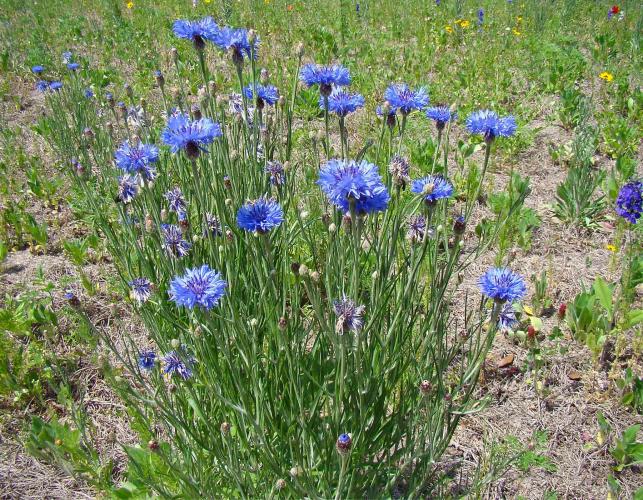
Cornflower is a much-branched herbaceous annual.
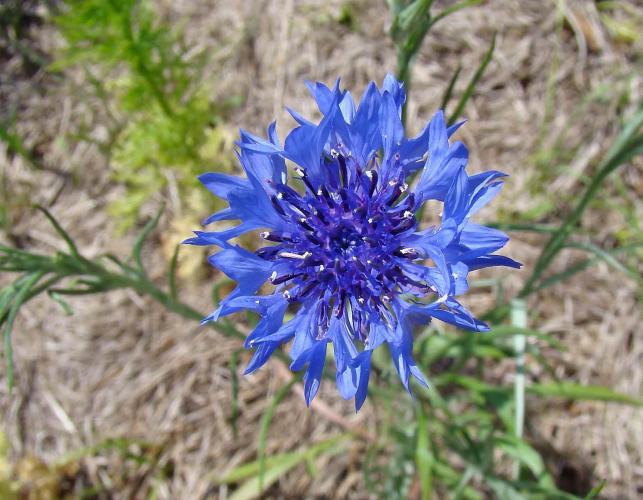
The flowerheads are about 1 inch across with a vase-shaped receptacle (the involucral bracts at the base of the flowerhead). The petals can be cornflower blue, pink, or white. A member of the thistle tribe, this composite lacks true (flattened) ray florets; instead, the outer florets of each head have enlarged corolla tubes that at a glance look something like the strap-shaped extensions of true ray florets.
Blooms May–September.
The leaves are alternate, narrow, linear, and sharply pointed.
Similar species: Ten Centaurea species have been recorded for our state.
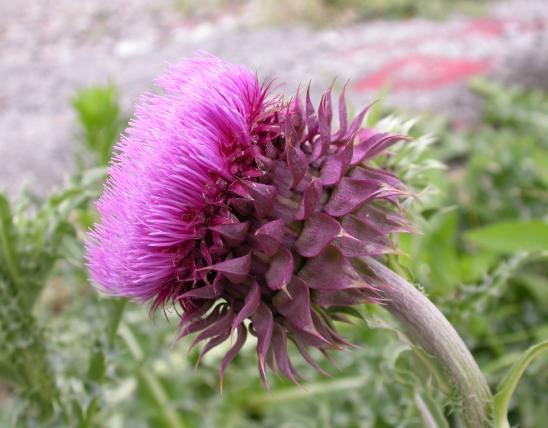
- Of special concern is the invasive spotted knapweed, Centaurea stoebe. Its principal leaves are deeply lobed, the florets are light purple to pinkish purple or rarely white, and the flowerheads are more thistlelike. Mostly in eastern and southern Missouri.
- American basket flower or starthistle (Centaurea americana) is uncommon as a native in southwest Missouri, and introduced sporadically elsewhere, sometimes cultivated as a garden flower. It's an annual with pinkish-purple, thistlelike flowerheads; the bracts at the base of the flowerhead resemble a basket-weave pattern.
- The other seven members of genus Centaurea recorded for Missouri are nonnative, introduced species known only from rare, limited, or historical collections. Some of them are severe invasives in other states.
Height: to 3 feet.

Scattered statewide.
Habitat and Conservation
Occurs in banks of rivers, ledges of bluffs, fallow fields, railroads, roadsides, and open, disturbed areas.
A native of Europe, cornflower is a popular garden flower that often escapes to nearby areas. It may cover entire fields.
Cornflower seeds are often included in packets of mixed wildflower seeds, so be aware that many so-called wildflower seed mixes include seeds for nonnative wildflowers.
Status
Nonnative wildflower; introduced from Europe. Apparently it is not as common in our state as was once thought.
Human Connections
Cornflower has a long history in Europe as a medicinal herb. It is a longstanding national and political symbol in Germany, Austria, Finland, France, Sweden, and Estonia.
Cornflower is a beloved garden flower and ais popular in bridal bouquets. Its intense blue color is admired by painters, designers, and crayon manufacturers.
Where did the name come from; isn't corn yellow? Cornflower used to be a common weed in European grain fields, where the word “corn” refers to any cereal grain, such as wheat, oats, rye, and barley. In Germany it’s called kornblume. American corn, also called Indian corn or maize (Zea mays), acquired its name because it is an American cereal crop.
Native wild European populations of cornflower are endangered in Great Britain due to aggressive herbicide use, elimination of brushy edges of crop fields, and other modern agricultural practices.
Ecosystem Connections
Bees, flies, butterflies, aphids, beetles, and other insects gain nourishment from cornflower’s nectar, pollen, sap, and foliage. Birds eat the seeds.
As a nonnative plant, its presence in native natural habitats displaces native species, which usually play larger roles in the ecosystem.