







Tall thistle is a native thistle that can grow to be 10 feet tall. Key identifiers include its leaves, which are unlobed (though they may be wavy or have only shallow, broad lobes), are felty-hairy beneath, and have prickles only along the edges.
Tall thistle is a tall, branching biennial or short-lived perennial. The first year, it grows as a basal rosette of leaves; the second year, it sends up its tall flowering stalk.
The stems are hairless or sparsely hairy, sometimes with patches of white felty hairs. The stems lack spiny-edged wings.
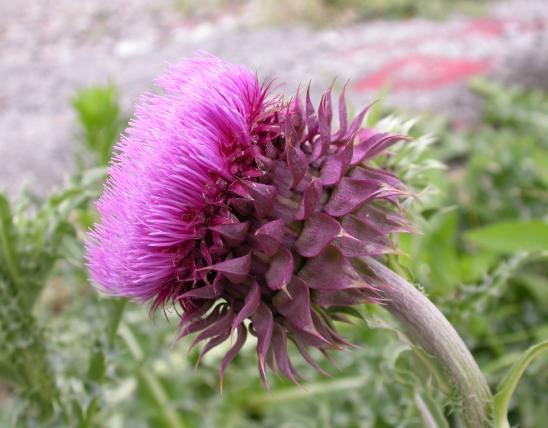
The flowerheads are many, solitary at the branch tips, pink-purple or reddish purple, rarely white. The outer involucral bracts have a dark spot; all bracts end in a weak prickle.
Blooms July–October.
The leaves are unlobed, toothed or wavy, with marginal prickles only (none on the leaf surface), and woolly-hairy beneath. The upper stem leaves are narrowly lance-shaped with longer spines.
Tall thistle and other native thistles can be distinguished from nonnative, Eurasian species by the following:
- Leaves of native thistles usually have whitened, woolly undersides, contrasting with the green upper sides (nonnatives are green on both sides).
- Eurasian thistles tend to have heavily branched stems and more numerous flowerheads per stem.
Similar species: Tall thistle is one of the most common and widespread species of native thistles in Missouri. See Ecosystem Connections for a list of the nine Cirsium species (native and nonnative, common and rare) that have been recorded for Missouri.
Tall thistle is closely related to field thistle (Cirsium discolor), and the two can hybridize where they grow near each other.
- Most or all of the leaves of field thistle are deeply lobed.
- Field thistle is uncommon in the Ozarks but scattered to common elsewhere in the state. It is more common in upland habitats and disturbed places.
Height: to 10 feet.

Scattered to common nearly statewide.
Habitat and Conservation
A native thistle occurring in bottomland forests, banks of streams and rivers, and bases of bluffs; less commonly on glades, upland prairies, and openings of upland forests; also old fields, railroads, and roadsides.
Compared to many other thistles, this species is more commonly associated with fairly shady habitats.
Status
Native Missouri wildflower.
Human Connections
The young shoots and leaves have been cooked and eaten.
Tall thistle is native to the eastern U.S. west to North Dakota and Texas, so this particular species of thistle is not a symbol of Scotland.
Ecosystem Connections
Tall thistle is one of several native thistles that are valuable components of our state's flora.
Bees, butterflies, skippers, and moths visit the flowers for nectar and pollen.
In late summer and fall, goldfinches feast on the seeds. Goldfinches' late-season nesting time coincides with the peak abundance of aster-family seeds, and they line their nests with the seeds' silky "parachutes."
There are 200 to 350 species of Cirsium thistles in the world; they are widespread in the Northern Hemisphere.
The nine species of Cirsium thistles recorded for Missouri fall into three groups: Nonnative (introduced from Eurasia); native to North America and Missouri; and native to North America but not native to Missouri. Here's how they break down:
Nonnative, introduced from Eurasia (both are invasive):
- Canada thistle (Cirsium arvense): scattered, most widely in the northwestern quarter of the state; a crop weed; considered invasive. ("Canada" in the name is inaccurate; it's from Eurasia.)
- Bull thistle (Cirsium vulgare): wildly scattered; a crop weed; considered invasive.
Native to Missouri:
- Tall thistle (Cirsium altissimum): scattered to common statewide.
- Carolina thistle (Cirsium carolinianum): scattered to common in the eastern Ozarks and Ozark border.
- Field thistle (Cirsium discolor): uncommon in the Ozarks; scattered to common elsewhere.
- Swamp thistle (Cirsium muticum): scattered to uncommon in the eastern Ozarks and Ozark border.
- Wavy-leaved thistle (Cirsium undulatum): uncommon, known from only a few collections in Jackson and Atchison counties, introduced sporadically in eastern Missouri. This species mostly occurs in states to our west; western Missouri is on the eastern border of its overall range.
Native to North America, but not native to Missouri; these have only rarely been found in our state:
- Platte thistle (Cirsium canescens): a single historical record in Jackson County; this species is native to western states.
- Texas thistle (Cirsium texanum): has only been collected from the city of St. Louis; this species is native to states south and west of Missouri.