













Although most sandpipers are shorebirds, associated with water, the upland sandpiper is rarely seen near water. Look for it flying over grasslands or standing upright on a fencepost or small shrub.
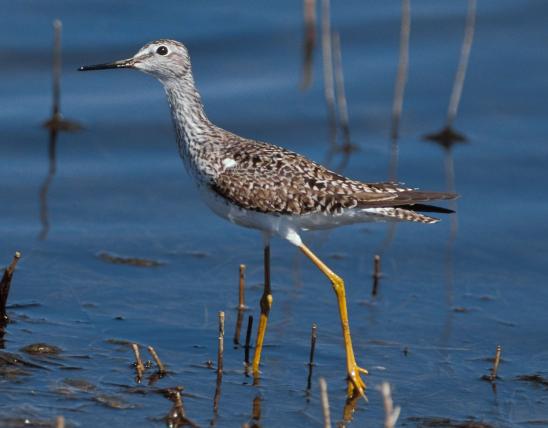
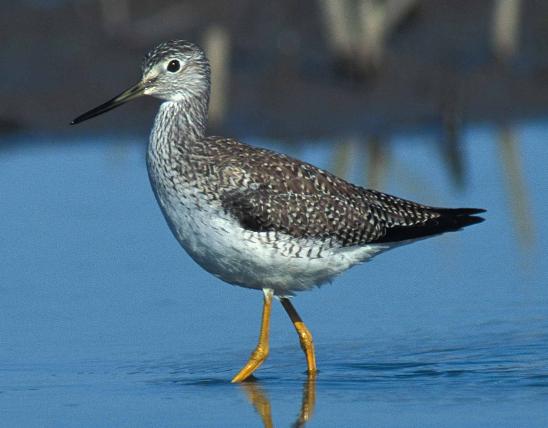
The upland sandpiper is a medium-sized member of the sandpiper family. The neck, wings, legs, and tail are long. The head is small and often described as dovelike. The bill is shorter than the head. The upperparts are mottled black and brown, the neck and breast are streaked with brown, and the belly is white. The legs and bill are yellow. The eyes are large, dark, and surrounded by a white eye ring.
The alarm calls vary; often, it is a series of three or more short, rapid notes, all on the same pitch, sometimes with a chattering quality. The song, mostly produced by males, is a variety of whistles, some resembling “wolf whistles.”
Habitat and behavior are keys to identifying this “shorebird-not-shorebird”:
- Upland sandpipers are usually seen flying over grasslands, old fields, or pastures, or sitting upright on a post or small shrub.
- Just after alighting on a fence post, an upland sandpiper will raise its wings high over its head and hold them there for a few seconds.
- The flight varies between stiff-winged sailing and rapidly vibrating wing motions like those of the spotted sandpiper.
- During flight, upland sandpipers make a gurgling, flutelike warble or trill.
Similar species: More than two dozen sandpipers occur in Missouri, and they are the most difficult group of shorebirds to identify. Fortunately, the upland sandpiper is not easily confused with other species. Its upland grassland and pasture habitat is a key identifier.
Length: 12 inches (tip of bill to tip of tail).
As a summer breeding resident, mostly seen in northern and western Missouri, where native grasslands historically predominated. During migration, may be seen statewide.
Habitat and Conservation
Although most sandpipers are associated with water, the upland sandpiper rarely is seen near water except occasionally in grassy areas next to lakeshores during migration.
In Missouri, they are often seen foraging on grazed pastures and prairies and vegetated mudflats near lakes for terrestrial invertebrates and grain. Most nesting occurs in the Glaciated Plains and Osage Plains of northern and western Missouri. A few pairs nest in the Ozarks and Ozark Border in small prairies and grassland in landscapes with a patchwork of grasslands and woodlands.
Upland sandpipers are easy to spot when they are standing on top of a fencepost, but once they move down into the grasses, only their heads may be visible above the vegetation.
Historically upland sandpipers were very abundant during migration — so abundant that, after excessive market hunting caused the decline of the passenger pigeon in the 1880s, they became the next species to be slaughtered in great numbers. They have never regained their former population size, but they seem to be adapting to new habitats, such as airports, mixed crop fields and pastures, alfalfa fields, and even large, open row-crop fields. Their success in raising young in these areas may vary considerably, however.
Food
Sandpipers forage on the ground for insects and other invertebrates.
They prey upon grasshoppers and crickets; moths and moth larvae (including cutworms and armyworms); beetles (including weevils) and their larvae; true bugs; and the grublike larvae of horseflies, deerflies, and crane flies. Earthworms, snails, centipedes, millipedes, ticks, and spiders are also eaten.
They also eat the seeds of grasses and forbs.
Status
Uncommon transient (migrant); uncommon summer (breeding) resident in the northern and western parts of the state.
Life Cycle
The upland sandpiper is one of only five shorebird species that regularly nests in Missouri. This species is present in Missouri from late March to early October.
They spend the winter in the pampas (grasslands) of southern Argentina — a habitat quite similar to our Great Plains. They begin their northward migration in mid-February, arriving on the U.S. coast of the Gulf of Mexico in early March. During April and May they move north, spreading out over the grasslands of the midcontinent. Most individuals depart in August and September.
Upland sandpipers nest on the ground amid dense vegetation in grassland habitats. A clutch comprises 2–7 (usually 4) eggs. Like many other ground-nesting birds, the young hatch with feathers and are able to run around and forage soon after hatching. They are able to fly around midsummer, in time to start migrating south.
The courtship displays are intriguing and attractive. The male, first, soars to great heights, almost out of sight, and begins to fly in large circles. During his many circles in the sky, he can be heard giving a guttural trill followed by a loud whistle that rises and falls in pitch. After he descends to earth and finds a mate, the pair often ascend again together, performing the display as a couple.
The display song has been compared to a wolf whistle, or the drawn-out cry of a red-tailed hawk. It can be hard to tell where the sound is coming from, and it can be heard a half mile or more away.
Human Connections
The diet of upland sandpipers makes them a friend to farmers. They eat many insects that are injurious to crops, notably grasshoppers, cutworms, billbugs, and weevils.
In the early years of the 20th century, overhunting, combined with habitat destruction, nearly wiped out this species. After people had exterminated the passenger pigeon, the upland sandpiper was going to be next. American golden-plovers, Eskimo curlews, and other shorebirds as well as waterfowl frequently were targets because of the vast size of their flocks. By the 1890s most of the shorebird populations were reduced to a small percentage of their pre-market-hunting populations.
We are fortunate that previous generations of Americans took decisive action to enact and enforce conservation laws, which rescued the upland sandpiper and many other birds from extinction. This species has recovered in many regions, but it has never regained its former populations in much of North America. It is a species of conservation concern in about 24 U.S. states and Canadian provinces.
Habitat loss remains a problem for this and other grassland species. Prairies and other native grasslands are prime habitat, but those have been nearly eliminated from our continent, converted into agricultural fields. Pastures, fallow fields, and old-style, comparatively small agricultural fields surrounded by thickets and weedy fencelines could still supply nesting habitat. But today’s agricultural practices, with intensive herbicide and pesticide use, enormous unbroken crop fields, and few fencelines and “weedy places,” greatly reduce useable habitat.
As with other migratory birds, conservation efforts must be made in all the places where upland sandpipers live and migrate through — in this case, from Alaska and Canada all the way south to Argentina, in southern South America.
Like the booming of the greater prairie-chicken, the harsh calls of dickcissels, and the flutelike songs of meadowlarks, the exultant music of upland sandpipers is an integral part of the grasslands of Missouri.
The genus name, Bartramia, was bestowed in honor of William Bartram (1739–1823), a Philadelphia-born explorer, naturalist, botanist, and ornithologist. In the early years of our nation, he explored, then wrote about the southeastern United States. He also was the mentor of Alexander Wilson (1766–1813), a schoolteacher and painter who went on to create the first complete, nine-volume, illustrated reference work on our continent’s birds, and who has been called “the father of American ornithology.”
The species name, longicauda, means “long-tailed.”
Ecosystem Connections
Like other grassland specialists, upland sandpipers require the proper type of habitat in which to live and, especially, in which to breed and raise their young.
- Their coloration makes them perfectly camouflaged within their grassy habitat, as they look remarkably like the dried grasses so prominent on prairies in spring.
- They will not live on bare land, but they also will not live in wooded areas.
- Their presence in an area usually indicates healthy tallgrass prairie habitat.
- The many kinds of grasshoppers, cutworms, billbugs, and weevils eaten by upland sandpipers are insects that naturally feed on the hundreds of species of tallgrasses and forbs native to prairies.
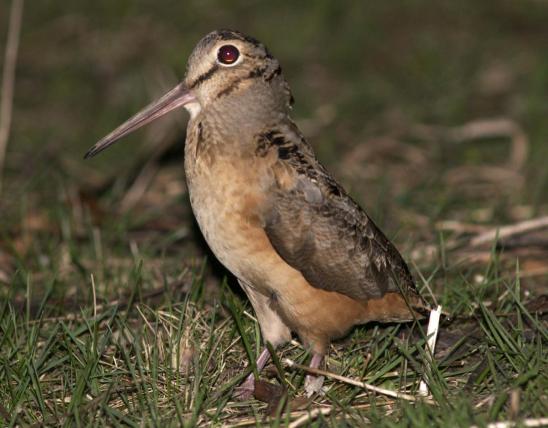
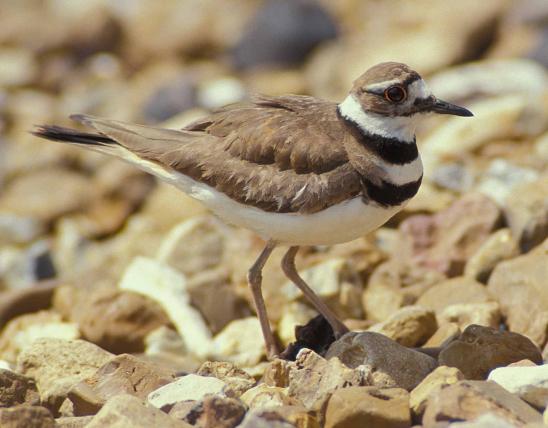
About thirty-five species of shorebirds migrate through Missouri each year. Of these, only five breed in Missouri on a regular basis. The upland sandpiper is one; the others are the killdeer, spotted sandpiper, black-necked stilt, and American woodcock.
Taxonomy: The closest relative of the upland sandpiper is an extinct species in the same genus, known only from fossils collected in Oregon. After that, the nearest relatives are sandpipers in genus Numenius, the curlews and the whimbrel. For a long time, the upland sandpiper was thought to be a type of plover, hence its former common name of “upland plover.”





About 350 species of birds are likely to be seen in Missouri, though nearly 400 have been recorded within our borders. Most people know a bird when they see one — it has feathers, wings, and a bill. Birds are warm-blooded, and most species can fly. Many migrate hundreds or thousands of miles. Birds lay hard-shelled eggs (often in a nest), and the parents care for the young. Many communicate with songs and calls.