









Canada thistle is native to Eurasia. It arrived on our continent probably before the Revolutionary War — most likely mixed in agricultural seed. A bad weed of crop fields and rangeland farther north, it causes problems in Missouri, too.
Canada thistle is a weedy perennial forb with wide-spreading, horizontal, fibrous, black roots that can be 3 feet deep. Aerial shoots (suckers) are sent up at 2–6 inch intervals. A whorl of basal leaves is produced the first year, and flowering stems the next.
The stems are grooved, slender, branch only at the top, and have patches of cobwebby hairs when young, becoming smooth (glabrous) as the plant grows. The stems do not have spiny-margined leaflike wings.
The leaves are alternate, oblong, tapering, stalkless, deeply divided, with prickly margins. They are green on both sides with a smooth or slightly downy lower surface. The leaves are well developed all the way up the stems.
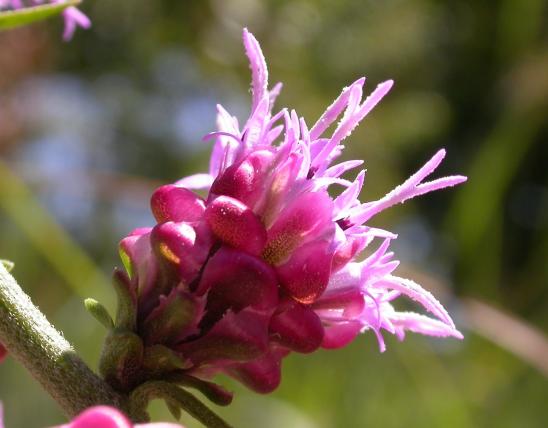
The flowerheads are rose-purple or white, and are smaller (¾ inch in diameter) and more numerous than for many other thistles. The flowerheads are compact and appear on upper stems. Some plants have only female flowers; others have both male and combination (perfect) flowers.
Blooms June–September.
The seeds are small (³⁄₁₆ inch long), light brown, smooth and slightly tapered, with a tuft of tan hair loosely attached to the tip.
Similar species: Nine species of Cirsium have been recorded in Missouri. Some are native, some nonnative, and their commonness and distributions vary.
- The other Eurasian thistle in genus Cirsium that occurs in Missouri is bull thistle (C. vulgare).
- A good example of a common native thistle is tall thistle (C. altissimum). See its page for more information on Missouri's other thistles that are native to North America.
Here are some tips for distinguishing nonnative thistles from our native thistles:
- The leaves of nonnatives, such as Canada and bull thistle, are typically green on both sides, while the leaves of natives usually have noticeably whitened, woolly undersides.
- Nonnative thistles tend to have heavily branched stems and more flowerheads per stem.
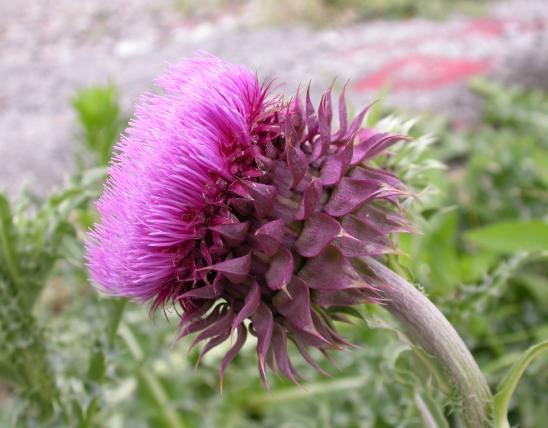
Musk thistle (Carduus nutans) is in a different genus. It is an invasive species increasingly common in Missouri. It has stems winged with spiny leaf tissue and looks quite different, with large, wide, nodding flowerheads with wide-based, spine-tipped involucral bracts that bend backward.
Height: 2–5 feet.

Scattered throughout the northern two-thirds of Missouri, but potentially statewide.
Habitat and Conservation
Canada thistle does best in disturbed areas (overgrazed pastures, old fields, waste places, fence rows, along roadsides), where it often occurs in patches.
It can occur in wet areas where water levels fluctuate (along stream banks and ditches).
It can invade sedge meadows and wet prairies from nearby disturbed sites.
This thistle is not usually found in undisturbed, high-quality prairies, good to excellent pastures, or in woodlands. In sites that are shaded most of the day, this plant grows tall and lax, with fewer flowers.
The seeds are dispersed in the wind and by water running in ditches. The plants spread rapidly by rhizomes or root segments.
Status
Invasive. Native to Europe and Asia, it occurs nearly throughout the United States and Canada.
Control
Human Connections
Like many U.S. weeds, this plant probably arrived as a contaminant in agricultural seed.
Because of its deep, spreading roots, it is tough to control once established.
A bane to farmers as well as to natural ecosystems, it has been considered a noxious weed in our state since 1909.
Calling it Canada thistle is inaccurate, since this species is native to Eurasia. Presumably, it got the name in the United States because many early infestations were in Canada.
There are many common names for this species worldwide. "Creeping thistle" is a good one, because of its creeping underground root system that creates a colony of plants. "Field thistle" is basically a translation of the scientific name.
Even in Eurasia, where it is native, this species is considered a weed injurious to crop farming.
This species has been introduced almost globally and is considered invasive in many of these regions.
A wide variety of strategies are employed to control this invasive thistle, including insect and fungal biocontrols, chemical herbicides, and strategic cutting (before the flower stem extends) to wear down the plants.
Ecosystem Connections
Canada thistle is an invasive exotic species that competes fiercely with native plants, and its presence degrades the native ecosystems it infests.
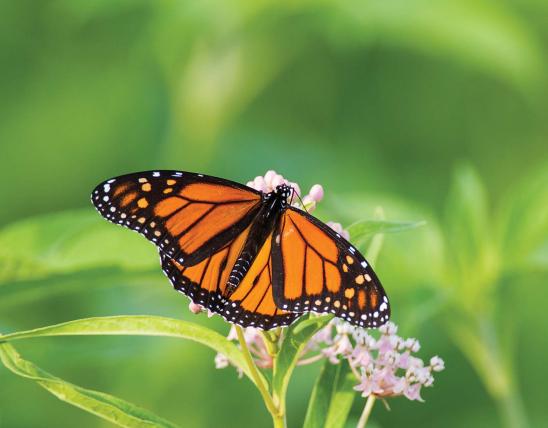
Canada thistle is a reasonably good nectar plant for bees and butterflies; pollination is mostly by honeybees.
As they do with native thistles, many species of butterflies, moths, flies, aphids, beetles, and other insects feed on the foliage, stems, roots, flowers, seeds, or sap.
Goldfinches eat the seeds.