












The original 120 acres of this area was donated in 1987 by William R. Kearn. In 2011 an additional 162 acres were added.
Media

Status
Name
Species of Conservation Concern
Scientific Name
Asio flammeus
Family
Strigidae (typical owls) in the order Strigiformes (owls)
Description
The short-eared owl is a medium-sized, heavily streaked with pale and dark browns above, and buff-white below with heavy dark streaks. The short ear tufts are difficult to see. The facial disk is pale, and the yellow eyes are surrounded with black. In flight, note the buff patch on the outer part of the upper side of the wing, and a dark crescent near the bend of the wing on the underside (the long-eared owl has a similar pattern, but it less prominent).
Its characteristic flight is buoyant and butterfly-like as it flies across open fields close to the ground.
The voice is varied with barks (like a small dog), hoots, squeaks, and hissing sounds — although it is usually silent on its wintering grounds in Missouri.
Similar species:
Long-eared owls have tall, noticeable ear tufts and are darker, especially on the breast.
Great horned owls are common in Missouri; they are larger and also have prominent ear tufts.
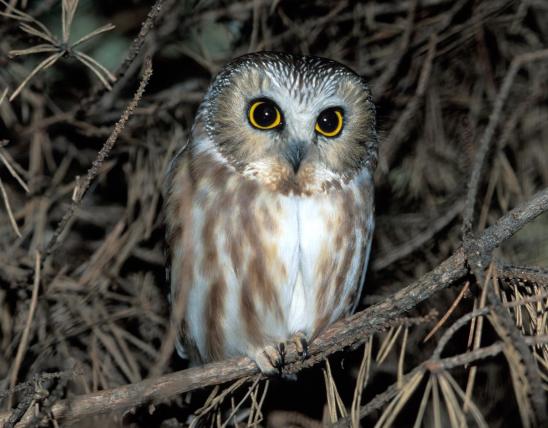
Barred owls, also common in Missouri, also have a round-headed profile, but they have brown, not yellow eyes, and are larger.
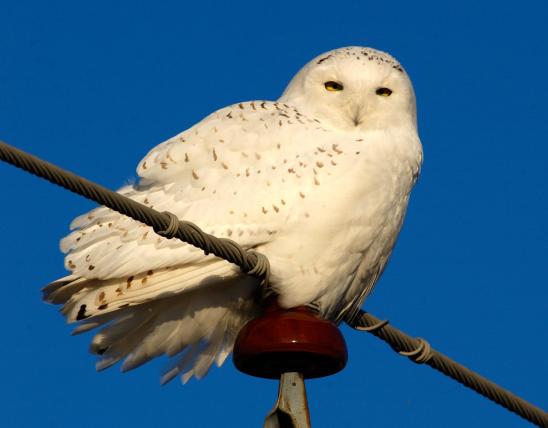
American barn owls are much lighter, with a white face and brown (not yellow) eyes.
Northern harriers (which are hawks, not owls) have a similar, mothlike flight, and they also occur in grasslands. Being hawks, they have a slimmer body shape.
Size
Length: 13–17 inches (tip of bill to tip of tail); wingspan: 34–40.5 inches.
Where To Find

Statewide.
Habitat and Conservation
Open grasslands, especially native prairie. Roosts on the ground or in low bushes.
Commonly active during the day, especially in early morning and late afternoon, as well as at night.
Their numbers in our state are highest between October and April. With careful searching you may discover a roost with up to 20 or more individuals in a ravine, in a thicket, among large hay bales, or in a dry, grassy watercourse.
The wintering range extends southward into Mexico; the year-round range is a band across the middle of North America, along the more northern U.S. states. Summer breeding range extends far into Canada and Alaska.
Food
Mice, rats, rabbits, gophers, lemmings, insects, and occasionally birds. Hunts while flying low over grasslands, with a mothlike flight.
Status
Uncommon winter resident and migrant. Extremely rare summer resident in the Glaciated Plains, Osage Plains, and Mississippi Lowlands regions of the state. A species of conservation concern in Missouri, due to declining numbers.
Life Cycle
Life Cycle
Nests on the ground. Unlike most owls, this species builds its own nest: a scrape on the ground, lined with grasses and feathers.
In the past, short-eared owls nested in Missouri with greater frequency, but today nesting is extremely rare. One reason may be that there are now very few grasslands where the owls can nest without being displaced by haying or grazing.
Clutches range from 1–11 eggs. Incubation lasts 21–37 days. Young leave the nest around 14–17 days after hatching, on foot and before they can fly.
Human Connections
This species is declining across the continent, mostly due to habitat loss, as the large, undivided tracts of open native grasslands they require are converted to cropland, pasture, and human development (buildings and roadways). Although their situation is not nearly as dire as that of the endangered greater prairie-chicken, both species face the same problem. Hopefully, efforts to maintain and restore grasslands will help this and many other grassland species, too.
Ecosystem Connections
As with other ground-nesting birds, the eggs and young are especially vulnerable to a variety of predators. Short-eared owls often nest in loose colonies, which may enable them to more quickly identify predators when they are detected. Nesting females tend to rely on their camouflage to keep them safe and will flush only as a last resort.
Title
Media Gallery
Image
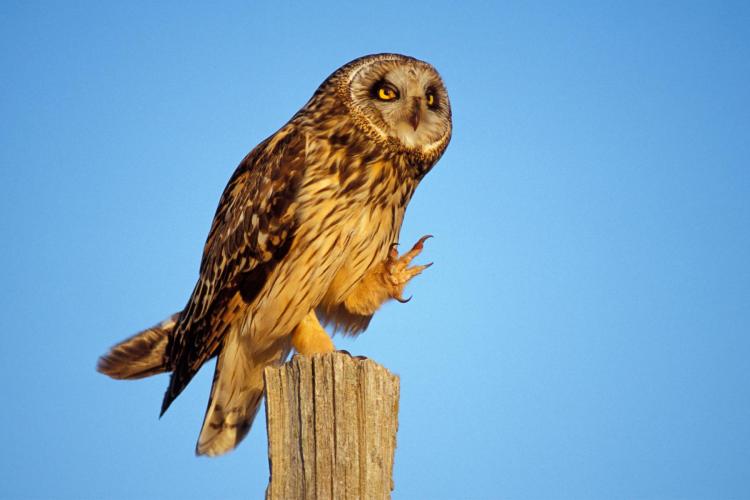
Credit
MDC Staff
Right to Use
Photo by MDC Staff, courtesy Missouri Department of Conservation
Image

Credit
Amy Prewitt
Right to Use
Photo by Amy Prewitt, courtesy Missouri Department of Conservation
Image

Credit
Amy Prewitt
Right to Use
Photo by Amy Prewitt, courtesy Missouri Department of Conservation
Image

Image

Image

Title
Similar Species
Similar Species
Media

Media

Media

Media

Media

Media

Media
Media
Media

Where to See Species
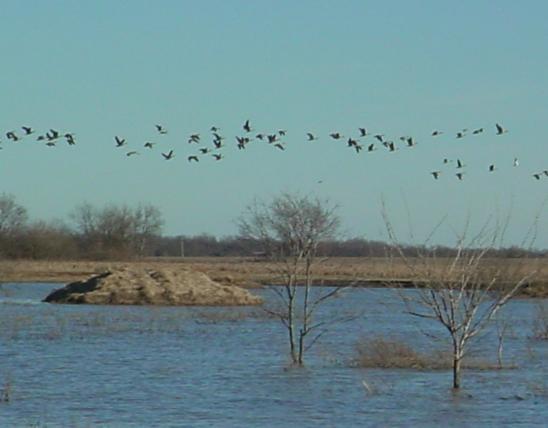
The 3,635-acre area takes its name from a trail through the area that played a major role in the history of this country.
About Birds in Missouri
About 350 species of birds are likely to be seen in Missouri, though nearly 400 have been recorded within our borders. Most people know a bird when they see one — it has feathers, wings, and a bill. Birds are warm-blooded, and most species can fly. Many migrate hundreds or thousands of miles. Birds lay hard-shelled eggs (often in a nest), and the parents care for the young. Many communicate with songs and calls.