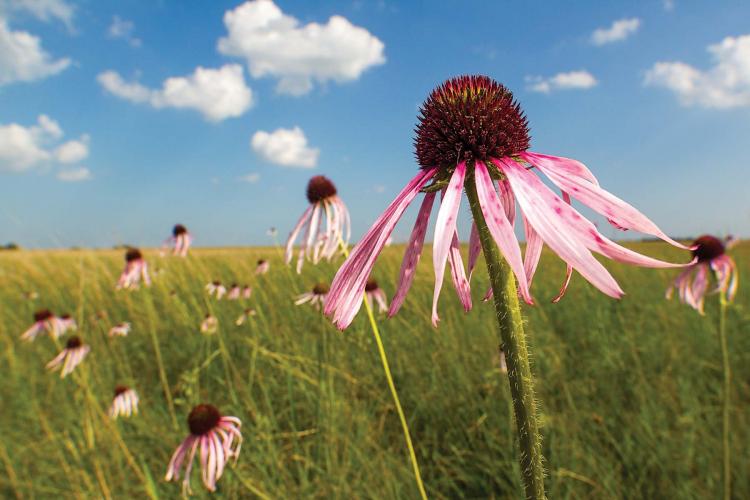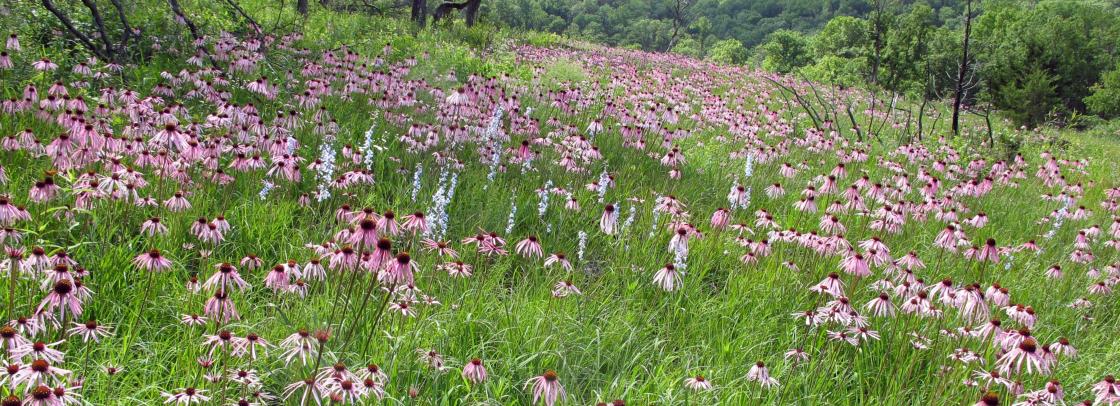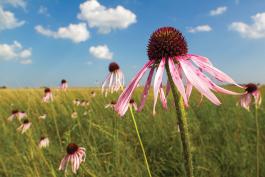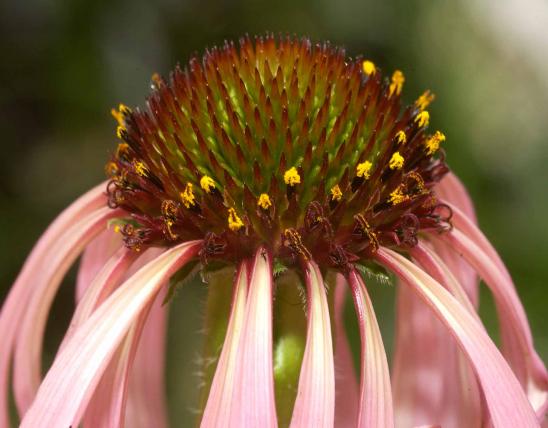








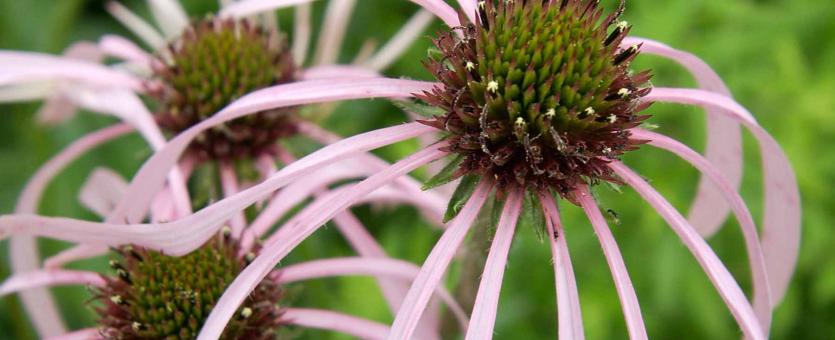
Pale purple coneflower is one of Missouri's five species of Echinacea. It is distinguished by its white pollen, drooping pink or purple ray flowers, and narrow, tapering leaves. It occurs nearly statewide, except for the Bootheel lowlands.
Pale purple coneflower is a showy perennial with a mostly unbranching stem arising from basal leaves, with a single, sunflower-like flower head.
The basal leaves are in a clump, are strap-shaped, and are up to 13 inches long including the long stalks; the stem leaves are shorter and narrow. The stems and leaves have stiff, spreading hairs.
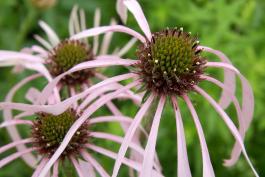
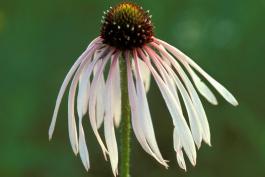
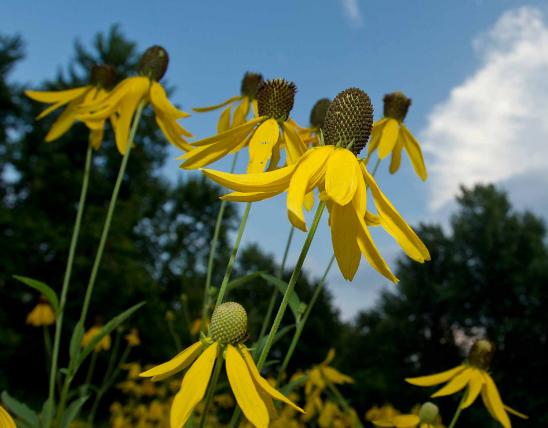
The flowerhead disk is knoblike, brown, with white stamens protruding; the petal-like ray flowers are pale purple, rose, or magenta (rarely white), slender and drooping, to 3½ inches long, the ends notched. The pollen is white (it looks like small crumbs amid the spiky disk bracts).
Blooms May–July.
The seedlike fruits are in a burrlike, dome-shaped head that blackens upon drying. The fruits are achenes (structurally similar to sunflower "seeds"), wedge-shaped, angled, slightly flattened, tan to nearly white.
Similar species: Five species of coneflowers (Echinacea) are recorded growing wild in Missouri.
- The most similar coneflower that you are most likely to see is glade coneflower (E. simulata). Like pale purple coneflower, it has pinkish-purple ray flowers that are narrow and drooping. But glade coneflower has yellow, not white pollen, and it occurs mainly in the eastern Ozarks.
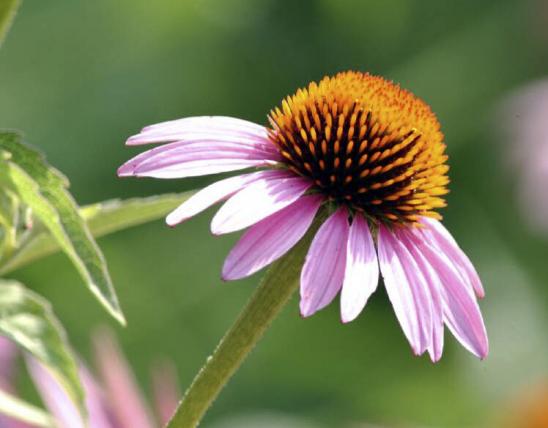
- Purple coneflower (E. purpurea) is widespread in nature and very popular in cultivation. Its ray flowers are pinkish purple but are shorter and wider, and are more spreading than drooping.
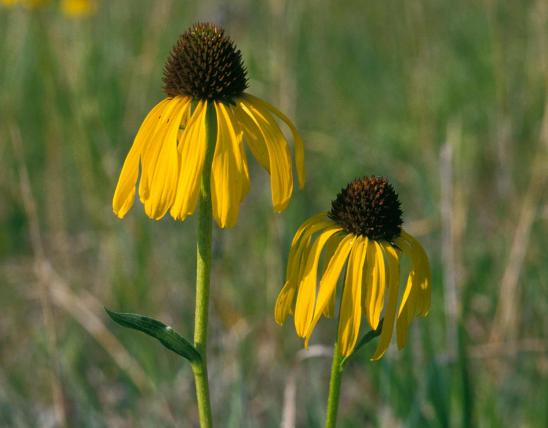
- Yellow coneflower (E. paradoxa), with its yellow rays, is easy to identify by its different color.
- Narrow-leaved coneflower (E. angustifolia) is rare in Missouri and has only been recorded sporadically over the decades. It is very similar to pale purple coneflower, but the rays are only about half as long and are more spreading, less drooping; its pollen is yellow. It is a Great Plains species, but in 2014, it was finally located in Missouri, in a native loess hill prairie in the northwest corner of the state. It is ranked as critically imperiled in Missouri.
Height: to 3 feet.

Scattered statewide, although apparently absent from the Mississippi Lowlands. In the eastern Ozarks, the similar glade coneflower (Echinacea simulata) tends to predominate.
Habitat and Conservation
Occurs in prairies, glades, savannas, openings of dry upland forests, pastures, roadsides, and railroads.
Status
Native Missouri perennial wildflower. Popular in native landscaping.
Human Connections
Along with other flowers in the genus Echinacea, this plant is often targeted by unscrupulous root collectors who sell them to manufacturers of herbal medicines. Scientists debate its efficacy. Such vandalism is one reason laws were enacted restricting the collecting of plants to protect wild populations.
Coneflowers are easily grown in gardens and are available at native plant nurseries.
The pale purple coneflower has long adorned the logo of the Missouri Prairie Foundation, a nonprofit land trust organization that, since 1966, has worked to protect and restore Missouri's prairie and other native grassland communities.
Ecosystem Connections
The seeds of coneflowers are eaten by goldfinches, whose late-summer breeding time corresponds with the abundant seed set of these and other sunflower-family flowers such as goldenrods, ironweed, and others.
The tough rootstocks of coneflowers prevent erosion.
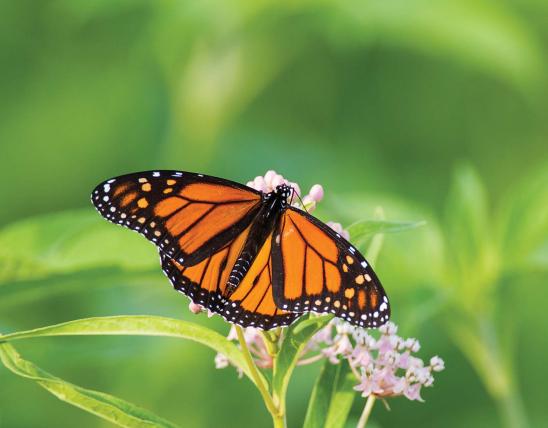
The regal fritillary, arogos skipper, and Ottoe skipper are three rare, native prairie butterflies that rely heavily on pale purple coneflower for nectar.