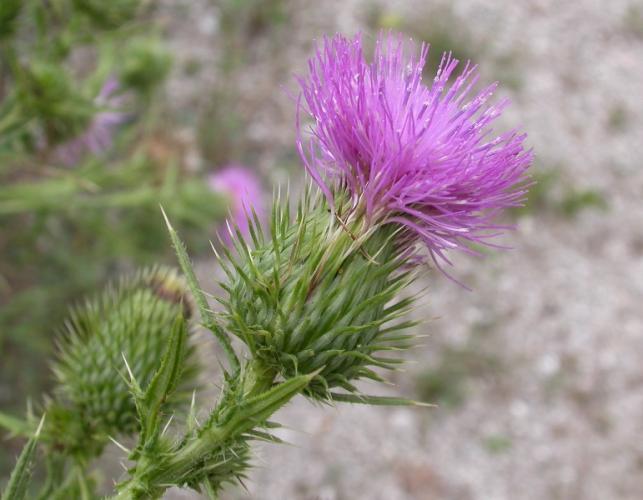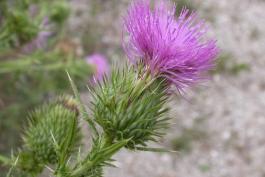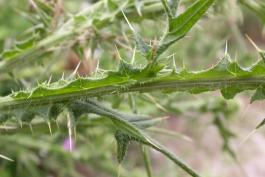








Bull thistle is a weedy introduction from Europe, found statewide. To tell it from our other thistles, note its stems with spiny-margined wings, and its leaves with the upper surface strongly roughened with stiff, spiny bristles.
Bull thistle is a biennial thistle; it grows the first year as a basal rosette of leaves, and sends up a flowering stem the second year. The upper stems and branches are winged with a wavy, prickly tissue and have cobwebby hairs.
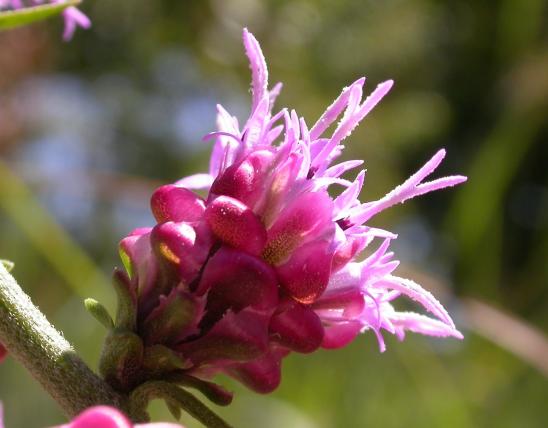
The flowerheads are typical of other thistles, reddish purple to purple, with a prominent involucre (the flowerhead base, covered by spine-tipped, leaflike bracts), which is covered with a fine, cobweb-like silk. Spines on the stems grow right up to the flowerheads.
Blooms June–September.
The leaves are alternate, deeply lobed, hairy, spiny, the upper surface strongly roughened with numerous short, stiff bristles, the lower surface with fine, cobwebby hairs. Each lobe has a spined tip. The leaf bases run down along the plant stem. The leaves become smaller and simpler the higher on the stem.
Similar species: Nine species of Cirsium have been recorded in Missouri. Bull thistle and Platte thistle (Cirsium canescens) are the only two with stems having spiny-margined wings.
- Platte thistle, however, has cream-colored flowers, and it has been collected only once in Missouri, along a railroad in Jackson County in 1951. (Its native range is in U.S. states west of Missouri.)
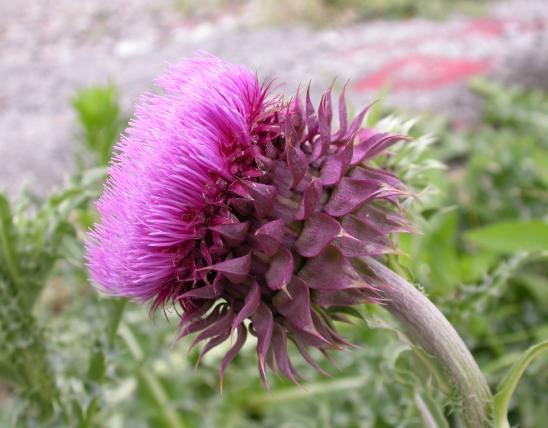
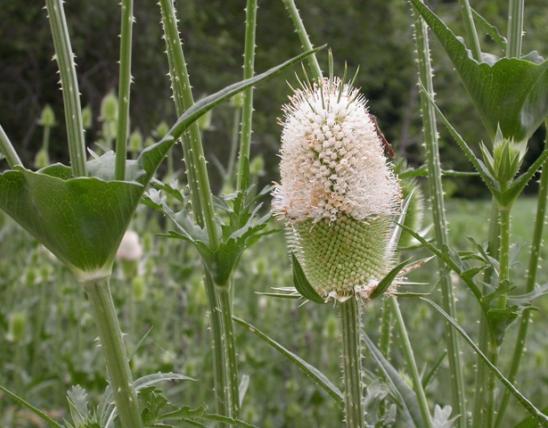
Note that musk thistle also has stems winged with spiny leaf tissue, but it is in a different genus and otherwise looks quite different:
- Musk thistle has large, wide, nodding flowerheads with wide-based, spine-tipped involucral bracts that bend backward.
Height: to 7 feet.
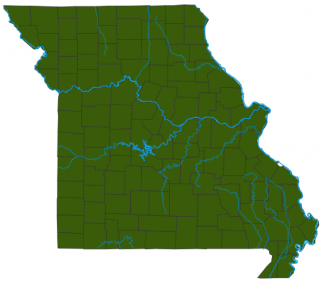
Widely scattered statewide.
Habitat and Conservation
Occurs in upland prairies and openings of disturbed upland forests; also pastures, railroads, roadsides, and open, disturbed areas. Native to Eurasia.
Status
Introduced, nonnative species. Native to Eurasia. Often considered a weed.
Human Connections
The early leaves can be cooked as a potherb. To prepare the young bloom shoots, wear gloves and snip off leaves and spines. Peel the outer rind from the stem, cut it into 3-inch sections, boil, and eat like an artichoke (dip in butter and pull stems through your teeth, discarding the stringy parts).
Ecosystem Connections
Thistles are a favorite of goldfinches, which eat the seeds and use the silky pappus ("parachutes") to line their nests.
Several types of bees, butterflies, and other insects visit the flowers.
A variety of caterpillars and beetles chew the leaves, but most mammals are put off by the spines.
The other Eurasian thistle in genus Cirsium that occurs in Missouri is Canada thistle (C. arvense).
Here are some tips for distinguishing nonnative thistles from our native thistles:
- The leaves of nonnatives, such as bull thistle, are typically green on both sides, while the leaves of natives usually have noticeably whitened, woolly undersides.
- Nonnative thistles tend to have heavily branched stems and more flowerheads per stem.