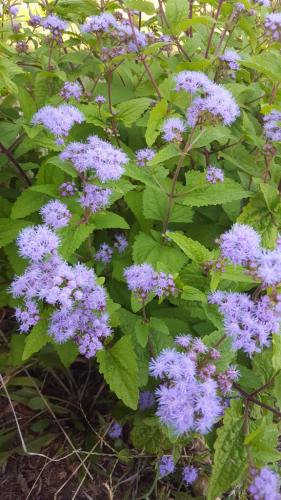














Mist flower, or wild ageratum, is a vigorous native perennial wildflower bearing fluffy-looking, bluish-purple flowerheads. It often occurs in large stands.
The flowerheads are in dense clusters (35–70 tiny florets per head), terminal or arising from the leaf axils, and blue or violet (rarely white).
Blooms July–October.
The leaves are opposite on short stems, ovate to triangular, with large teeth.
Similar species: Mist flower strongly resembles some nonnative, annual ageratums (Ageratum conyzoides and A. houstonianum) that are sold as bedding plants for flower gardens. They are sometimes called floss flowers or bluemink.
- The nonnative true ageratums are annuals with thin, fibrous roots, while our native mist flower (Conoclinium) is a vigorous perennial with a mass of interwoven rhizomes.
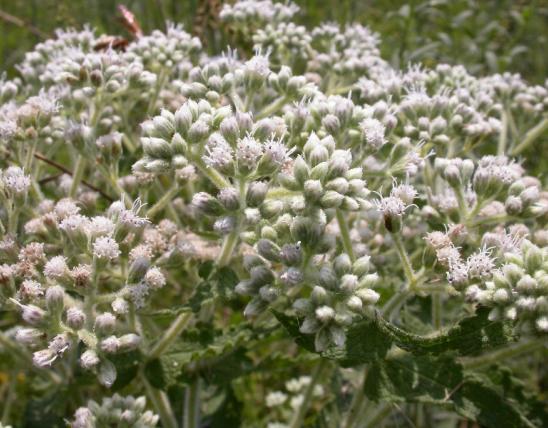
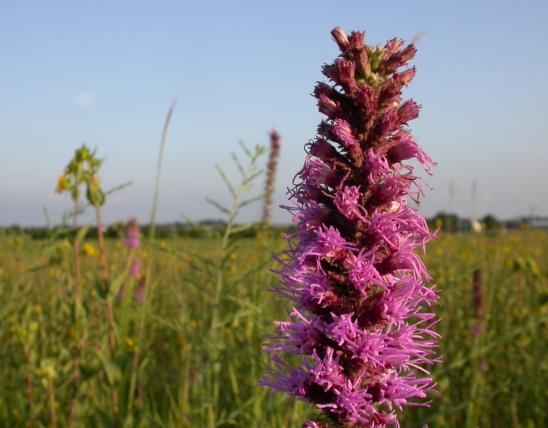
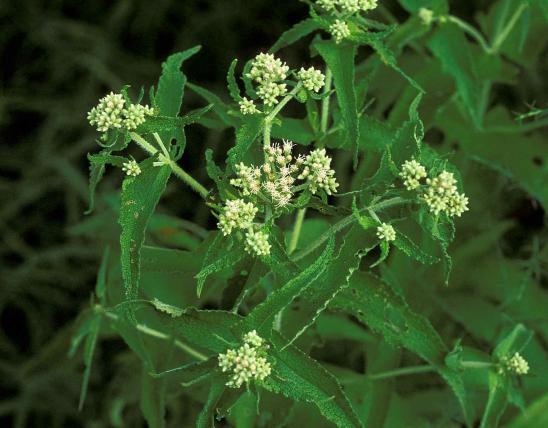
- Mist flower and true ageratums are in the same tribe as bonesets, thoroughworts, white snakeroot, and blazing stars.
Height: normally 12–18 inches.

Scattered, mostly south of the Missouri River.
Habitat and Conservation
Occurs in bottomland forests, swamps, banks of streams and rivers, margins of ponds and lakes, marshes and fens, ditches, gardens, railroads, roadsides, and shaded to open disturbed areas.
Status
Native Missouri perennial wildflower.
Human Connections
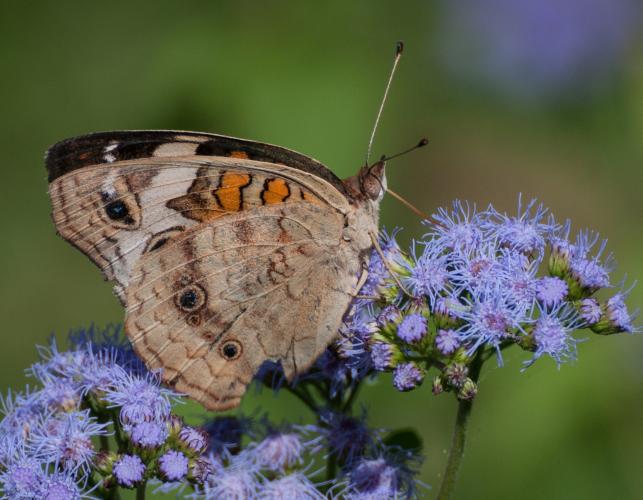
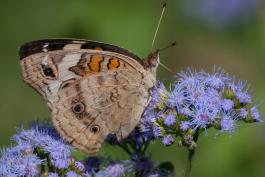
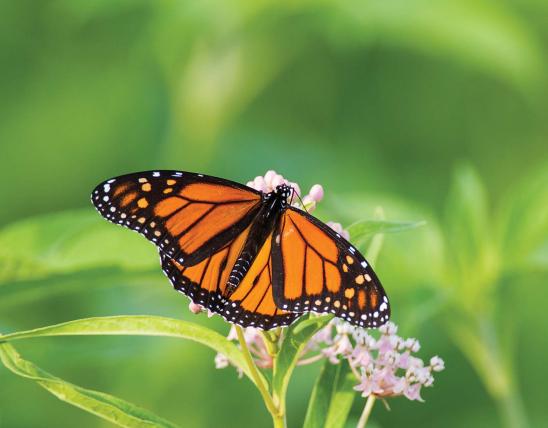
It is fun to watch butterflies, bees, and tiny solitary wasps eagerly visit clusters of mist flowers in late summer and early fall.
The incredibly cool, lilac-blue flowers contrast sharply with the fiery-hot reds, oranges, and yellows of fall color. It's a feast for the eyes.
Under cultivation, mist flower spreads rapidly with an interwoven mass of roots and can be aggressive.
- Cut back the plants during the summer to encourage a more compact growth habit before flowering begins in August.
- Where its spreading isn't a problem, it provides good color, and food for late-season pollinators, until the first frost.
- Mist flower's hardy, aggressive nature makes it a good choice for restoring disturbed ground in damp or wet places, to stabilize soils.
The genus name, Conoclinium, is from the Greek for "cone bed," referring to the plant's conical receptacle. The species name, coelestinum, is from the Latin for "sky blue."
Ecosystem Connections
Butterflies, skippers, and bees are strongly attracted to the flowers. Other insects eat the foliage.
Not many mammals eat this plant because of its bitter taste.