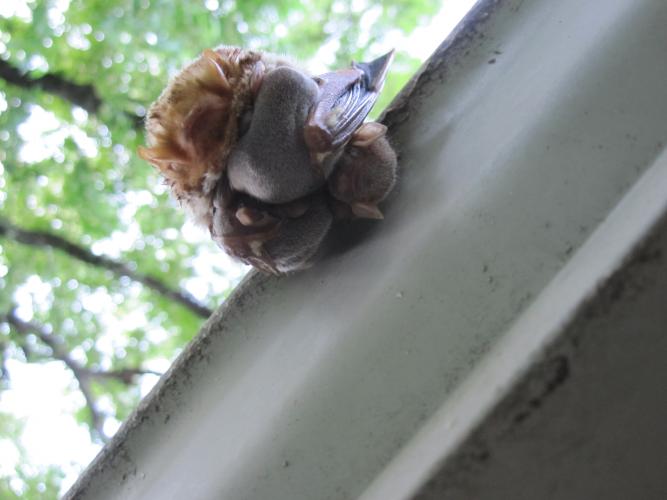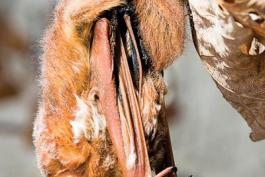











The eastern red bat is one of Missouri's most commonly seen bat species. It is migratory and is mostly seen here between May and September. Unlike most of our bats, they frequently sleep in trees, and their rusty red, tan, or grayish coloration helps them blend in with fall foliage. The males are redder than the females.
Red bats exhibit a wide range in coloration. The upperparts vary from bright orangish red to buff, with the tips of the hairs often frosted.
- This is the only common Missouri bat species in which the males and females have different coloration: males are redder and less frosted than the females.
- Both sexes have a yellowish white patch in front of each shoulder that may continue in a broken but noticeable band across the chest.
The snout and ears are usually pink. The wing membrane is brownish black, contrasting with the pale, usually red forearm bone and fingers. The unfurred portion of the tail membrane is brownish. The ears are similar in color to the back.
The ears are short, broad, and rounded; they are sparsely furred inside but densely furred outside for the half nearest the head.
Both sides of the wing membrane are furred outward from the body toward the elbow; on the undersurface, the furring extends along the forearm to the wrist and up to a third of the way down the fingers.
The large, wide tail membrane is thickly furred on its entire upper surface but thinly furred on the undersurface for only the half nearest the body.
The body fur is longer on the neck than on the back, making a slight ruff.
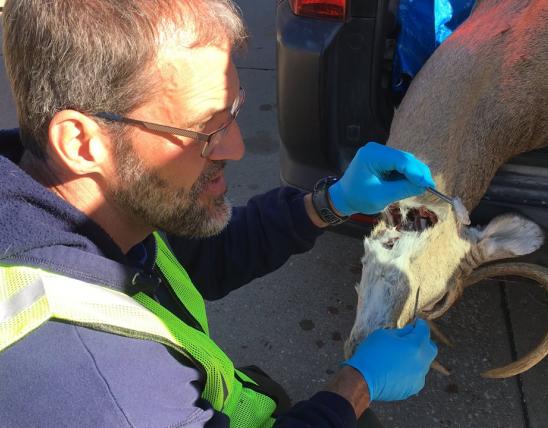
For your safety and the safety of bats, do not handle bats. Biologists who study bats receive special training and pre-exposure rabies vaccinations. Bats are not aggressive toward people but will bite in self-defense if handled. If you absolutely must handle a bat, wear heavy leather gloves. For more information about bats, see the bats group page.
Similar species: The eastern red bat is easily distinguished from all other bats in Missouri by its color and (except for the closely related hoary bat) by the well-furred tail membrane. The hoary bat is easily distinguished by its larger size and its darker brown fur with white tips.
- The one exception is the very rarely encountered Seminole bat (Lasiurus seminolus), which is a Missouri species of conservation concern, occurring only accidentally across southern Missouri, with records as far north as Pulaski County; we are in the northwestern edge of its range and are most likely to see this species in summer. The Seminole bat used to be considered a subspecies of red bats and is distinguished by its rich, mahogany brown fur with whitish tips, as opposed to brick to rusty red of the red bat.
Total length: 95–126 mm (3¾–5 inches); tail length: 41–63 mm (1½–2½ inches); weight: 5–14 g (about 0.2–0.5 ounce); ear length: 9–12 mm (⅜–½ inch).
Statewide, May–September; some are present during winter, especially in the southern part of the state.
Habitat and Conservation
The eastern red bat is primarily a solitary, tree-inhabiting species. During summer, it frequents woodland-edge habitats around cities or farms and roosts in trees, shrubs, or even on the ground. In spring and fall, they often hang on shrubs or tall weeds during the day. They may also use undisturbed parts of buildings or caves.
In foraging, they usually fly fairly high, erratic courses and occasionally descend spirally toward the ground. With their narrow, pointed wings, they can easily maneuver within small areas. They can fly 40 miles per hour.
Red bats that spend the winter in Missouri mostly hide in clusters of dead leaves, hollows of trees, or under bark. A few use caves. Red bats also can overwinter in eastern red cedars and hardwoods on south-facing slopes. When temperatures approach freezing, red bats switch to roosting under leaf litter.
In summer, adult red bats are solitary, although several sometimes roost in the same tree. They spend the day among the foliage, hanging from the branches by one or both hind feet. They resemble dead leaves. The females do not form nursery colonies.
In fall, a few red bats swarm at the mouths of certain caves, mingling with other species of bats. Many eastern red bats may migrate southward, beginning in September and continuing until November. Most migration occurs at night. They probably migrate several hundred miles and can fly great distances over water.
Food
Red bats consume flying insects such as moths, beetles, crickets, flies, and cicadas. There is evidence suggesting that eastern red bats eavesdrop on the echolocation calls of other bats to identify the presence of prey.
Red bats start to feed 1–2 hours after dusk and continue into the night. They are sometimes active in daytime, especially in winter. They forage along the margins of upland woodlands, wooded floodplains, and fencerows. They also forage above ponds and grasslands and around streetlights. Each bat has its own particular hunting area.
Prior to migration, these bats become very fat. This source of energy helps sustain them on their long flight and possibly supplements their meager winter fare.
Status
Native Missouri bat.
Life Cycle
Eastern red bats are migratory across their wide range in the eastern United States, extreme southeastern Canada, and northeastern Mexico. Most individuals breed in the north and winter in the south. From May through September they are present statewide, but some are also present during winter, especially in the southern part of Missouri. These may be local overwintering bats, or they may be migrants from farther north.
Breeding occurs in August and September. Gestation is between 80 and 90 days, but the eggs are not shed from the ovaries until spring, as occurs in other Missouri bats. The 1 to 4 young are born from late May through June.
At birth the young are blind and hairless, but the ears, tragus, and membranes are well developed. The eyes probably open in the first few days after birth, as occurs in most other Missouri bats. The female is very solicitous of her young, licking and grooming them.
The young can fly at about 4 to 6 weeks of age.
Control
Human Connections
As with other bat species, red bats help people by controlling populations of many kinds of pest insects.
Many people harbor a repugnance toward bats, in part due to their association with night, caves, and dark, “creepy” places, but red bats break the mold. They live and roost in trees, not too differently than many beloved birds and squirrels, and they sometimes sleep in leaf litter. Their rusty red coloration, reminiscent of beautiful fall foliage, is genuinely attractive.
This species constitutes a large proportion of fatalities documented beneath wind turbines. It has been suggested that red bats’ habit of roosting high up in tall trees may be causing them to use wind turbines for this purpose.
The first part of the scientific name, Lasiurus, means “hairy tail.” This refers to the furred upper surface of the tail membrane that is characteristic of this genus. The last part, borealis, means “northern,” but that adjective, applied long ago, does not represent its actual range. The common name refers to this bat’s range within the eastern United States and describes the predominant color.
Ecosystem Connections
The predator-prey relationship between bats and moths has led moths to evolve many fascinating ways to avoid being captured by bats. Several types of moths, upon sensing the sonar clicks of bats, will immediately, reflexively, engage in erratic flight patterns, or produce sounds that can confuse or jam the bats’ echolocation abilities.
While in most bat species, females give birth to only one, or maybe two pups per year, and have only two mammary glands, red bats (Lasiurus spp.) give birth to up to four and have four mammary glands. It is likely that red bats are subject to greater mortality than other bat species, as indicated by the higher number of young per female. Their relatively exposed roosts make them vulnerable to disturbances such as strong winds, rain, and predators.
Eastern red bats are adapted to survive drastic temperature fluctuations. Those that do not migrate normally spend the winter in sheltered spots such as tree cavities and respond to changes in temperature. When the environmental temperature rises, they may arouse and feed on what flying insects are available..
If this is the eastern red bat, is there also a western red bat? Yes, there is! The western red bat (also called the desert red bat, Lasiurus frantzii) occurs from southern Canada through the western United States, through Mexico, and into Central America. There is also a southern red bat (Lasiurus blossevillii) that lives in South America.
Red bats are especially fond of roosting in oak and hickory trees, as opposed to pines and other conifers. The terra cotta, orange, and rust colors of the dead or autumn leaves offer incredible camouflage. The durable, leathery leaves of oaks, which often hang on to the branches late in the fall season and well into winter, can provide cover, insulation, and shelter from the elements and from predators.